
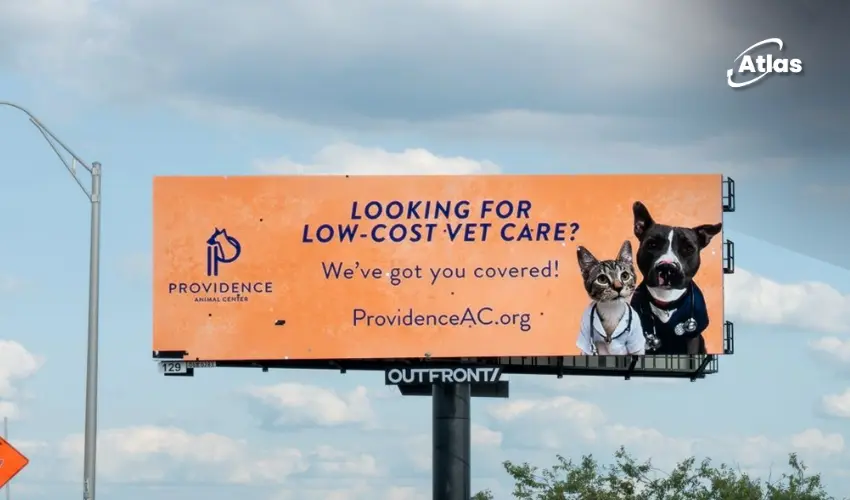
Providence Animal Center Shows How OOH Can Give Back
Out-of-home advertising is often discussed in terms of reach, frequency, awareness and brand recall.
But at its best, OOH can also be a public service.
A recent billboard effort for Providence Animal Center, shared by Jeffrey Jones on LinkedIn, shows how outdoor media can help connect people with organizations and resources that make communities stronger. With support from OUTFRONT Media and Keystone Outdoor Advertising, the campaign helped Providence Animal Center share its message about affordable veterinary care and spay/neuter services across the region.
The campaign is a reminder that billboards do not only have to sell products or promote commercial offers. They can also help good causes be seen by the people who need them most.
Using Billboard Space as a Community Resource
The idea behind the campaign is simple: when a nonprofit has an important service to share, visibility can make a real difference.
Providence Animal Center provides services that matter to pet owners and animals, including affordable veterinary care, medical support, adoption services, spay/neuter programs and community resources.
For many families, awareness of these services can be the difference between delaying care and finding accessible support.
That is what makes billboard support valuable for a nonprofit organization. A billboard can reach people who may not be actively searching for help online, but who may still need information about affordable care for their pets.
Why Local OOH Matters for Animal Welfare
Animal welfare is deeply local.
People need to know where they can adopt, where they can access affordable vet care, where spay/neuter services are available and which organizations are actively serving their area.
Digital channels can help with search and follow-up, but OOH plays a different role. It puts the message into daily movement: on roads, near neighborhoods, along commuter routes and across high-visibility community corridors.
For Providence Animal Center, that kind of visibility helps the organization become more present in the lives of local residents.
Someone may see the billboard while driving to work. Another person may notice it while running errands. A pet owner may remember the message later when they need affordable veterinary support. That delayed recall is one of OOH’s strongest community advantages.
The Power of Industry Relationships
This campaign also highlights something important about the OOH industry itself: relationships matter.
According to the campaign context shared on LinkedIn, billboard space was generously provided by teams at OUTFRONT Media and Keystone Outdoor Advertising, helping Providence Animal Center extend its reach to thousands of people throughout the region.
That support reflects a side of the industry that is sometimes overlooked.
OOH companies own and manage highly visible public-facing media. When they choose to support nonprofit work, they can provide something that many organizations could not easily access on their own: scale, credibility and presence in the physical world.
For a nonprofit, that presence can turn a message into a regional reminder.
Beyond Awareness: Helping People Take the Next Step
Nonprofit advertising has to do more than create general goodwill.
It needs to make information clear, accessible and easy to act on. That is especially true when the message is connected to care services, adoption, spay/neuter programs or community assistance.
The strongest nonprofit OOH campaigns usually focus on one clear action or one clear need. In this case, the message is centered on affordable veterinary care and spay/neuter services, two areas where public awareness can directly support animal health and reduce barriers for pet owners.
This is where OOH becomes more than a media channel. It becomes a connector between need and resource.
Why the Campaign Works
- It supports a clear community need: Affordable veterinary care and spay/neuter services are practical resources that can help pet owners and animals.
- It uses local visibility: Billboards place Providence Animal Center’s message into the daily routes and routines of people across the region.
- It makes nonprofit services easier to discover: OOH can reach people who may not know these resources exist or may not be actively searching online.
- It reflects the power of partnership: Support from OUTFRONT Media and Keystone Outdoor Advertising helped extend the campaign’s reach.
- It turns media inventory into social impact: Donated billboard space becomes a tool for strengthening the community.
- It connects emotionally: Animal welfare campaigns naturally invite empathy, care and local participation.
- It shows a broader role for OOH: Outdoor media can promote services, support nonprofits and make important causes more visible.
What Marketers Can Learn
The biggest lesson from this campaign is that OOH can create value beyond commercial outcomes.
For brands, agencies and media owners, outdoor advertising can be a way to participate in community life. The same signs that help launch products or build brand awareness can also help nonprofits extend their mission.
That does not make the media less strategic. In many ways, it makes the strategy more meaningful.
When a billboard helps people find affordable care for their pets, the campaign becomes part of a service pathway. When media owners donate space to a local cause, they are using existing resources to increase public access to helpful information.
This is a useful reminder for marketers: attention is powerful, but attention directed toward a real community need can be even more powerful.
The OOH Lesson
OOH is uniquely positioned to support community messaging because it lives in public space.
Unlike ads that appear only inside personal feeds or private screens, billboards are shared by everyone who moves through the area. That gives them a civic quality. They can reflect what a community values, what it needs and which organizations are working to help.
For Providence Animal Center, this means the message can reach pet owners, potential adopters, donors, volunteers and community members in one shared environment.
The campaign also shows why local media partnerships matter. Nonprofits often have strong missions but limited visibility budgets. OOH partners can help close that gap by offering space, expertise and local market knowledge.
Why Giving Back Starts With Being Seen
Many nonprofit organizations already do meaningful work every day, but awareness remains one of their biggest challenges.
People cannot use a service they do not know exists. They cannot support a cause they have never encountered. They cannot share a resource they have never seen.
That is why visibility matters.
In this case, the billboard campaign gives Providence Animal Center a larger public platform to talk about services that can improve animal welfare and help families care for their pets.
Sometimes giving back does not begin with a complicated program. It begins with using the media resources already available to help a good cause reach more people.
Bottom Line
The Providence Animal Center billboard campaign is a strong reminder of the social value of out-of-home media.
With support from OUTFRONT Media and Keystone Outdoor Advertising, the campaign shows how billboard space can help a nonprofit organization promote essential services, increase awareness and connect with the community.
For the OOH industry, it is also a reminder of what makes the medium special. Outdoor signs are not only advertising surfaces. They are public platforms.
And when those platforms are used to support organizations doing important work, they can help more people — and more animals — get the care they need.
Sometimes giving back starts with simply helping a good cause be seen.
Plan your OOH campaign
Get recommendations for markets, formats and availability based on your campaign goals.
Request a media plan
Comments
Share your take. Keep it constructive and specific.