
The Wa Turns an Empty Stuttgart Facade Into Childlike Cultural OOH
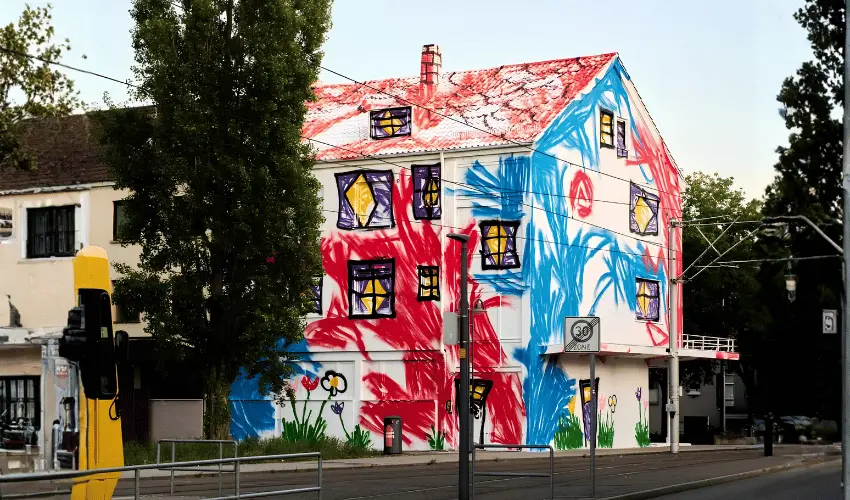
“A kid could do it.” That line could sound dismissive, but here, it is the whole point. For PFFFestival in Stuttgart, French artist The Wa transformed the facade of an empty house by deliberately rejecting polish, precision, and adult design logic.
That line could sound dismissive.
Here, it is the whole point.
For PFFFestival in Stuttgart, French artist The Wa transformed the facade of an empty house by deliberately rejecting polish, precision and adult design logic.
The building becomes a canvas for something that feels immediate, naïve and almost instinctive.
Childlike does not mean careless
The most interesting part of the execution is that the apparent simplicity is intentional. Children do not usually draw with concern for visual hierarchy, brand systems, or architectural restraint—they draw what feels important. Scale can be inconsistent, perspective can be wrong, and color can be excessive. That complete freedom becomes the core creative method.
Children do not usually draw with concern for visual hierarchy, brand systems or architectural restraint.
They draw what feels important.
Scale can be inconsistent.
Perspective can be wrong.
Color can be excessive.
And that freedom becomes the creative method.
The facade becomes the medium
This is not conventional OOH in the sense of placing a poster on a wall.
The wall itself becomes the work.
That distinction matters.
The architecture is not a neutral support surface.
Windows, edges, proportions and the emptiness of the building all become part of the composition.
Why empty buildings are powerful canvases
An unused facade already carries a certain visual silence.
It is present in the city but not actively communicating.
That makes the transformation especially noticeable.
When a previously blank or inactive surface suddenly gains color and personality, the contrast creates immediate impact.

The city gets interrupted without technology
No screen, animation, projection mapping, or interactive sensor is required. The disruption comes entirely from raw visual language. The work feels strange and captivating simply because the building suddenly behaves like a drawing, compelling people to look twice.
No animation.
No projection mapping.
No interactive sensor.
The disruption comes entirely from visual language.
The work feels strange because the building suddenly behaves like a drawing.
That shift is enough to make people look again.
Why the phrase works
“A kid could do it” also creates a useful tension around artistic value.
The phrase is often used to dismiss contemporary art.
The Wa flips that idea by treating childlike logic as the source of the work's strength.
The campaign asks audiences to consider whether sophistication always requires complexity.
Public art and OOH share the same attention economy
Although this is cultural work rather than commercial advertising, it operates in the same visual environment as OOH.
It competes for attention against:
- Architecture.
- Traffic.
- Retail signage.
- Billboards.
- Street furniture.
That makes the execution relevant to outdoor strategy.
The work has to communicate immediately from a distance.
Raw visual language creates memorability
Highly polished advertising is everywhere.
That means roughness can become a form of contrast.
A childlike image on a full building facade feels unusual because it refuses the visual expectations of commercial media.
Scale makes the childish logic feel surreal
The visual idea becomes more interesting because of scale.
A childlike drawing on paper is familiar.
The same logic stretched across a house becomes surreal.
The audience sees a visual language associated with intimacy and play applied to something architectural and public.
That mismatch creates the memorable moment.

Why this works better on a facade than on a poster
If the same artwork appeared inside a conventional poster frame, part of the idea would disappear.
The building transformation is essential.
The work gains meaning from the fact that the house itself seems to have been redrawn.
The medium and the concept are inseparable.
A useful lesson for brands
Commercial brands can learn from this kind of cultural intervention.
Commercial brands can learn from this kind of cultural intervention. Not every outdoor idea needs more copy, technology, or polish. Sometimes one strong visual rule is enough: make the building look like a child got to design it.
More copy.
More technology.
More polish.
Sometimes one visual rule is enough.
In this case:
Make the building look like a child got to design it.
Bottom line
The Wa's PFFFestival facade in Stuttgart shows how architecture can become media without behaving like advertising.
The work uses a deliberately unfiltered, childlike visual language to transform an empty building into something strange, playful and impossible to ignore.
Its strength comes from restraint in the strategy, not the execution.
One idea governs everything.
A kid could do it.
And at building scale, that is exactly why people stop to look.
Frequently asked questions
What is the idea behind The Wa's Stuttgart facade intervention?
The artist used the deliberately unfiltered visual logic of a child to transform an empty house facade into a public artwork.
Where did the installation appear?
The work appeared at PFFFestival in Stuttgart.
Why is the phrase A kid could do it relevant?
The phrase reflects the creative premise: the work rejects over-polished design and instead embraces the directness, imperfection and imagination associated with children's drawings.
Why does this matter from an OOH perspective?
The project demonstrates how architecture itself can become media, creating impact through transformation rather than conventional poster placement.
Plan your OOH campaign
Get recommendations for markets, formats and availability based on your campaign goals.
Request a media plan
Comments
Share your take. Keep it constructive and specific.