
MAP360 Turns Empty Comic-Con Spaces Into High-Impact OOH
Major entertainment events such as San Diego Comic-Con create extraordinary audience concentration.
They also create intense competition for outdoor media, with premium building wraps, billboards and convention-district placements often carrying equally premium costs.
MAP360 Collective approached that challenge by looking beyond conventional inventory and identifying empty urban surfaces that could become powerful storytelling opportunities.
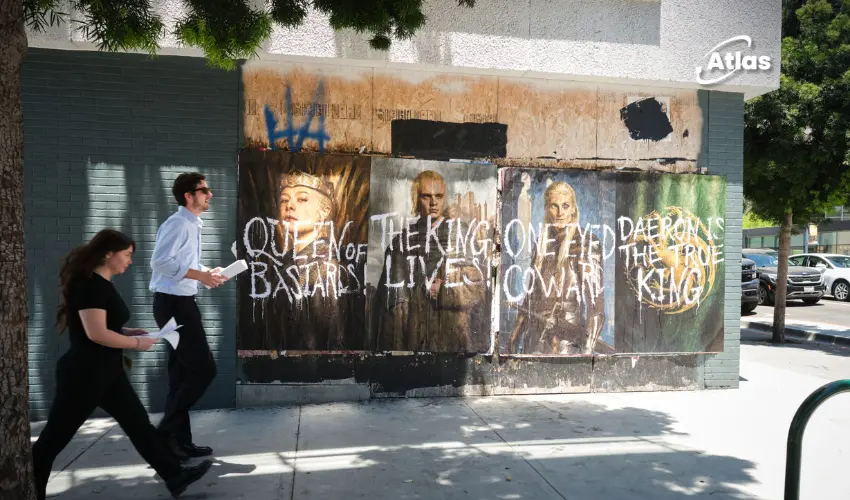
Two executions placed entertainment brands directly within the Comic-Con environment: a window transformation for Project Hail Mary and a wall installation supporting House of the Dragon.
Turning windows into a retail activation
For the physical release of Project Hail Mary, MAP360 partnered with Alliance Home Entertainment and MGM to transform windows near 6th and G in San Diego.
Instead of treating the windows as passive graphic space, the campaign incorporated a QR code that connected public attention with a direct consumer action.
According to the campaign description, the activation helped sell out the available inventory within 24 hours.
Why the QR code mattered
QR codes are not automatically effective simply because they appear in an advertisement.
They work best when the audience understands why scanning is worthwhile and when the placement gives people enough time and proximity to act.
A street-level window provides both advantages.
- Pedestrians can approach the creative: The code can be scanned from a practical distance.
- The product offer is clear: Audiences understand that the activation connects with the physical release.
- The location supports dwell time: People walking through the district can stop without processing the message from a moving vehicle.
- Demand can be measured: Scans and resulting sales create a direct response layer for the campaign.
This allowed the execution to function as both an awareness placement and a temporary outdoor storefront.

House of the Dragon claims a city wall
For HBO’s House of the Dragon, MAP360 installed campaign creative on a wall near 5th and Market.
The execution used the physical scale of the surface to reinforce the strong themes and dramatic tone of the current season.
Wall-based OOH is particularly effective for fantasy entertainment because it offers enough space to communicate world-building, characters and atmosphere without reducing the campaign to a small conventional poster.
The placement also positioned the series within the movement of Comic-Con audiences travelling through downtown San Diego.
Why contextual walls work for entertainment
Entertainment campaigns benefit when audiences encounter them within environments already connected with discovery, fandom and cultural conversation.
During Comic-Con, the streets surrounding the convention center become an extension of the event itself.
A wall at a strategic intersection can therefore perform several roles:
- Build franchise scale: Large creative gives the title a dominant physical presence.
- Support thematic storytelling: The surface can carry more atmospheric and dramatic imagery.
- Reach audiences between events: Fans encounter the campaign while moving through downtown.
- Generate social content: Visually striking walls can become backdrops for photos and video.
Finding value beyond premium inventory
Comic-Con advertising is often associated with landmark hotel wraps, major digital screens and large official sponsorship packages.
Those formats can deliver enormous visibility, but they are not the only way to become part of the event environment.
Unused windows, temporary walls and overlooked façades can offer meaningful alternatives when they are located along relevant audience routes.
The strategic value comes from understanding how people move through the district rather than purchasing scale for its own sake.
Empty space as a creative opportunity
MAP360’s approach begins with identifying urban surfaces that are not currently functioning as formal media.
An empty storefront window or blank wall may appear commercially inactive, but during a major event it can sit directly within a valuable audience journey.
Transforming these spaces creates benefits for both advertisers and property environments.
The brand gains a distinctive placement, while the unused surface becomes more visually active and purposeful for the duration of the campaign.
Different formats for different objectives
The Project Hail Mary and House of the Dragon executions demonstrate how two unconventional surfaces can serve different marketing roles.
The window campaign was closer to direct response. Its QR code invited an immediate action tied to product availability.
The wall campaign focused more heavily on visibility, atmosphere and cultural presence.
Neither approach is inherently stronger. The value depends on matching the format with the objective.
- Use windows for proximity and interaction.
- Use walls for scale and visual storytelling.
- Use QR codes when the next action is immediate and valuable.
- Use event foot traffic to amplify relevance.

From physical placement to measurable impact
The reported sellout connected with the Project Hail Mary activation demonstrates why unconventional OOH should not be viewed only as a creative stunt.
When media, message and action are aligned, a physical installation can contribute directly to demand.
The House of the Dragon wall shows the complementary brand-building role, helping a major entertainment property maintain visibility within one of the most competitive fan environments of the year.
Together, the campaigns show how non-traditional OOH can support both conversion and cultural presence.
Bottom line
MAP360 Collective’s Comic-Con work demonstrates that powerful entertainment advertising does not always require the most expensive conventional inventory.
By transforming windows near 6th and G for Project Hail Mary and a wall near 5th and Market for House of the Dragon, the company turned overlooked urban spaces into strategic media opportunities.
One activation used a QR code to connect outdoor visibility with rapid product demand. The other used scale and thematic creative to place a major television series within the heart of the fan experience.
The result reinforces a valuable OOH principle: empty space is only empty until the right story finds it.
Plan your OOH campaign
Get recommendations for markets, formats and availability based on your campaign goals.
Request a media plan
Comments
Share your take. Keep it constructive and specific.