
Greenpeace Puts Scott Reef in Front of Parliament and Woodside HQ
From Sandy the Turtle to a Street-Level Political Statement
The Flip Off Woodside campaign first introduced audiences to Sandy, the green sea turtle who speaks up for Scott Reef in a courtroom-style campaign film voiced by iconic Australian actor Michael Caton. In its next chapter, Greenpeace Australia Pacific and Thinkerbell shifted the message from screen to street, proving again how well-placed OOH advertising can turn a public issue into an immediate public encounter.
Rather than relying on generic awareness, the campaign used location-specific messaging to reach the people Greenpeace wants to influence most. That strategy is one of the strongest advantages of mobile out-of-home advertising: it can bring a message to a specific building, neighborhood or institutional setting and make the surroundings part of the story.
Canberra: A Message for Anthony Albanese and Murray Watt
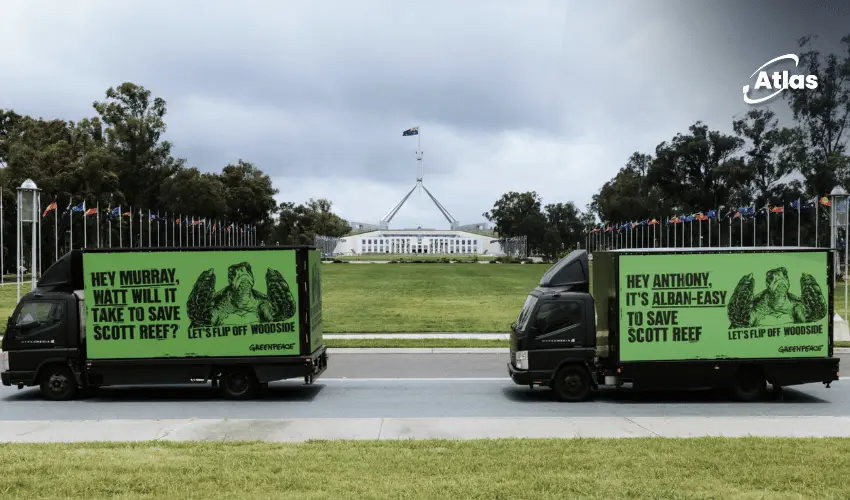
In Canberra, two mobile billboard trucks were parked outside Parliament House. One read, “Hey Anthony, it’s Alban-easy to save Scott Reef”, aimed at Prime Minister Anthony Albanese. The other asked Environment Minister Murray Watt, “Hey Murray, Watt will it take to save Scott Reef?” Both messages featured Sandy raising her flippers beside the line “Let’s Flip Off Woodside.”
The creative worked because it was both targeted and public-facing. It named the decision-makers directly while remaining highly visible to everyone around Parliament. This is the kind of contextual execution that gives smart OOH planning its power: the medium is not just a surface for copy, but a strategic way to place a message in the right physical conversation.
By putting the trucks on the approach to one of Australia’s most symbolically important political landmarks, Greenpeace turned mobile media into a form of public pressure. The result feels more urgent than a distant statement because the message is literally parked where decisions are made.
Perth: Taking the Fight to Woodside’s Home Turf
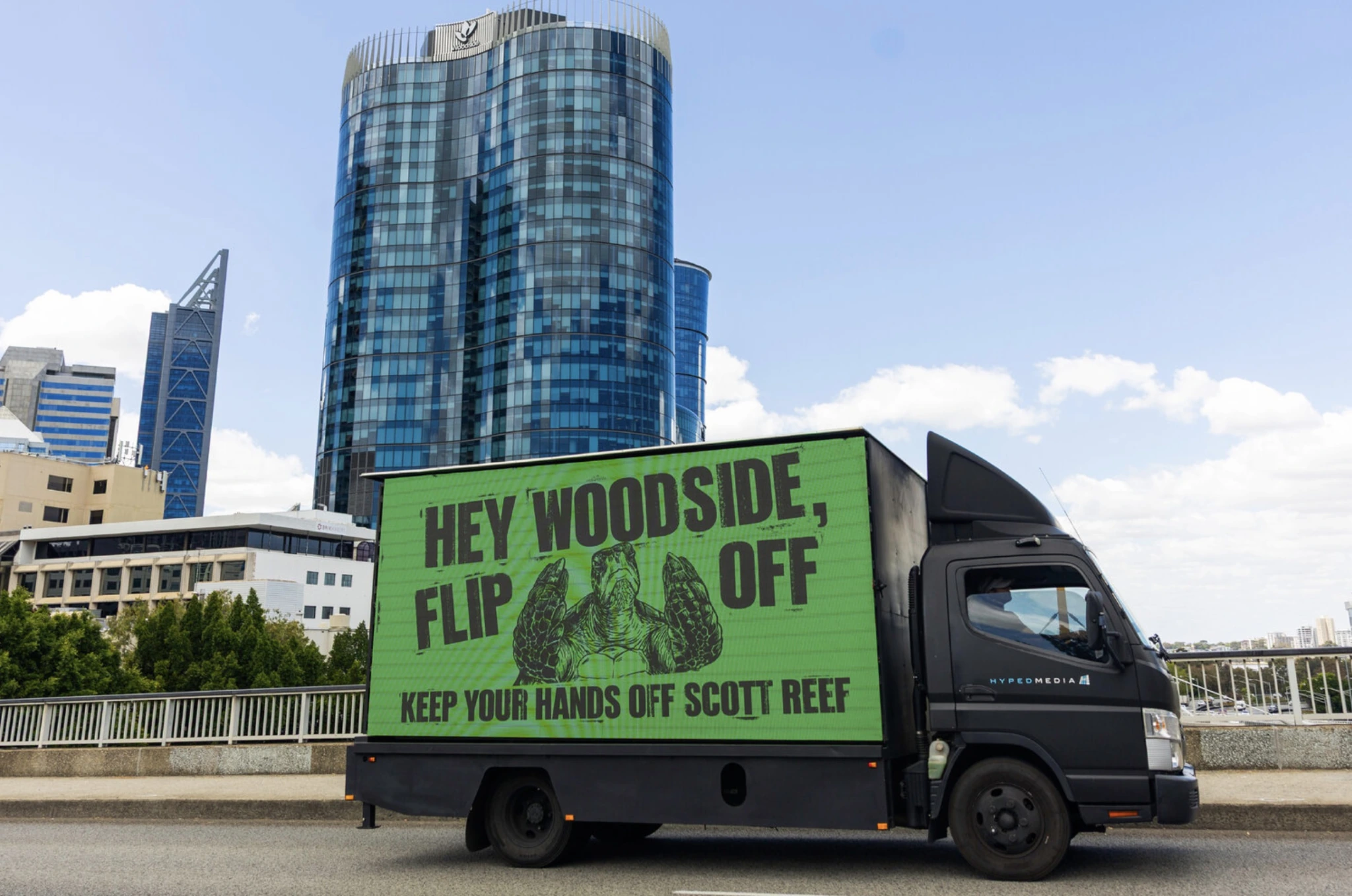
The Perth element of the activation took the same campaign energy and redirected it toward Woodside Energy headquarters. There, a mobile billboard carried the more direct line: “Hey Woodside, Flip Off. Keep Your Hands Off Scott Reef.” Instead of appealing to policymakers, this execution confronted the company by bringing the creative right into its orbit.
That is where street-level visibility and moving media can be especially effective. A mobile billboard does not need to stay fixed in one place to make an impression. It can circulate, be photographed, be shared on social platforms and amplify a brand or advocacy message beyond the people who physically see it first.
Why Mobile Billboards Fit the Campaign So Well
This activation is a good example of how mobile billboard campaigns can support advocacy, issue-based communications and time-sensitive messaging. Unlike static placements, the trucks could be deployed exactly where Greenpeace needed them most, and the copy could be customized for different audiences without diluting the broader platform.
- Precision: the campaign appeared outside Parliament House and around Woodside headquarters, not in random high-traffic areas.
- Context: the meaning of the message changed depending on where the truck was seen.
- Mobility: the unit could circulate and create multiple moments of visibility in a single day.
- Shareability: passers-by were encouraged to photograph and share the truck, extending the message far beyond the route itself.
For organizations planning advocacy media, this is a reminder that strong OOH is not always about scale alone. Sometimes it is about placement, timing and relevance. A focused mobile route, backed by clear creative and a recognizable campaign character, can be more powerful than a broader but less specific media buy.
The Broader Message: Scott Reef as the Real Subject
Although the trucks carry playful wordplay, the campaign’s underlying subject is serious. Greenpeace says Anthony Albanese and Murray Watt hold Scott Reef’s future in their hands, and it argues that Woodside’s Browse gas plans threaten one of Australia’s most precious ocean ecosystems. The creative therefore uses humor and boldness not to soften the issue, but to make it more visible.
That balance is important in any cause-led OOH campaign. The work must be memorable enough to draw attention, but anchored strongly enough in the issue that the audience understands what is at stake. Here, Sandy the turtle gives the platform an instantly recognizable symbol, while the trucks make the ask unmistakably direct.
What Brands and Organizations Can Learn
There are several takeaways from Greenpeace’s use of mobile OOH:
- Tailor the message to the location. The Canberra lines were political; the Perth line was confrontational and corporate.
- Use a recurring campaign asset. Sandy the turtle gave continuity between film, digital content and OOH.
- Make the creative easy to share. High-contrast visuals and short copy work well for both street visibility and social amplification.
- Think beyond awareness. The goal was not simply to be seen, but to influence how people talk about Scott Reef and who they hold accountable.
For advertisers, advocacy groups and public-interest organizations alike, the campaign shows how context-first planning can make a message feel more immediate, more targeted and more newsworthy.
Plan Purpose-Driven OOH With Atlas OOH
Greenpeace Australia Pacific and Thinkerbell used mobile billboards to transform a campaign platform into a physical presence outside the exact institutions they wanted to challenge. It is a sharp example of what happens when creative, geography and timing work together.
If your brand or organization wants to launch a targeted campaign with mobile OOH, transit media or localized outdoor formats, Atlas OOH can help you evaluate the right placements, routes and contextual opportunities. Request a tailored OOH media plan with Atlas OOH and put your message where it matters most.
Frequently Asked Questions
What is the Flip Off Woodside campaign?
It is a Greenpeace Australia Pacific campaign created with Thinkerbell that uses Sandy the green sea turtle to protest Woodside’s Browse gas plans and call for the protection of Scott Reef.
Why were mobile billboards used in Canberra and Perth?
Mobile billboards allowed Greenpeace to take the message directly to Parliament House and Woodside Energy headquarters, increasing visibility, immediacy and public shareability.
Who were the campaign messages aimed at?
The Canberra trucks addressed Prime Minister Anthony Albanese and Environment Minister Murray Watt, while the Perth execution targeted Woodside directly near its headquarters.
Why is Scott Reef central to the campaign?
Scott Reef is the ecosystem the campaign seeks to protect from the potential impact of Woodside’s Browse gas development plans.
What can brands learn from this activation?
The campaign shows how mobile OOH can turn advocacy messages into timely, location-specific statements by placing creative directly in front of the people and institutions a campaign wants to influence.
Sources
Plan your OOH campaign
Get recommendations for markets, formats and availability based on your campaign goals.
Request a media plan

Comments
Share your take. Keep it constructive and specific.