
Ariana Grande Takes Petal Global With Minimalist OOH
A new music era often begins long before audiences press play.
For the release of Ariana Grande’s eighth studio album, petal, outdoor advertising helped move the project from digital anticipation into physical public space.
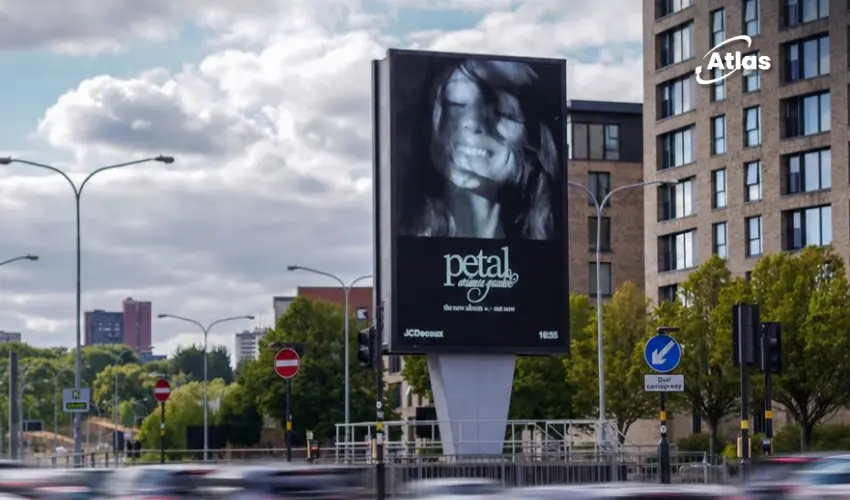
The featured billboard presents a black-and-white portrait of the singer alongside the lowercase album title and the release date:
July 31, 2026.
Similar promotional banners have been reported in London and Mexico City, giving the campaign an international presence built around one consistent and immediately recognizable visual system.

A restrained visual introduction
The billboard avoids the visual density often associated with major album launches.
There is no extensive track information, promotional language or complicated explanation of the project.
Instead, the execution relies on three primary elements:
- Ariana Grande’s portrait.
- The album title, petal.
- The July 31 release date.
This restraint gives each element more importance and allows the creative to be understood quickly from a distance.
Why black and white stands out outdoors
Music advertising frequently relies on intense colors, complex imagery and highly expressive typography.
The monochrome treatment of the petal campaign takes the opposite approach.

Black-and-white photography creates a quieter and more editorial presence within colorful city environments. This contrast can help the billboard attract attention without depending on visual noise.
The photographic style also gives the album a more intimate and personal tone, encouraging audiences to focus on the artist rather than a large collection of decorative elements.
The artist remains the primary brand asset
Ariana Grande has an appearance and public identity that audiences can recognize without requiring extensive supporting information.
The campaign uses that familiarity efficiently.
Her portrait occupies the central role, while the album title and release date provide only the information necessary to introduce the project.
This creates an effective hierarchy for outdoor media:
- Recognize the artist.
- Discover the new album title.
- Remember the release date.
The billboard does not need to explain who Ariana Grande is. It can dedicate its limited viewing time to signaling the beginning of a new era.
Turning a digital release into a physical event
Albums are now primarily discovered and consumed through streaming platforms, social networks and mobile devices.
OOH gives those digital releases a physical presence.
A large billboard makes the album visible to people who may not follow every online announcement or fan account. It also signals that the release is significant enough to occupy public space.
- OOH creates scale: The album artwork becomes part of the city rather than remaining on a phone screen.
- Repeated exposure creates familiarity: Commuters can encounter the title and date several times.
- Public visibility creates cultural importance: The release feels like a broader entertainment moment.
- Physical media generates digital content: Fans can photograph the billboard and redistribute it online.
A consistent international rollout
Similar petal banners appearing across international cities help establish one connected global campaign.
London and Mexico City represent different audiences and media environments, but the same portrait, title treatment and monochrome palette can unite the placements.
This consistency is particularly valuable for a global artist.
Fans in different countries encounter the same visual introduction, making each billboard feel like part of a coordinated worldwide release rather than an isolated local advertisement.
Why Mexico City matters for music OOH
Mexico City has a large and highly active audience for international music, entertainment and fan culture.
Outdoor placements allow album campaigns to enter that culture at street level, appearing alongside the daily journeys of residents, commuters and visitors.
Fans may also treat the billboards as destinations, travelling to photograph them and sharing their locations through social media communities.
This transforms a standard advertising placement into part of the fan experience surrounding the album.
JCDecaux provides urban visibility
The featured billboard is operated by JCDecaux, whose outdoor media network gives entertainment campaigns access to established public locations and high-traffic urban audiences.
For a minimalist campaign, placement quality becomes especially important.
The creative does not depend on an elaborate installation or interactive technology. Its impact comes from the combination of a recognizable artist, a strong image and a prominent urban location.
OOH as a fan-discovery mechanism
Although existing fans may already know the album title and release date, the billboard also reaches casual audiences.
Someone who recognizes Ariana Grande but has not followed the rollout can understand the essential announcement in seconds.

This makes OOH useful at several levels:
- It rewards fans by bringing the album era into their city.
- It reminds occasional listeners that new music is available.
- It reaches broader audiences beyond existing social followers.
- It supports streaming discovery by making the album title easier to recognize later.

Comments
Share your take. Keep it constructive and specific.