
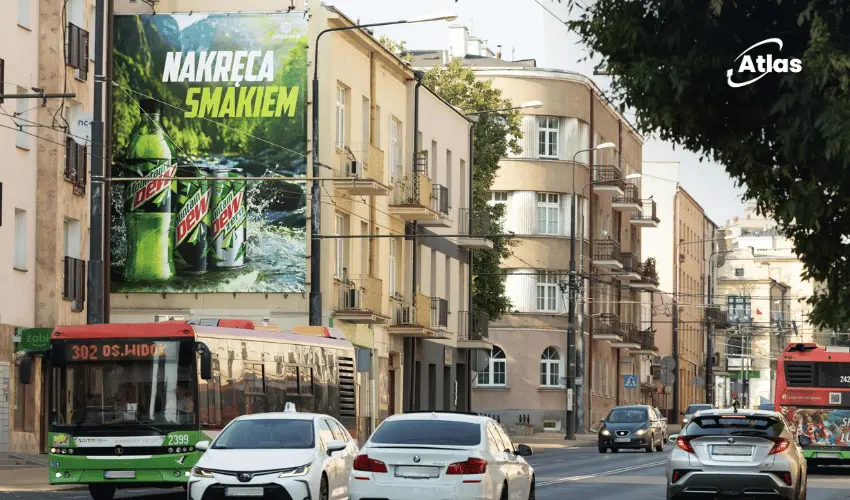
Mountain Dew Brings Its High-Energy Brand Identity to OOH Across Poland
Some brands can adapt to almost any media environment.
Others need the format itself to feel like part of the personality.
Mountain Dew clearly belongs to the second group.
The brand has spent years building its identity around energy, spontaneity and intense experiences.
So when it came time to plan a nationwide outdoor campaign in Poland for PepsiCo, the media strategy needed to reflect that same character.

The answer was straightforward:
Go big, and go where the impact is hardest to miss.
When media personality matches brand personality
Mountain Dew is not a quiet brand.
Its visual language, tone and cultural positioning have consistently leaned toward movement, excitement and high-energy experiences.
That makes restrained media choices feel less natural.
Large-format OOH provides the scale needed to make the physical campaign behave like the brand itself.
Scale becomes part of the creative
Large outdoor formats create more than reach.
They change how a campaign feels.
A bold visual appearing at building scale can communicate confidence and intensity before the audience even processes the copy.
For Mountain Dew, that matters because energy is not simply a product message.
It is part of the brand’s identity.
- Large surfaces amplify color and visual intensity.
- High-impact locations increase perceived importance.
- Scale helps the campaign break through urban clutter.
- Repeated city presence reinforces brand recognition.
Strong locations matter as much as strong creative
A high-energy visual can lose impact when placed somewhere with limited visibility.
That is why location selection becomes a critical part of the idea.
The campaign was planned around strong, highly visible outdoor sites capable of giving Mountain Dew enough presence to feel dominant within the surrounding environment.
Instead of using OOH simply as another distribution channel, the campaign treats location as part of the creative system.
A nationwide campaign needs consistency
Running across Poland creates another challenge.
The campaign needs to maintain the same level of energy across multiple cities and different media environments.
That requires more than repeating one layout everywhere.
It requires choosing sites that can deliver a consistent level of visual impact.
The format may change from market to market, but the overall impression should remain recognizably Mountain Dew.

Why distinctive identity matters
Mountain Dew has evolved its communication over time, but one thing has remained consistent: a strong and recognizable brand personality.
That continuity gives the campaign an advantage.
The media does not need to explain what Mountain Dew stands for from scratch.
It can amplify assets and associations audiences may already know.
This is especially valuable in OOH, where viewing time is limited and recognition often happens before detailed reading.
OOH makes energy physical
Energy is an abstract idea.
You cannot literally place spontaneity or excitement on a billboard.
But the combination of scale, color, composition and location can make the campaign feel energetic.
That is one of OOH’s strongest advantages.
The medium can convert intangible brand attributes into physical presence.
From beverage advertising to urban interruption
The best large-format beverage campaigns do more than show the product.
They interrupt the environment.
Mountain Dew’s visual language is well suited to this because it can use saturated color, product scale and dynamic composition to separate itself from the neutral architecture surrounding the media.
The billboard becomes more than an announcement.
It becomes a burst of brand energy inside the city.

Media planning as brand translation
The campaign also illustrates an important principle in media strategy:
Planning is not separate from creative expression.
The decision to use large formats and high-impact locations helps determine how the brand is perceived.
In that sense, media selection becomes another way of translating the brand identity.
- The brand defines the personality.
- Creative expresses that personality visually.
- Media determines how that personality occupies space.
- Location determines how strongly audiences experience it.
Plan your OOH campaign
Get recommendations for markets, formats and availability based on your campaign goals.
Request a media plan
Comments
Share your take. Keep it constructive and specific.