
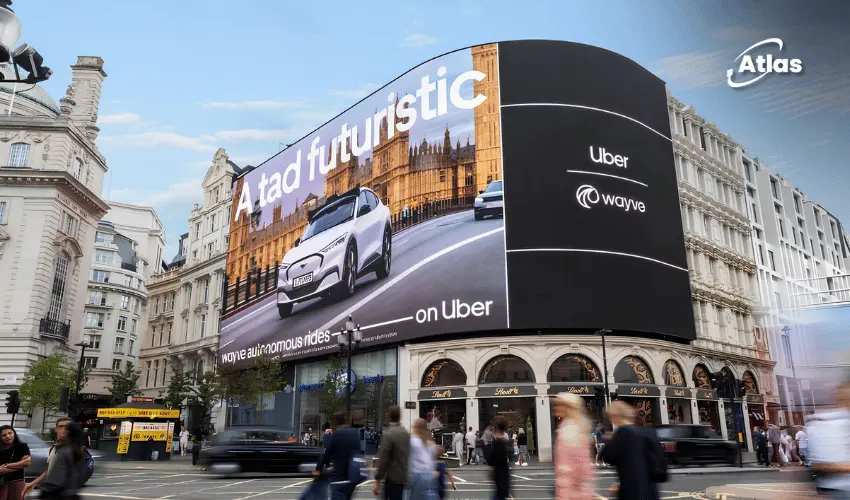
Wayve Autonomous Rides on Uber: How OOH Introduces a New Mobility Experience to London
Atlas OOH Can Help New Technology Feel Familiar in Public Space
When a brand is introducing something people may not have experienced before, outdoor advertising has the power to make the unfamiliar feel visible and real. Atlas OOH can help translate emerging technologies into campaigns across billboards, transit and street-level media so the story feels clear, public and relevant from the very first impression.
If your brand needs to turn innovation into something people can recognize in daily life, start building an outdoor strategy designed to introduce new ideas with clarity and real-world visibility.
Introducing autonomous vehicles to a city, not just an audience
This campaign is not simply announcing a new product.
It is introducing an entirely new type of ride experience to London.
That changes the strategic role of the creative.
The work has to create awareness.
It has to reduce distance.
And it has to make the technology feel like something that belongs in the city rather than something abstract or futuristic.
According to the supplied information, people in London can open the Uber app and try their luck at being matched with a Wayve autonomous vehicle.
Alright London: the campaign says hello before it explains
One of the smartest parts of the campaign is its tone.
Instead of leading with heavy technical messaging, the work speaks to London in a direct and conversational way.
“Alright London” feels local.
It feels relaxed.
And it makes the technology feel less intimidating by framing the message as an introduction rather than a lecture.
The bus shelter placement near Old Street Station helps reinforce that idea by placing the autonomous vehicle story in a familiar urban commuting environment.
If your campaign needs the same balance of visibility and accessibility, explore a transit and street-level media strategy that meets audiences inside their everyday routines.
Wit makes the technology feel more approachable
The supplied campaign description highlights that the OOH uses words that say hello to London with a cheeky bit of wit.
That matters because wit changes the emotional entry point.
Autonomous vehicles could easily be introduced through serious, technical or corporate language.
Instead, Wayve and Uber choose simple lines that feel conversational.
The result is a mobility campaign that sounds more like the city and less like a spec sheet.
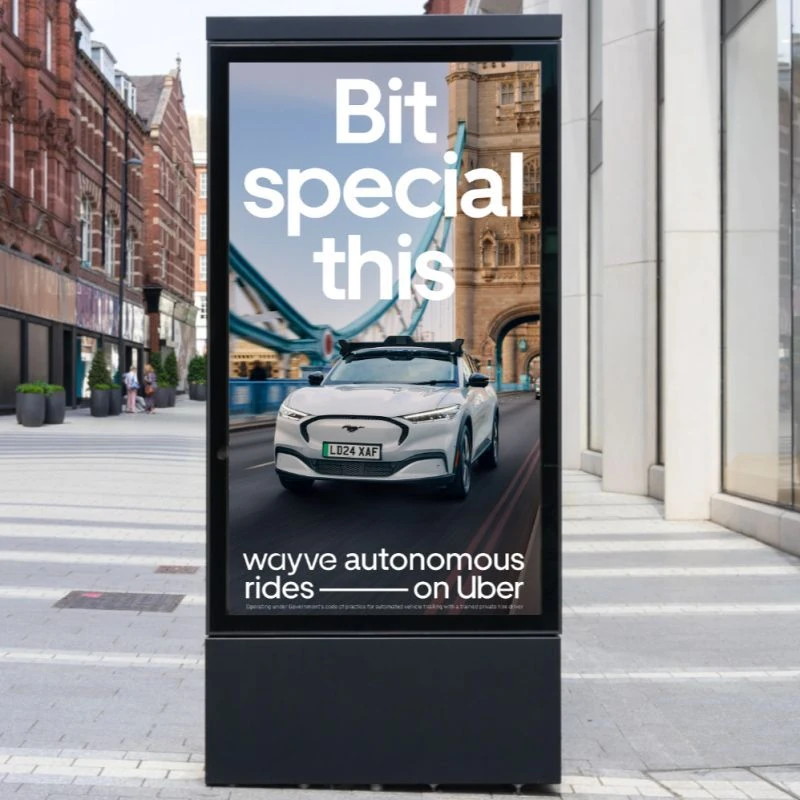
Bit special this
The line “Bit special this” is a strong example of that approach.
It sounds understated.
It sounds local.
And it lets the audience do a bit of the work themselves.
The message does not spell out every technical detail.
It simply suggests that what people are seeing is something unusual and noteworthy.
For brands launching something audiences may not immediately understand, consider outdoor creative that uses tone and context to open the conversation before asking the audience to process the full story.
Location gives the message more meaning
OOH becomes stronger when the message and the environment support each other.
That is exactly what happens here.
Autonomous rides are being introduced in the same public environments where people already think about transport, movement and how they get across the city.
The medium helps the product story make sense faster.
People do not have to imagine the relevance.
They are already standing in it.
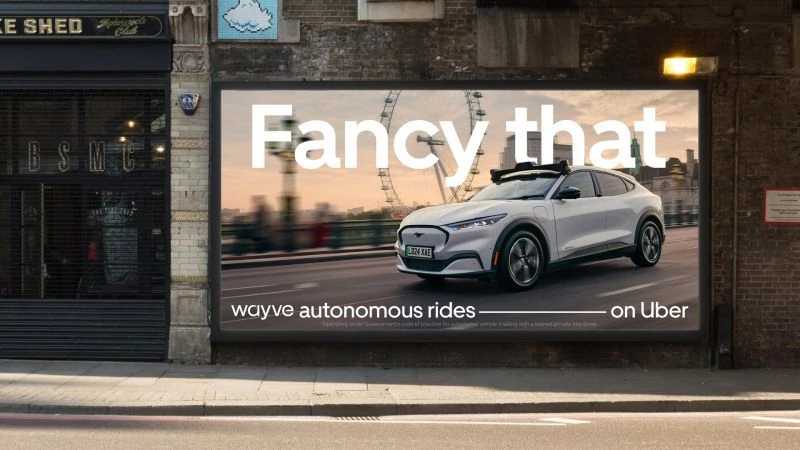
Fancy that: large format helps scale the introduction
The line “Fancy that” takes the same tone into a larger, more dramatic format.
Here the autonomous vehicle is shown on a large billboard with a familiar London backdrop, helping extend the campaign from local encounter to citywide statement.
The headline remains short and playful, which is exactly what outdoor media rewards.
It can be read quickly, understood easily and connected instantly to the car and brand names below.
New technology needs public proof
One important role of this campaign is simple: it makes the service feel real.
That is especially important for something like autonomous mobility.
People may have heard of the idea before.
They may have seen news coverage.
But OOH puts the service into the public visual landscape of the city.
It signals that this is not just a concept or prototype story anymore.
It is part of the transportation conversation happening now.
Atlas OOH Can Help Emerging Mobility Brands Build Public Recognition
Wayve and Uber show how OOH can help a new category gain familiarity by combining strong placements, readable creative and messaging that feels rooted in the city. Atlas OOH can help mobility, technology and innovation brands create outdoor campaigns that make new services feel more visible, trustworthy and culturally relevant.
Whether the objective is a citywide introduction, a commuter-focused rollout or a broader multi-format launch, request an outdoor plan built around the places where audiences are most likely to encounter, notice and remember the story.
Short copy is doing a lot of work
This campaign also shows the value of restraint.
The headlines are short.
The imagery is clear.
The vehicle is the hero.
And the brand line “Wayve autonomous rides on Uber” explains just enough.
That balance is important because the idea itself is already doing a lot of cognitive work for the audience.
The campaign does not overload the viewer with detail.
It invites curiosity instead.
Why this campaign works
The work succeeds because it combines several smart choices:
- A genuinely new story — autonomous vehicles are a major category introduction.
- Clear city relevance — the message is aimed directly at London.
- Cheeky local tone — the campaign sounds conversational instead of technical.
- Strong visual clarity — the vehicle remains central and easy to identify.
- Contextual placement — the ads appear in places tied to everyday movement and urban travel.
Atlas OOH Can Bring Autonomous Mobility Into the Public Conversation
For mobility brands introducing a new service, the strongest OOH does more than create awareness — it gives the innovation a visible place in everyday city life. Atlas OOH can help translate emerging transportation ideas into public-facing campaigns across transit, billboards and DOOH.
If your brand is ready to move from innovation story to real-world visibility, build a campaign that introduces the technology where people already move, commute and make transportation choices.
Bottom line
Wayve autonomous rides on Uber show how OOH can help a new technology feel less abstract and more publicly real.
The campaign does not try to explain everything at once.
It introduces.
It humanizes.
And it uses London wit to make a major mobility shift feel a little easier to welcome.
Ready to take a new idea into the real world? Start the conversation and build an OOH campaign designed to introduce innovation with clarity, scale and relevance.
Frequently asked questions
What is the Wayve autonomous rides on Uber campaign?
It is a London OOH campaign designed to introduce autonomous vehicles to the public through Uber, using witty local headlines and outdoor placements across the city.
What is the main purpose of the campaign?
The campaign is meant to make autonomous vehicles feel more familiar by showing the technology in public and connecting it to simple, witty London-specific messaging.
Can people in London actually try a Wayve autonomous ride on Uber?
According to the supplied information, people in London can open the Uber app and try their luck at being matched with a Wayve autonomous vehicle.
What kind of OOH headlines does the campaign use?
The campaign uses short, cheeky phrases such as “Alright London,” “Bit special this,” and “Fancy that” to introduce the autonomous vehicle service in a way that feels conversational and local.
Sources
Plan your OOH campaign
Get recommendations for markets, formats and availability based on your campaign goals.
Request a media plan

Comments
Share your take. Keep it constructive and specific.