
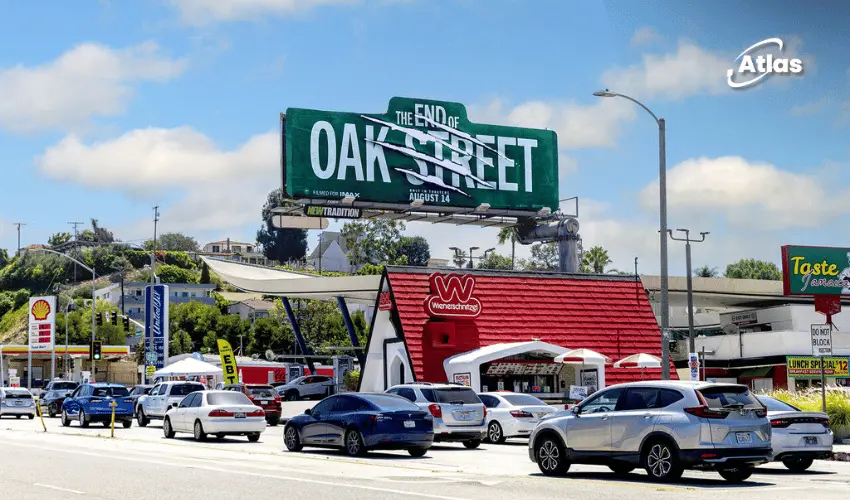
The End of Oak Street Goes Larger Than Life Across LA and NYC
Some stories are too big to stay inside one screen.
For The End of Oak Street, the campaign expanded beyond trailers, cinema screens and digital promotion by moving directly into the streets of Los Angeles and New York City.
The approach is simple:
Big story. Big screen. Even bigger presence.
Large-format outdoor media gives the film a physical scale that traditional entertainment advertising cannot replicate in quite the same way.

Taking the film beyond the theater
Theatrical campaigns traditionally build anticipation through trailers, posters and promotional content.
OOH adds another dimension.
It places the movie directly into the city and makes the launch visible to audiences whether or not they are actively looking for entertainment content.
Why Los Angeles and New York matter
Los Angeles and New York are natural environments for high-impact entertainment advertising.
Both cities offer enormous audience density, major cultural influence and highly visible outdoor media locations.
For a theatrical campaign, appearing prominently in these markets sends a signal of scale.
The film is no longer simply promoted.
It occupies space.
- Los Angeles connects directly with the entertainment industry.
- New York provides immense pedestrian and commuter visibility.
- Both markets generate significant social amplification.
- Premium OOH reinforces the sense of a major release.
Scale becomes part of the message
Movie campaigns naturally benefit from large visual storytelling.
Cinematic imagery, dramatic characters and high-production artwork can lose some of their impact when reduced to a mobile screen.
Large-format OOH restores that sense of scale.
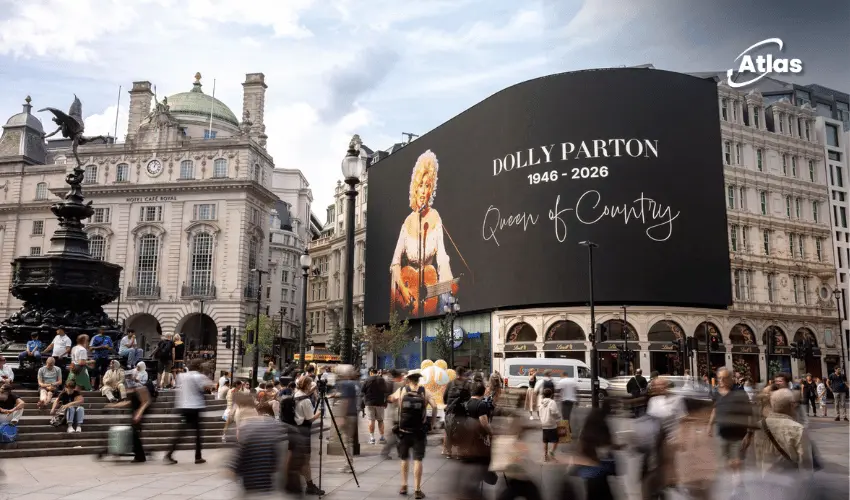
A film image that fills an entire building, billboard or digital landmark feels closer to the visual experience audiences expect from cinema itself.
OOH creates unavoidable awareness
Digital advertising often depends on audiences opening an app, visiting a platform or remaining within a particular content environment.
Outdoor media works differently.
It becomes part of the physical journey.
Commuters, pedestrians, drivers and visitors can encounter the film simply by moving through the city.
This makes OOH particularly valuable during theatrical release windows when broad awareness needs to build quickly.
From one hero placement to citywide presence
The End of Oak Street had already demonstrated the value of special-build outdoor through its dinosaur claw execution.
Expanding the campaign across LA and NYC adds another layer: reach.
A special build can create the hero moment.
A broader large-format rollout ensures that the movie remains visible beyond that single stunt.
Together, the two approaches can perform different jobs:
- Special builds generate surprise and conversation.
- Large-format OOH creates consistent awareness.
- Multiple city placements reinforce recognition.
- Social sharing extends the campaign beyond the street.

The city becomes a second screen
The phrase “beyond the theater” captures an important shift in entertainment marketing.
A movie campaign no longer lives only in cinemas or on streaming platforms.
The city itself can become another screen.
Buildings, roadside structures, transit environments and digital landmarks provide canvases capable of extending the movie’s visual world into everyday life.
This is especially powerful when creative is designed to use the scale of those environments rather than simply reproducing a standard poster.
Why repetition matters
One billboard may create a memorable impression.
Several coordinated placements across major audience routes create familiarity.
That repeated exposure is valuable because theatrical marketing operates within short and competitive launch windows.
Consumers may see several new releases promoted simultaneously.
The title that appears repeatedly across the city can become easier to recall when audiences decide what to watch.
Physical presence creates perceived importance
There is also a psychological advantage to seeing a film promoted at enormous scale.
Large public placements can make a release feel culturally significant.
The audience sees that the movie has taken over premium space in major cities, reinforcing the perception that this is a title worth noticing.
This is difficult to communicate through small-screen media alone.

Designed to travel beyond the physical placement
High-impact OOH is also inherently shareable.
A dramatic billboard or large urban takeover can become content for social media, entertainment press and industry coverage.
This creates a multiplier effect.
The physical audience sees the campaign in person, while digital audiences see photographs and videos of the same execution online.
The media placement therefore becomes content in its own right.
Plan your OOH campaign
Get recommendations for markets, formats and availability based on your campaign goals.
Request a media plan
Comments
Share your take. Keep it constructive and specific.