
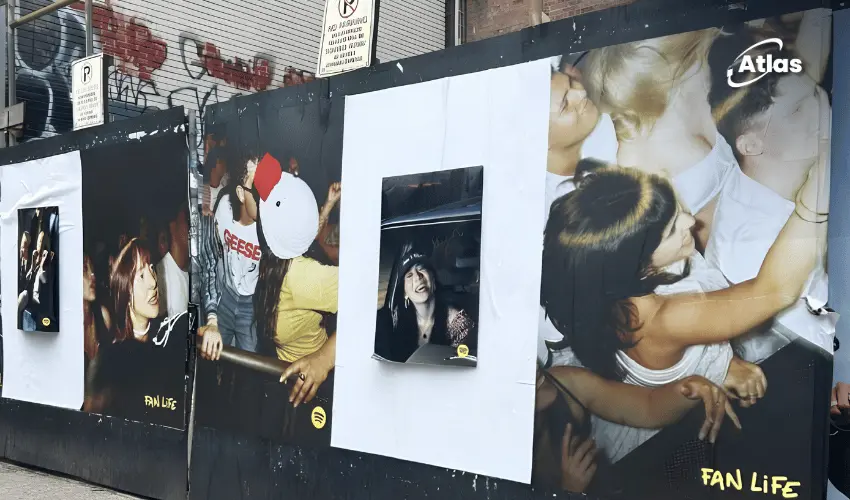
Spotify Turns Fan Rituals Into Tear-Off Street Posters
Music fans already know how to advertise the artists they love.
They dress differently.
They copy hairstyles.
They make hats, signs, outfits and inside jokes.
Spotify’s latest Fan Life work simply pays attention.
Instead of inventing a new behavior for audiences to perform, the campaign takes rituals that already exist inside fan communities and turns them into the creative system.
Fan behavior becomes the media idea
That is what makes Fan Life particularly effective.
The campaign does not begin with Spotify asking:
“What should fans do for us?”
It begins with:
“What are fans already doing?”
That shift changes the tone completely.

Tear-off posters turn OOH into something people can own
The latest street executions introduce another layer of participation.
The posters include perforated sections that fans can physically tear off and take home.
That transforms the media from something audiences only look at into something they can keep.
The poster is no longer just an impression.
It becomes an object.
Why collectability matters
Music fandom has always been connected with collecting.
Tickets.
Posters.
Vinyl.
Merchandise.
Setlists.
Signed memorabilia.
The tear-off mechanic fits naturally into that behavior.
Spotify does not have to teach fans why taking a piece home matters.
They already understand the value of owning something connected to an artist they care about.
Signed pieces add scarcity
Some of the tear-off pieces are signed by the artists.
That small detail changes the entire incentive structure.
The audience no longer knows whether the next piece might be more valuable than the last.
Scarcity creates urgency.
And urgency encourages people to interact with the poster sooner rather than later.
- The poster becomes collectible.
- Signed pieces introduce rarity.
- Fans have a reason to visit the physical location.
- The media naturally creates social content when pieces are found.
The campaign understands fandom as performance
Fan Life has repeatedly focused on highly specific fan rituals.
These are not generic signs of liking music.
They are behaviors recognizable to people inside the community.
Examples include:
- A$AP Rocky fans wearing pink hair rollers.
- Geese fans in crocheted goose hats.
- Pitbull fans wearing suits and bald caps.
Each ritual works because it belongs to a specific artist-fan relationship.
Specificity makes the campaign more universal
That may sound contradictory.
But the more specific these observations become, the more believable the campaign feels.
Someone may not understand why a Geese fan wears a crocheted goose hat.
But they probably understand what it feels like to belong to a community with its own symbols and jokes.
The campaign becomes universal through very specific examples of belonging.
Why Spotify can credibly tell these stories
Spotify sits in an interesting position.
The platform is not the artist.
It is not the fan.
But it exists between the two.
That gives Spotify access to music culture at enormous scale while allowing the brand to celebrate fandom rather than place itself at the center of it.
The campaign works best when Spotify behaves like an observer and amplifier.
The brand steps back
This is especially important in fandom marketing.
Brands can quickly weaken a cultural idea when they over-brand the behavior they are trying to celebrate.
Fan Life avoids that problem by allowing the fans, artists and rituals to remain the interesting part.
Spotify provides the platform.
The community provides the story.
Street posters are the right medium
Wildposting and street poster formats have a long relationship with music culture.
They are associated with concerts, club nights, album releases and underground scenes.
That gives the format cultural credibility before the creative even begins.
A perforated poster also feels physical and slightly imperfect in a way that suits fan behavior better than a polished digital screen might.
Participation happens without technology
One of the smartest aspects of the execution is how little technology it requires.
No QR code is necessary for the basic interaction.
No app download.
No NFC trigger.
No augmented reality layer.
The interaction is completely physical:
See it. Tear it. Take it.
That simplicity lowers the barrier to participation.
The disappearing poster becomes proof of engagement
There is also something interesting about what happens to the media over time.
As fans remove pieces, the poster physically changes.
The depletion becomes visible evidence that other people have already interacted with it.
A partially stripped poster can actually become more intriguing than a pristine one.
It signals:
Something is happening here.
The media records participation
Most OOH does not visibly change when someone engages with it.
This campaign does.
Every missing tear-off section becomes a record of an interaction.
The campaign effectively leaves behind a physical participation trail.

From street interaction to social amplification
The physical mechanic is also naturally designed to travel online.
Fans can photograph:
- The original poster.
- The piece they removed.
- A signed version they discovered.
- The poster after other fans have interacted with it.
That gives Spotify multiple content moments from one physical placement.
Fans become the distribution network
Once a piece leaves the poster, the campaign also leaves the media site.
The fan takes it home.
It may appear on a wall, desk or social feed.
In that sense, the audience physically redistributes the advertising.
The poster becomes portable media.
Plan your OOH campaign
Get recommendations for markets, formats and availability based on your campaign goals.
Request a media plan
Comments
Share your take. Keep it constructive and specific.