
Huggies Turns Little Movers Into Little Monsters With One Simple OOH Joke
Some OOH ideas work because they explain the product, while others work because the audience already knows half the joke. This Huggies execution leans into that second approach with brilliant copy-led OOH techniques.
Others work because the audience already knows half the joke.
This Huggies execution leans into that second approach.
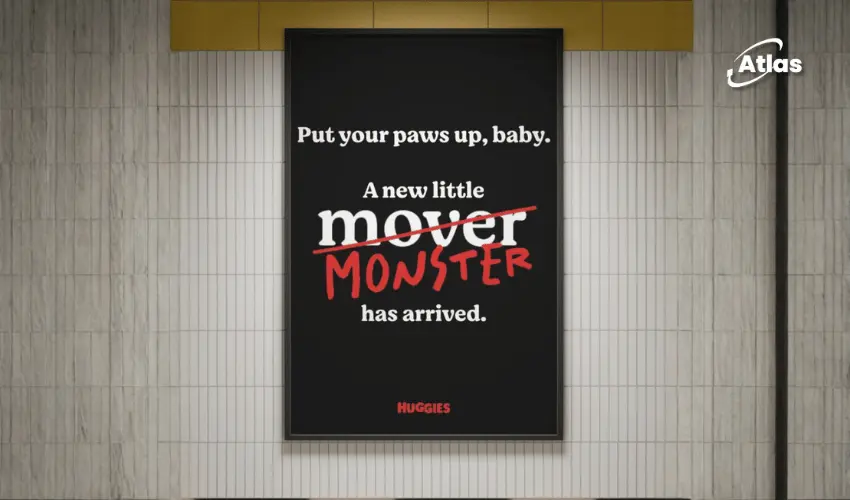
The ad reads:
“Put your paws up, baby.”
Then:
“A new little mover has arrived.”
Except “mover” is crossed out and replaced with:
“monster.”
The audience brings the cultural context
The creative relies on a reference many people can recognize without explanation.
“Paws up” is strongly associated with Lady Gaga fandom, while “Little Monsters” is one of pop culture’s most recognizable fan-community names.
Huggies takes that language and redirects it toward babies who are entering the active, constantly moving stage associated with Little Movers.
The product name already contains the setup
This idea works because Huggies does not need to force the connection.
The product is already called Little Movers.
Changing one word creates the joke:
Little Movers → Little Monsters.
That makes the cultural reference feel structurally connected to the product instead of added afterward.
Typography becomes the main visual device
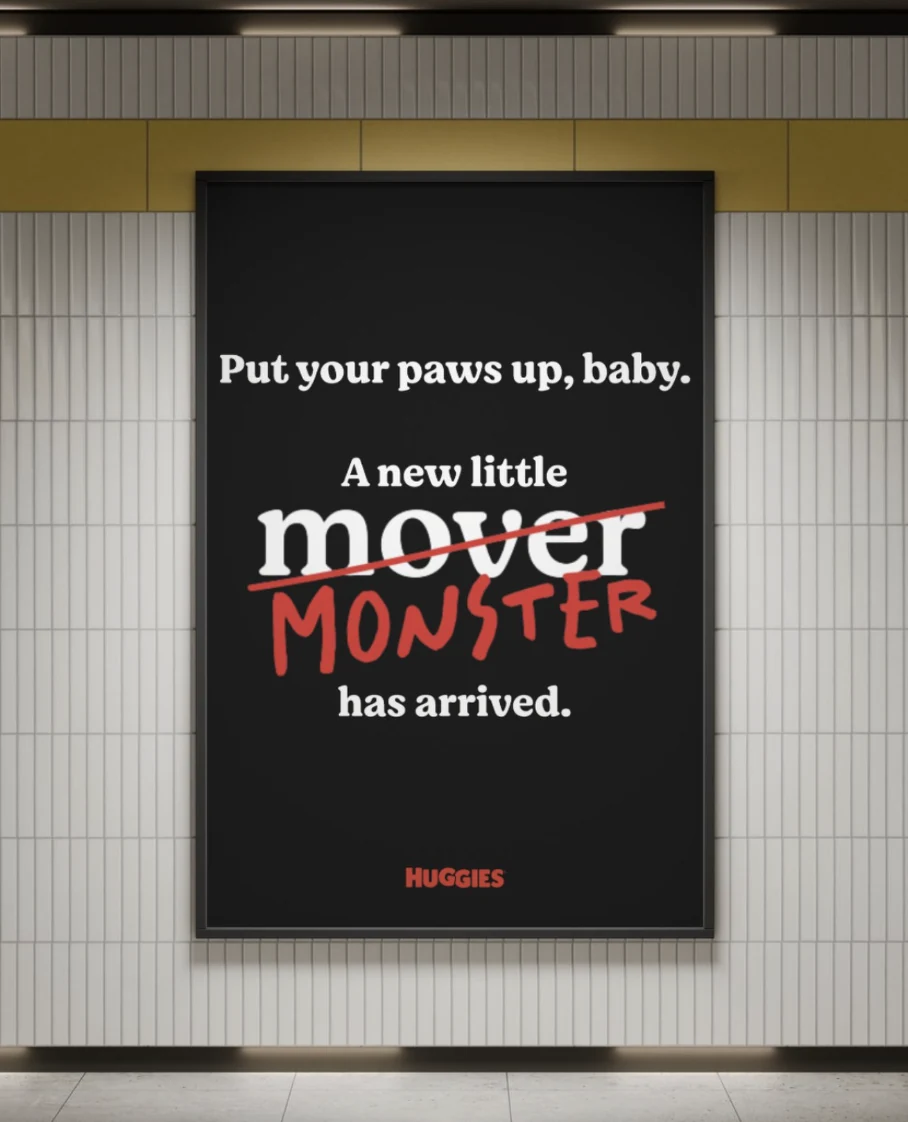
The execution relies on minimalist billboard advertising and typography advertising rather than a baby photo, product pack, or elaborate illustration. The headline hierarchy does most of the visual work across a black background with white serif type and a red handwritten correction.
The headline hierarchy does most of the work.
Black background.
White serif type.
Red handwritten “MONSTER.”
And one line crossing out “mover.”
The design makes the transformation visible instantly.
Why the red handwritten word matters
“Monster” does not simply replace “mover.”
It looks like someone has physically corrected the advertisement.
That gives the message more personality.
The red handwritten treatment feels mischievous, slightly chaotic and more energetic than the formal white typography around it.
That visual contrast reinforces the behavior the product is built for: babies who are no longer staying still.
The restraint is what makes the joke visible
The execution contains almost nothing unnecessary.
No detailed product benefit list.
No large pack shot.
No long explanation of absorbency or fit.
The Huggies logo appears at the bottom, while the copy owns the majority of the visual space.
That hierarchy gives audiences time to understand the joke first and attribute it second.
Why this works especially well outdoors
OOH audiences often have only a few seconds to process a billboard. This campaign relies on fast wordplay advertising: drivers read “Put your paws up, baby,” notice “mover” crossed out for “monster,” and immediately recognize the Huggies brand.
The campaign fits that reality.
- Read “Put your paws up, baby.”
- Notice “mover” being crossed out.
- Read “monster.”
- Recognize the Huggies brand.
The entire idea can land almost immediately.
The campaign uses culture without needing celebrity imagery
One of the interesting aspects of the execution is that it does not need a celebrity portrait.
The cultural reference lives entirely in language.
That lets Huggies benefit from recognition without turning the ad into a conventional celebrity-led layout.
There is an important attribution line to respect
The creative clearly draws on Lady Gaga-related fan language.
But based on the supplied information, that should not automatically be interpreted as a confirmed formal collaboration or endorsement.
That distinction is important when describing the campaign.
The strongest analysis is simply that Huggies uses a recognizable pop-culture reference to make Little Movers more memorable.
Atlas OOH can help brands build similarly immediate ideas
This pop culture OOH campaign is a useful reminder that minimalist billboard advertising does not always need complex production to become memorable. Sometimes one sharp line, a clever visual interruption, and a recognizable cultural reference are enough.
Sometimes one line, one visual interruption and one strong cultural reference are enough.
Atlas OOH can help brands turn sharp copy and recognizable cultural moments into billboard, transit and street-level campaigns designed to be understood quickly in real-world environments.
Bottom line
Huggies takes a product name that already contains movement and gives it a pop-culture twist.
“Little Movers” becomes “Little Monsters.”
“Put your paws up” provides the cultural recognition.
The typography delivers the joke.
And the product remains connected to the idea without needing to dominate the ad.
It is a simple example of how one well-chosen cultural reference can make a functional product name feel much more memorable.
If your brand has a line, behavior or cultural connection that could become a stronger real-world idea, Atlas OOH can help turn it into an OOH campaign built for visibility, recognition and relevance.
Frequently asked questions
What is the main idea behind the Huggies ad?
The creative turns Huggies Little Movers into Little Monsters through a simple word replacement, connecting active babies with a recognizable pop-culture reference.
What does Put your paws up, baby refer to?
The phrase echoes the paws-up gesture strongly associated with Lady Gaga's fan culture.
Is this confirmed as an official Lady Gaga collaboration?
The supplied information supports a clear cultural reference, but does not confirm a formal partnership or endorsement by Lady Gaga.
Why does the execution work in OOH?
The message is short, the visual hierarchy is strong and the audience can understand the joke quickly without needing a product demo or long explanation.
Sources
- Huggies Little Movers Diapers - Huggies / Kimberly-Clark
- Huggies + Pull-Ups Disney/Pixar Walmart Collection - Arc Worldwide
Plan your OOH campaign
Get recommendations for markets, formats and availability based on your campaign goals.
Request a media plan


Comments
Share your take. Keep it constructive and specific.