
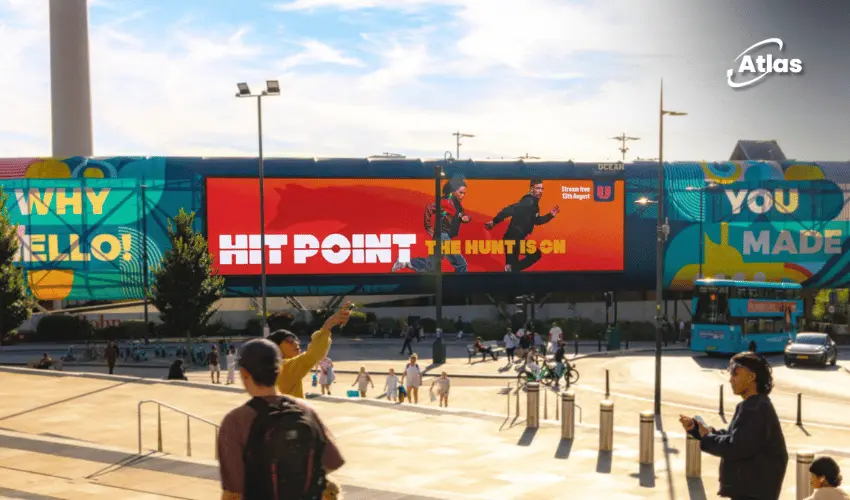
Hit Point Takes The Hunt Is On Across Rail, City Centres and Bus Media
Some campaign lines are written for one ad.
Others are strong enough to organize the entire media system.
“The Hunt Is On” belongs to the second group.
For Hit Point, the line gives the campaign a simple idea that can travel physically through the city and adapt to very different OOH environments without losing meaning.
One idea that can move
The strongest part of the platform is its flexibility.
A “hunt” naturally implies movement, pursuit, discovery and location.
That makes it especially compatible with outdoor media.
Instead of feeling attached to one static poster, the idea can follow audiences across real journeys.

National Rail makes the journey part of the idea
Rail environments are a natural fit for a campaign built around pursuit.
Passengers are already moving between destinations, changing routes and navigating spaces.
The campaign can therefore meet them inside a real journey and make the language of “the hunt” feel more contextually relevant.
- Rail adds movement.
- Stations add dwell time.
- Repeated commuter exposure builds familiarity.
- The journey itself reinforces the campaign theme.
City centres provide scale
Large city-centre placements perform a different role.
They give the campaign visual dominance.
Instead of asking audiences to discover the creative gradually, these formats make the hunt feel public and immediate.
Scale turns the campaign from an entertainment message into an urban presence.
Bus T-sides keep the campaign moving
Bus T-sides add literal mobility.
The campaign no longer waits for audiences to pass a fixed location.
The creative travels through neighborhoods, commercial areas and commuter routes.
For a platform built around “The Hunt Is On,” that moving presence feels especially appropriate.
The medium itself starts behaving like the campaign idea.
Why visual consistency matters
A multi-format campaign can easily become fragmented.
Rail panels, large-format screens and bus media all have different dimensions, viewing distances and audience behaviors.
Hit Point avoids that problem by carrying the same distinctive visual language through every touchpoint.
The layouts may adapt, but the identity remains consistent.
Recognition before explanation
That consistency matters because many entertainment campaigns compete for the same attention.
Audiences may only have seconds to process a placement.
Distinctive visual assets allow recognition to happen before every detail is read.
The campaign becomes easier to identify as audiences encounter it multiple times across the city.
The line creates narrative tension
“The Hunt Is On” also creates something many entertainment campaigns need: tension.
The phrase suggests that something has already begun.
There is movement.
There is urgency.
There is a reason to pay attention.
The audience may not know the full story yet, but the line provides enough intrigue to create curiosity.

OOH can tease without explaining everything
Entertainment advertising often performs better when it does not over-explain the plot.
Outdoor media has limited viewing time, so the campaign can focus on mood, tension and recognition rather than synopsis.
Hit Point benefits from that restraint.
The line establishes the chase.
The visual system establishes the world.
The streaming call-to-action completes the journey.
From public awareness to streaming action
The campaign ends with a simple commercial message:
Hit Point. Stream free on U.
That line gives the OOH a clear destination without interrupting the creative idea.
The structure becomes:
- See the hunt in public space.
- Recognize the visual world.
- Build curiosity through repeated exposure.
- Stream the title on U.
The campaign turns the city into part of the story
One of the most interesting aspects of the rollout is how naturally the idea fits urban media.
Rail stations, buses and city centres are all spaces defined by movement and searching.
The campaign does not need to manufacture that feeling.
The environment already provides it.
One platform, many touchpoints
The campaign demonstrates the advantage of starting with a strong central idea before choosing formats.
Once the idea is clear, each medium can express it differently.
- Rail turns the hunt into a journey.
- City-centre media turns it into spectacle.
- Bus T-sides turn it into movement.
- Repeated visual identity turns it into recognition.
That is what makes the campaign feel connected rather than simply widespread.
Why this matters for entertainment OOH
Entertainment campaigns often have access to strong visual assets but weak media integration.
A poster may look good individually but lose coherence when spread across different formats.
Hit Point shows another approach.
The creative idea and the media behavior reinforce one another.
The result feels like one campaign experienced in several ways.

Bottom line
Hit Point’s OOH campaign demonstrates how one strong line can become a complete outdoor system.
“The Hunt Is On” works because it can move with the audience.
National Rail adds journey.
City centres add scale.
Bus T-sides add mobility.
And the same distinctive visual language keeps everything connected.
One idea. Many streets. One recognizable hunt.
Plan your OOH campaign
Get recommendations for markets, formats and availability based on your campaign goals.
Request a media plan
Comments
Share your take. Keep it constructive and specific.