
Godzilla Minus Zero Brings Monster-Sized Experiential OOH to Paris
Godzilla Takes Over the Champs-Élysées With 3D Outdoor Advertising
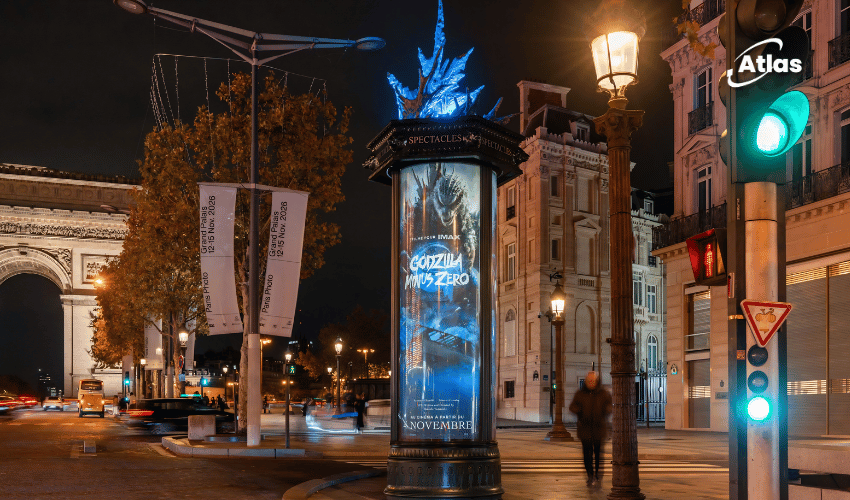
One of Paris’s most recognisable forms of Street Furniture Advertising became an unexpected stage for Japanese cinema. On the upper Champs-Élysées, an iconic Morris column displayed artwork for Godzilla Minus Zero, the follow-up to Godzilla Minus One, while a sculptural installation of the monster’s jagged dorsal spines burst from the structure’s roof.
The special activation, delivered by JCDecaux Live in collaboration with Anime Limited, was created to mark the film’s French theatrical release on November 4, 2026. According to the official JCDecaux announcement, the display ran from November 3 to 9 and sat within a broader Morris-column advertising presence across the capital.
The idea works because the media format is not just a place to print a film poster. Its roof becomes the scene, visually suggesting that Godzilla is emerging into the city. For Out-of-Home Advertising, the result is a memorable example of how a classic structure can carry a completely contemporary entertainment launch.
Blue Backlighting Turns a Morris Column Into Cinematic Creative OOH
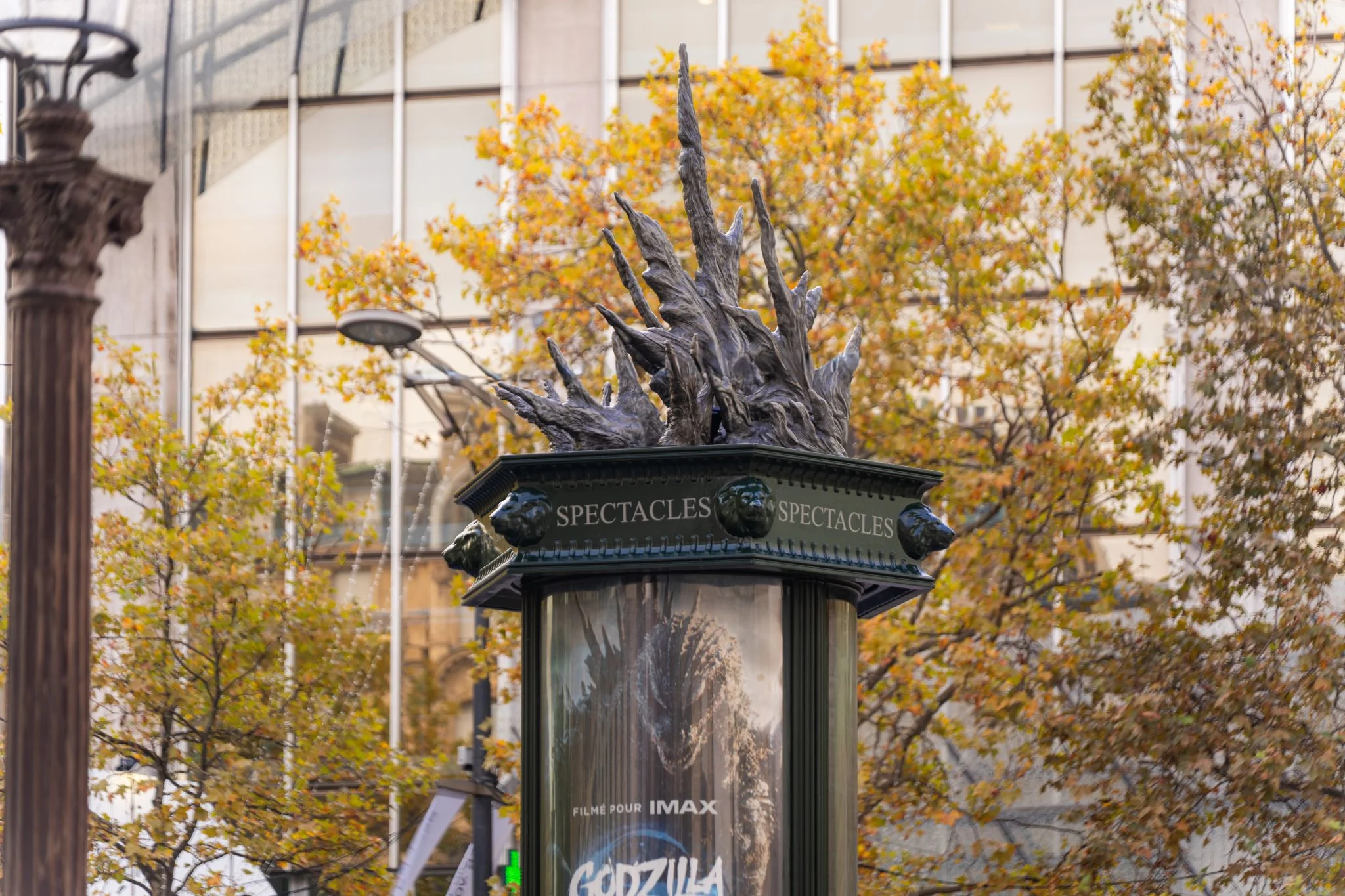
The most striking part of the installation is its contrast between day and night. During the day, the sculpted spikes create a rugged three-dimensional silhouette above the historic column. At night, the same forms glow in electric blue, referencing Godzilla’s instantly recognisable atomic breath.
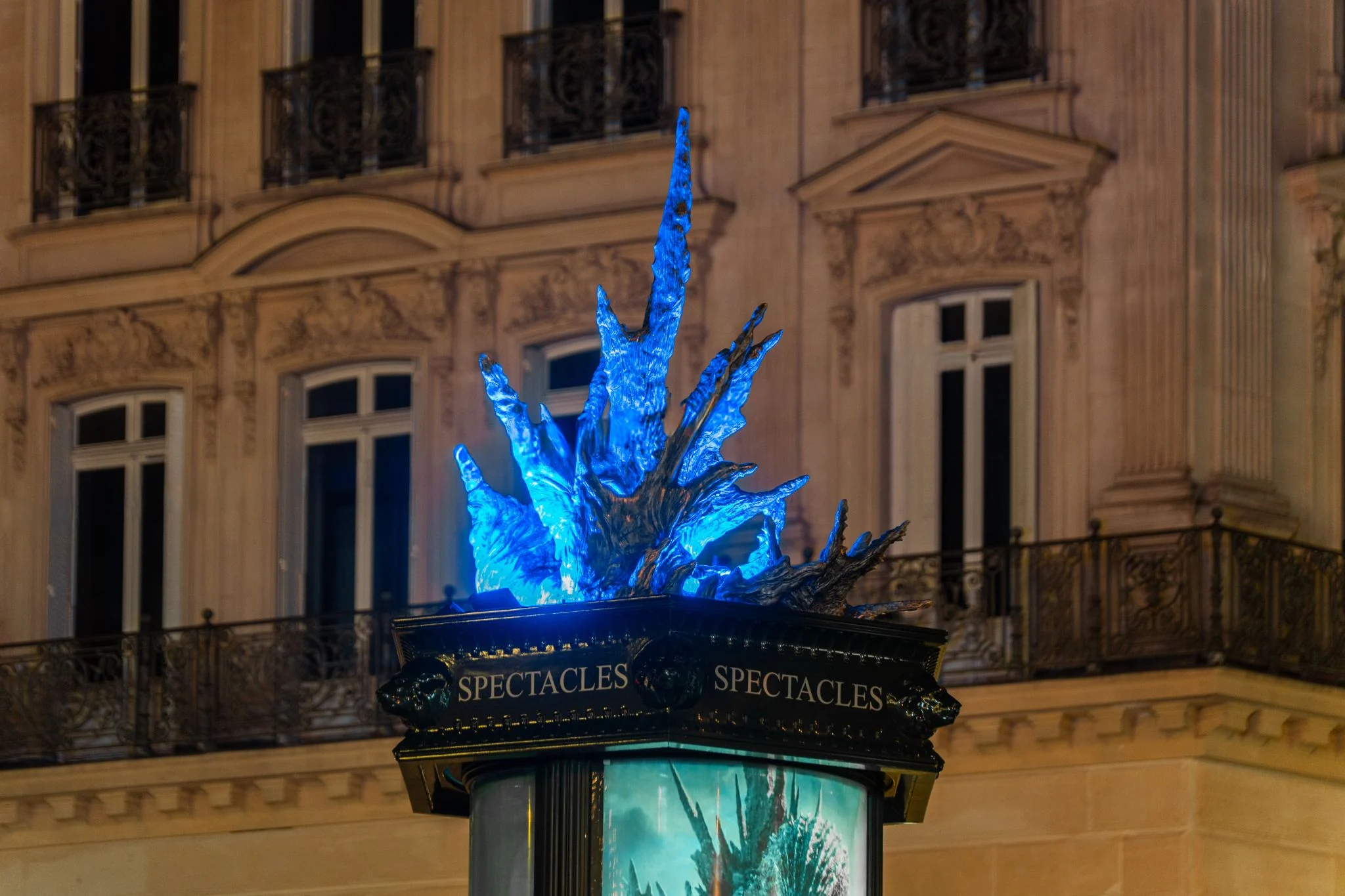
That lighting choice is more than a visual flourish. It gives the OOH Campaign a second creative expression after sunset without changing the underlying message. A relatively contained physical footprint becomes a much bigger landmark through shape, colour and illumination.
This echoes the logic behind other dimensional builds covered by Atlas OOH, such as Dolmio’s 3D billboard in Shepherd’s Bush, where a familiar advertising character also extends beyond the standard media surface.
Why Historic Street Furniture Advertising Works for a Modern Kaiju Film
Parisian Morris columns are traditionally used for cultural posters and entertainment announcements. That makes them a particularly appropriate host for a theatrical release: the format already belongs to the city’s visual language of cinema, performance and public culture.
Rather than overpowering that heritage, the Godzilla activation uses it. The cylindrical movie poster remains legible at pedestrian level, while the rooftop element introduces an unexpected, unmistakably monster-sized silhouette above the street.
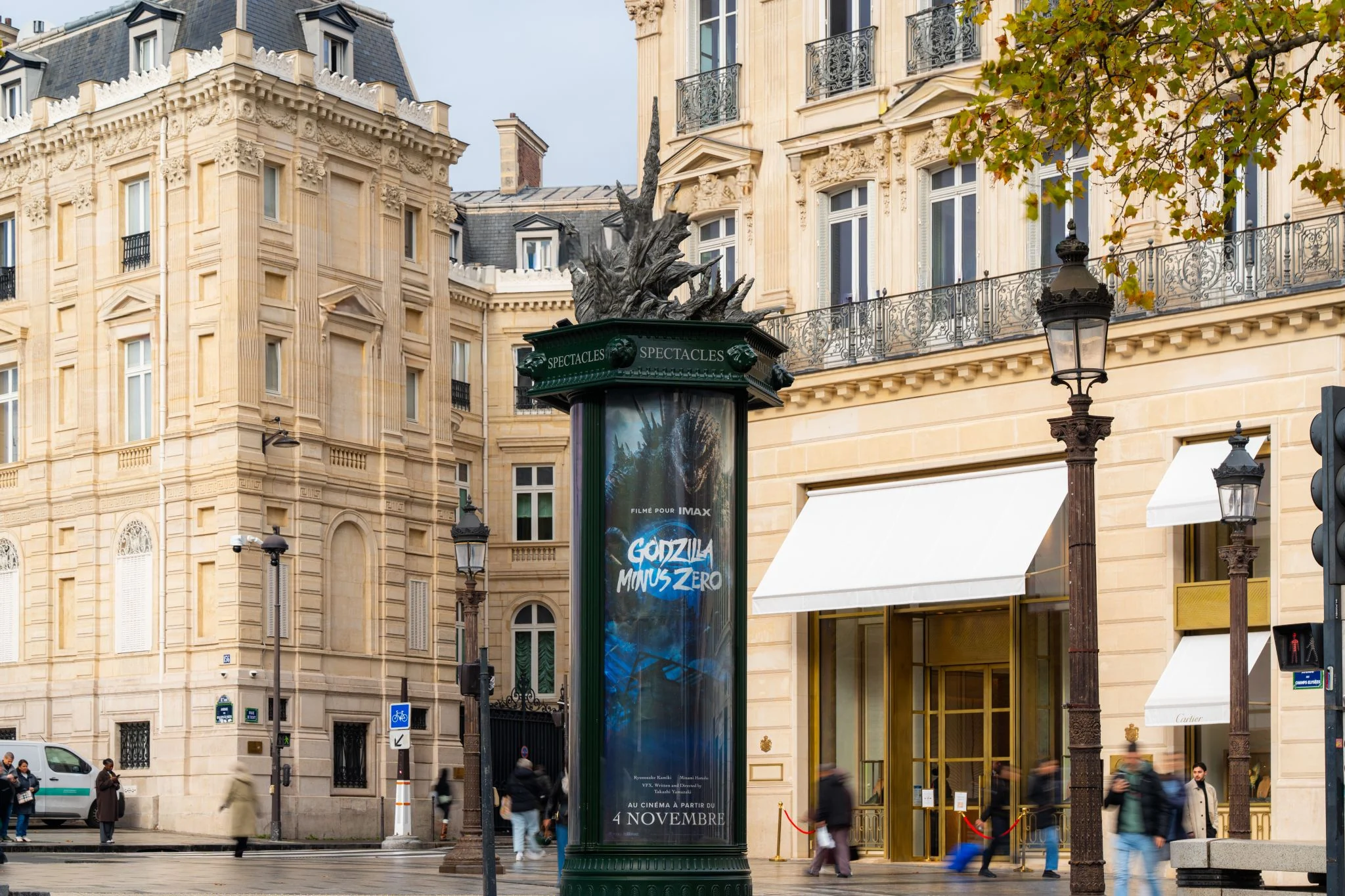
For entertainment marketers, the placement illustrates a useful principle: contextual OOH does not always require a brand-new media structure. Sometimes it requires finding a distinctive way to work with a familiar one. Explore creative street-furniture and special-build media planning with Atlas OOH.
Experiential OOH Makes the Fictional World Feel Physically Present
The campaign’s theatrical value comes from making an impossible creature feel surprisingly close. Passersby encounter a small physical fragment of Godzilla’s world embedded within an ordinary Paris streetscape. The monster does not need to appear in full: its dorsal plates are enough to create recognition and tension.
This type of Experiential OOH is especially suited to movie marketing because audiences are already primed to recognise character signatures, props and effects. The advertising device can communicate the mood of a story before anyone watches the trailer.
For another example of entertainment concepts extending into physical public space, see Atlas OOH’s coverage of Spider-Man’s fan activation at Circular Quay. A different execution, but the same larger ambition: invite audiences to experience the entertainment property outside the screen.
JCDecaux Live Shows the Power of Special-Build OOH Marketing
The Paris installation was executed by JCDecaux Live, the company’s unit dedicated to special out-of-home activations. Its design changes the upper portion of the Morris column while preserving the poster display below, creating a strong relationship between an established media asset and a new sculptural element.
In the official announcement, JCDecaux Live and Artvertising development director Pierre-Henri Bachot emphasised the ability to transform urban furniture into a genuine set for brands. The company described creativity, viral potential and street-level impact as goals of the activation. These are statements of intent, not independently measured audience-performance results.
Special-build OOH Advertising can help deliver that ambition when the physical extension grows directly from the campaign idea. Here, the spines do not feel like a decorative add-on. They are the visual shorthand for Godzilla itself.
What This Godzilla OOH Campaign Teaches Entertainment Brands
- Make the media part of the story: the Morris column’s rooftop becomes the monster’s silhouette.
- Choose one unmistakable symbol: dorsal spines establish recognition without a full creature sculpture.
- Design for multiple dayparts: the daytime special build transforms into a blue-lit nighttime landmark.
- Use the location’s existing identity: a heritage poster column is a natural setting for a cinema launch.
- Connect hero placements with a wider campaign: the signature installation was supported by other Morris-column placements in Paris.
It is also a useful comparison with Other Mommy’s crying horror billboard in London and Netflix’s multifaceted Lupin Part 4 OOH campaign. Each brings a narrative motif into a real-world advertising format in a different way.
Atlas OOH: Make Your Next Campaign Unmissable
Godzilla Minus Zero demonstrates the value of building Creative OOH around one defining visual asset. The audience can understand the idea from the other side of the street, while people who get closer discover the film artwork and construction details.
For brands planning entertainment launches, premieres or major cultural moments, Atlas OOH can help align special builds, Street Furniture Advertising and location-led media planning around one clear creative idea.
Bottom line: A historic advertising column on the Champs-Élysées became a stage for the King of the Monsters. By combining dimensional construction, dramatic lighting and the familiarity of a Parisian cultural format, JCDecaux Live and Anime Limited created an OOH Campaign 2026 that feels like a piece of the film has escaped into the city.
Explore an Atlas OOH media plan for your next entertainment campaign.
Frequently Asked Questions
What is the Godzilla Minus Zero OOH campaign in Paris?
It is a special-build outdoor activation created by JCDecaux Live with Anime Limited that adds Godzilla-inspired 3D dorsal spines to a Morris advertising column on the Champs-Élysées.
Where was the Godzilla installation placed?
It appeared near the upper Avenue des Champs-Élysées in Paris, close to the Arc de Triomphe.
When did the campaign run?
The special installation and wider Morris-column campaign ran November 3–9, 2026, alongside the November 4 French theatrical release.
What makes the installation different at night?
Blue backlighting illuminates the sculptural dorsal spines, evoking Godzilla’s signature atomic breath.
Why does the campaign qualify as experiential OOH?
The installation physically transforms traditional outdoor street furniture into an element of the movie’s fictional world instead of simply adding a poster.
Sources
Plan your OOH campaign
Get recommendations for markets, formats and availability based on your campaign goals.
Request a media plan
Comments
Share your take. Keep it constructive and specific.