
When the Address Becomes the Creative Idea: Carrefour x Monopoly in Paris
Some outdoor campaigns use location well.
Others make location the idea.
This Carrefour Monopoly activation in Paris does the second.
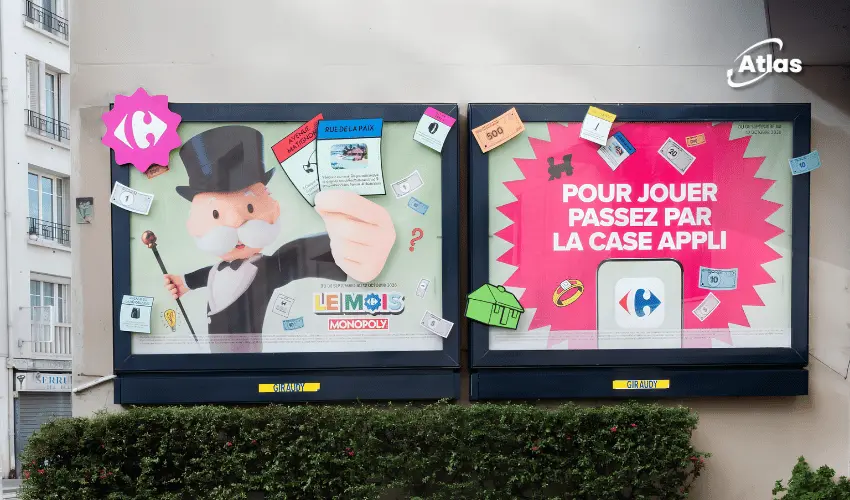
As part of Carrefour Monopoly Month, renewed for a second consecutive year, Giraudy deployed a special event-format installation from 8 to 14 September across four addresses that already carry weight inside the world of Monopoly: rue de Courcelles, rue Lecourbe, rue de Vaugirard and rue de Belleville.
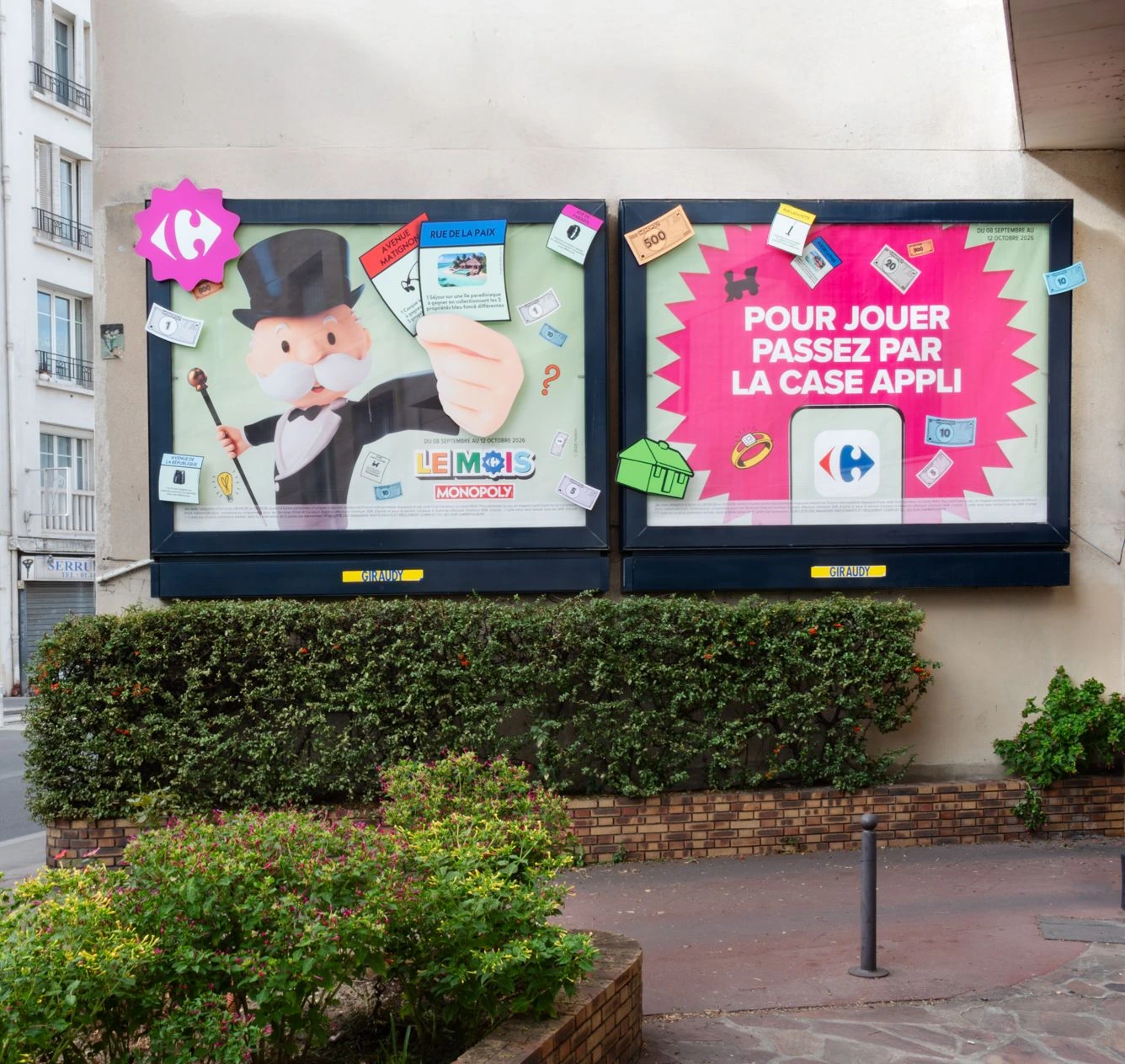
Across 9 privatized 8m² placements, tailor-made deformatting allowed Monsieur Monopoly and the game’s visual elements to escape the usual frame and take over the city in a way that felt playful, contextual and immediately legible.
Atlas OOH Can Turn Contextual Locations Into Part of the Creative Idea
The Carrefour x Monopoly activation shows how powerful OOH can become when the location is not just a media choice, but part of the message itself. Atlas OOH can help brands identify streets, neighborhoods, landmarks and high-value environments where the physical location strengthens the campaign concept instead of simply providing visibility.
If your brand has an idea that could become more relevant through location, start planning a contextual OOH campaign where the address, environment and creative work together as one experience.
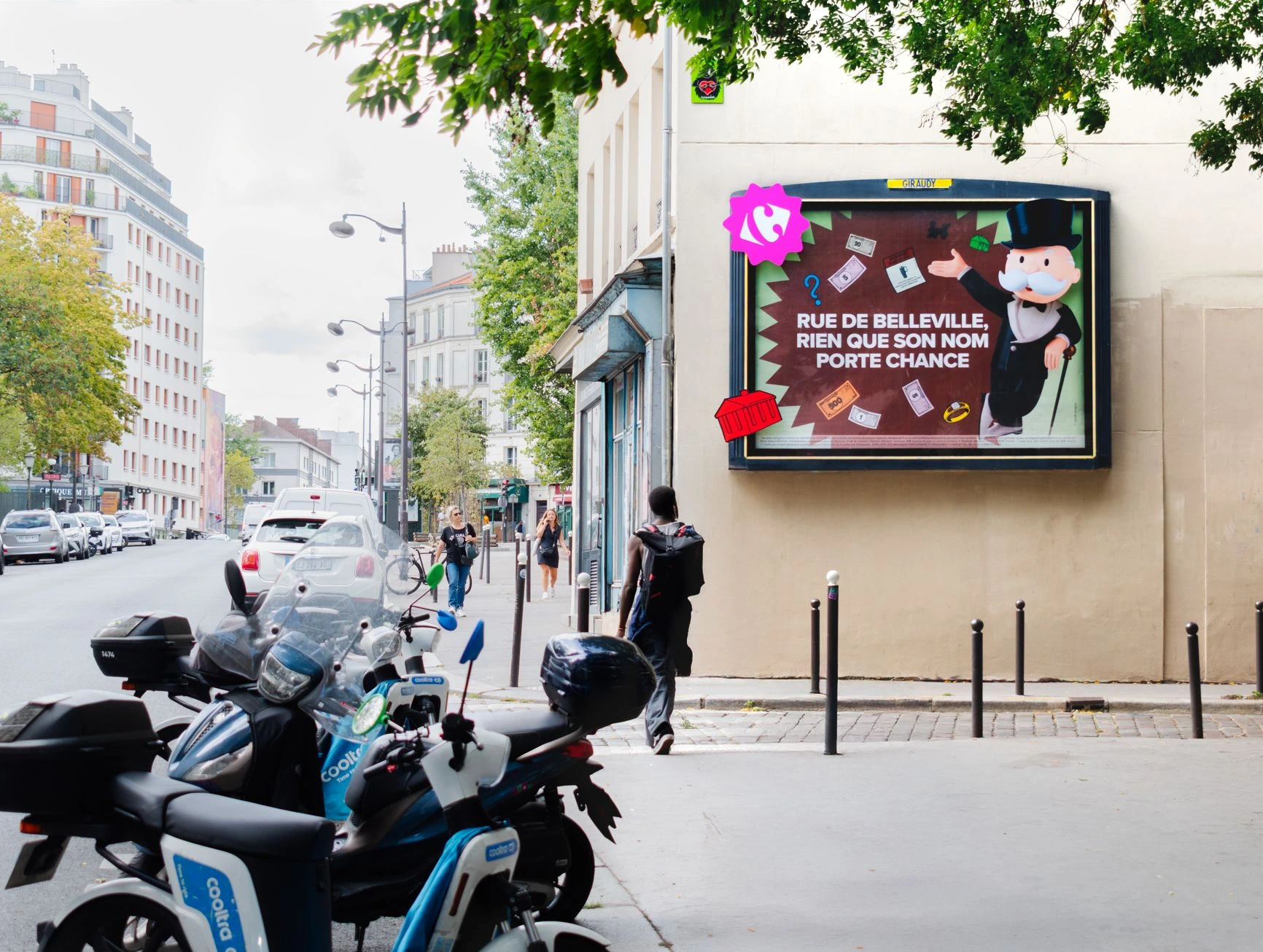
Rue de Belleville becomes part of the line
One of the campaign’s clearest examples appears on Rue de Belleville, where the copy reads: “Rue de Belleville, rien que son nom porte chance.”
The line works exceptionally well because it is tied directly to its physical location. Rather than deploying a generic, portable billboard, this location-based advertising strategy ensures the creative gains value from the exact address where it is seen.
That is the point.
The creative is not portable in the same way a generic billboard would be.
It gains value from the exact address where it is seen.
Rue de Courcelles continues the city-as-board idea
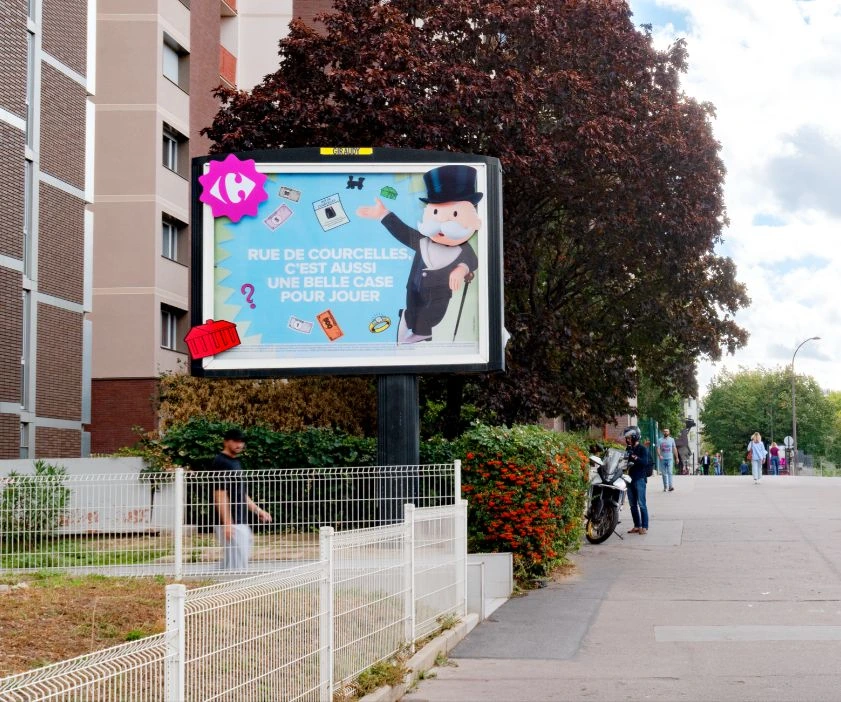
Another execution appears on Rue de Courcelles with the line: “Rue de Courcelles, c’est aussi une belle case pour jouer.”
Again, the street is not just where the media sits.
It is part of the script.
That creates a stronger mnemonic effect because the audience links the copy, the location and the campaign mechanic in one single mental image.
From outdoor media to a real urban game board
That is what makes the campaign especially interesting from an OOH perspective.
It does not simply decorate Paris with Monopoly branding.
It transforms the audience’s route through the city into a playful extension of the game itself.
The urban journey becomes a kind of board progression.
Every placement feels like another square in the experience.
Special Build deformatting helps the characters escape the frame
The supplied information notes that the campaign used custom deformatting so Monsieur Monopoly and the game’s iconography could break free from the standard format.
That decision matters because it reinforces the whole strategic story.
If the streets are leaving the board, the creative should also feel like it is leaving the frame.
The production choice mirrors the conceptual choice.
Atlas OOH Can Help Transform the City Into Part of Your Campaign
Carrefour and Monopoly demonstrate how a network of placements can turn an ordinary urban route into a connected brand experience. Atlas OOH can help brands develop multi-location campaigns across billboards, street furniture, DOOH and experiential formats that use each placement to extend the central creative idea.
Whether the objective is a contextual activation, a citywide rollout or a campaign built around specific landmarks, build an OOH strategy that makes every location feel intentional and connected to the story.
Why contextual Retail OOH & Experiential OOH are so effective here
Retail campaigns often rely on promotions, urgency and mass visibility.
This one still does that, but it adds a layer of cultural and geographic intelligence.
Because the addresses themselves are famous within Monopoly, the work feels tailored instead of generic.
And because Carrefour Monopoly Month is already a recognizable retail moment, the execution feels timely and ownable.
Atlas OOH can help brands turn location into a storytelling device
This campaign is a strong reminder that the best outdoor ideas do not always start with format. They often start with context. Atlas OOH helps brands build campaigns where streets, neighborhoods, landmarks and local behavior become part of the creative system rather than just media coordinates.
If your brand wants to create work that feels more specific, memorable and built for the place where it appears, Atlas OOH can help develop contextual billboards, street furniture and experiential activations designed around the logic of the location itself.
What brands can learn from Carrefour x Monopoly
- Let the location do narrative work.
- Use custom creative for each placement when context matters.
- Extend the idea beyond awareness into participation.
- Align the physical format with the conceptual story.
- Think of the city as a system, not just a collection of media faces.
Bottom line
Carrefour and Giraudy created a contextual OOH activation that makes perfect strategic use of place. By bringing Monopoly streets out of the game board and into the real city, the campaign transforms familiar Paris addresses into active parts of the creative idea.
It is playful.
It is site-specific.
And it shows exactly how outdoor media becomes more powerful when the placement is not just where the campaign appears, but why the idea works at all.
Frequently asked questions
What was the Carrefour Monopoly Paris OOH campaign?
It was a contextual outdoor activation created for Carrefour Monopoly Month, where Giraudy deployed tailor-made OOH formats across four iconic Monopoly street addresses in Paris.
When did the activation run?
According to the supplied information, the Paris activation ran from 8 to 14 September.
How many OOH placements were used?
The campaign used 9 privatized 8m² placements across the selected Monopoly-related locations in Paris.
Why does the campaign stand out?
It turns the address itself into part of the creative idea, using real Monopoly street names as contextual media placements so the city becomes part of the game narrative.
Sources
- Grand jeu Le Mois Monopoly - Carrefour France
Plan your OOH campaign
Get recommendations for markets, formats and availability based on your campaign goals.
Request a media plan
Comments
Share your take. Keep it constructive and specific.