
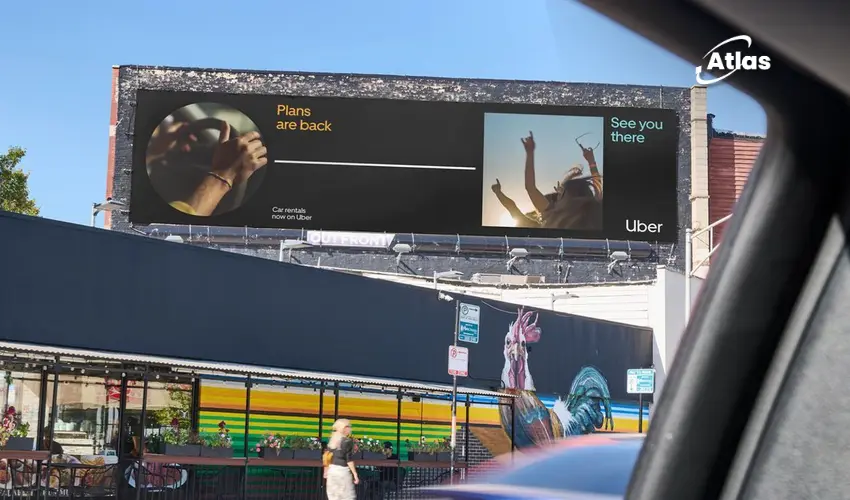
Searching for outdoor advertising companies usually means the buyer is past basic curiosity. They may need billboards, transit media, airport placements, digital out-of-home, street furniture, or a multi-city campaign, but they are not always sure who to trust or how to compare proposals.
That uncertainty is reasonable. The OOH market includes media owners, local billboard companies, national operators, specialist agencies, programmatic platforms, production vendors, and buying partners. Each can be useful, but they do different jobs.
Atlas OOH sits in the buying and planning layer: helping advertisers compare options, markets, formats, pricing logic, availability, and measurement before budget is committed. This guide explains how to evaluate any OOH partner with the same discipline.
For category-specific planning, see the Atlas guide to financial services and fintech OOH advertising.
Start With the Job You Need Done
Before comparing companies, define the campaign job. A single premium board near a store opening is different from a national launch, a conference takeover, a political advocacy buy, a multi-city recruitment push, or a programmatic DOOH test.
If the job is simple and you already know the exact unit, direct buying from a media owner may be enough. If the job requires comparing cities, vendors, formats, pricing, creative specs, and measurement, a buying partner is usually more useful.
Comparison Table
| Evaluation area | What to ask | Why it matters |
|---|---|---|
| Inventory access | Do you represent one owner or compare multiple owners? | Single-owner access can limit options; multi-owner planning helps find the right fit. |
| Market strategy | Why these cities, corridors, and formats? | A strong plan should be tied to audience movement, not just available boards. |
| Pricing transparency | What is media, production, installation, or tech fee? | Clear cost structure prevents surprises after the proposal. |
| Creative support | Will creative be resized, reviewed, or adapted by format? | OOH creative fails when specs and reading distance are ignored. |
| Proof and reporting | What proof of posting and delivery will I receive? | Verification is the baseline before any outcome analysis. |
| Measurement | Which KPI will the campaign influence? | Awareness, traffic, leads, and sales need different measurement plans. |
Media Owner vs OOH Agency vs Buying Platform
A media owner controls specific inventory. That can be excellent when the owner has the right locations for your objective. The limitation is that the proposal naturally favors what they own.
An OOH agency or buying partner can compare across owners and formats. That matters when you need to know whether billboards, transit, airport, street furniture, digital screens, or a mixed plan will work better for your objective.
Programmatic platforms add automation and flexible screen buying. They are useful for dynamic, timed, and testable campaigns, but they still need planning discipline. For background, see how programmatic DOOH works.
Red Flags in an OOH Proposal
- No reason for the market choice. If the plan cannot explain why a city or corridor matters, it is just inventory.
- One blended number with no cost logic. You should understand media, production, timing, and any separate fees.
- No proof of posting plan. Delivery verification is not optional.
- Creative treated as an afterthought. Specs, distance, motion, and dwell time shape performance.
- Measurement promised before delivery is verified. Start with proof, then layer outcomes.
How to Build a Better Brief
A good OOH company can help refine the brief, but the advertiser should bring the basics: objective, markets, timing, audience, budget range, creative constraints, and the action you want people to take.
If you are not sure what to include, use the Atlas guide to building an OOH campaign brief for pricing and availability. A clearer brief leads to better inventory comparisons and fewer generic proposals.
Where Atlas Fits
Atlas OOH is strongest when a brand needs to compare options across markets or formats. For example, a buyer might need Los Angeles billboards, New York billboards, Austin billboards, or a mixed plan that combines static, digital, airport, and transit media.
For cost context, review billboard costs in 2026. For measurement order, use privacy-first DOOH measurement.
Plan your OOH campaign
Get recommendations for markets, formats and availability based on your campaign goals.
Request a media plan
Comments
Share your take. Keep it constructive and specific.