
Quick answer: Houston billboard advertising works best when the plan connects locations to audience movement. Start with the campaign objective, then choose corridors, neighborhoods, formats, creative, timing, and measurement. Do not buy a board only because it is available; buy it because it supports the business goal.
Search demand around Houston billboards shows buyer intent: people are not only learning what OOH is, they are looking for options in a specific market. That makes Houston a useful topic for brands comparing local, regional, and multi-market outdoor advertising.
How to Plan Houston Billboard Advertising
Houston is a large, spread-out market. A good OOH plan should account for where the audience actually moves: commuter corridors, employment centers, retail zones, entertainment districts, neighborhoods, event areas, and routes that matter to the product or service.
The best first step is a brief. Define what the campaign should do: awareness, store visits, leads, hiring, event attendance, app installs, search demand, or market entry. If the objective is unclear, inventory comparisons become guesswork.
Planning Table
| Campaign goal | Houston planning focus | Format fit | Measurement signal |
|---|---|---|---|
| Retail or restaurant traffic | Trade areas, nearby corridors, shopping zones | Static or digital billboards near decision routes | Store visits, promo activity, local search |
| B2B visibility | Business districts, airport routes, conference areas | Premium bulletins, digital screens, airport media | Direct traffic, branded search, lead volume |
| Recruiting | Commuter paths and employment clusters | Billboards, transit, mobile OOH | Applications, careers page visits, QR or short URL activity |
| Event promotion | Venue approaches, nightlife zones, hotel corridors | Digital billboards and mobile billboards | Ticket visits, RSVPs, branded search |
| Market launch | Priority neighborhoods and citywide coverage | Mixed static, digital, and mobile OOH | Search lift, site traffic, leads by geography |
Static, Digital, and Mobile Options
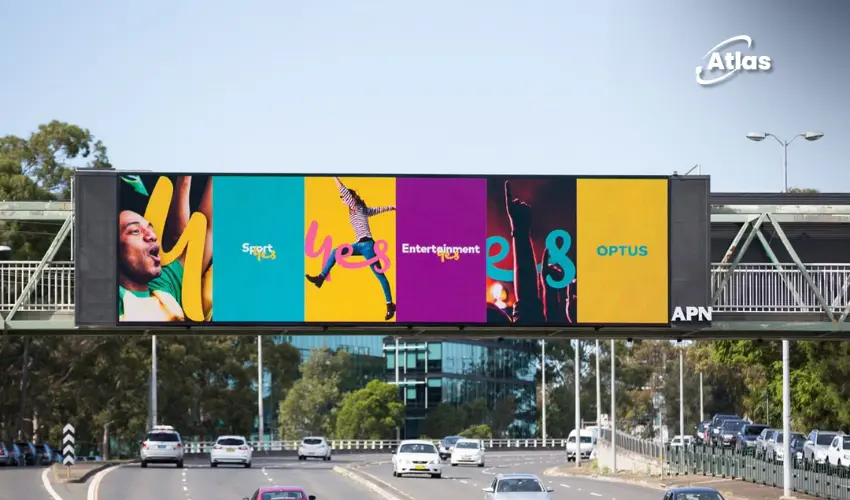
Static billboards are useful when the campaign needs consistent presence in one place. Digital billboards are useful when the message needs to change by time, offer, event, or campaign phase. For more detail, read the Atlas digital billboard advertising guide.
Mobile billboards can help when routes and timing matter more than fixed placement. They can support store openings, event activity, recruiting, and local launches. The Atlas mobile billboard advertising guide explains when that format fits.
Pricing Logic
Houston billboard pricing depends on location quality, visibility, traffic pattern, format, campaign length, demand, production, installation, and share of voice. Digital campaigns may also depend on loop structure, dayparting, and whether the buy is guaranteed or programmatic.
Use price as one input, not the entire decision. A lower-cost board can be inefficient if it misses the audience or cannot support the creative. For broader pricing context, use Atlas on billboard costs in 2026.
Creative Rules for Houston Billboards
- Lead with one idea. Drivers and passengers do not have time for dense copy.
- Use strong contrast. Houston weather, light, and distance can punish low-contrast designs.
- Match CTA to context. Use short URLs or memorable search phrases for road environments.
- Localize only when it helps. Neighborhood or location cues should make the ad more useful, not cluttered.
- Design for the exact format. Static, digital, and mobile placements need different creative discipline.
Where Atlas Fits
Atlas can help compare Houston billboard options with other formats and markets. The goal is not just to buy space; it is to build a plan that explains why each placement, date, and creative belongs in the campaign.
If you are comparing vendors, inventory, or proposals, use the Atlas guide to outdoor advertising companies before committing budget.
Plan your OOH campaign
Get recommendations for markets, formats and availability based on your campaign goals.
Request a media plan
Comments
Share your take. Keep it constructive and specific.