
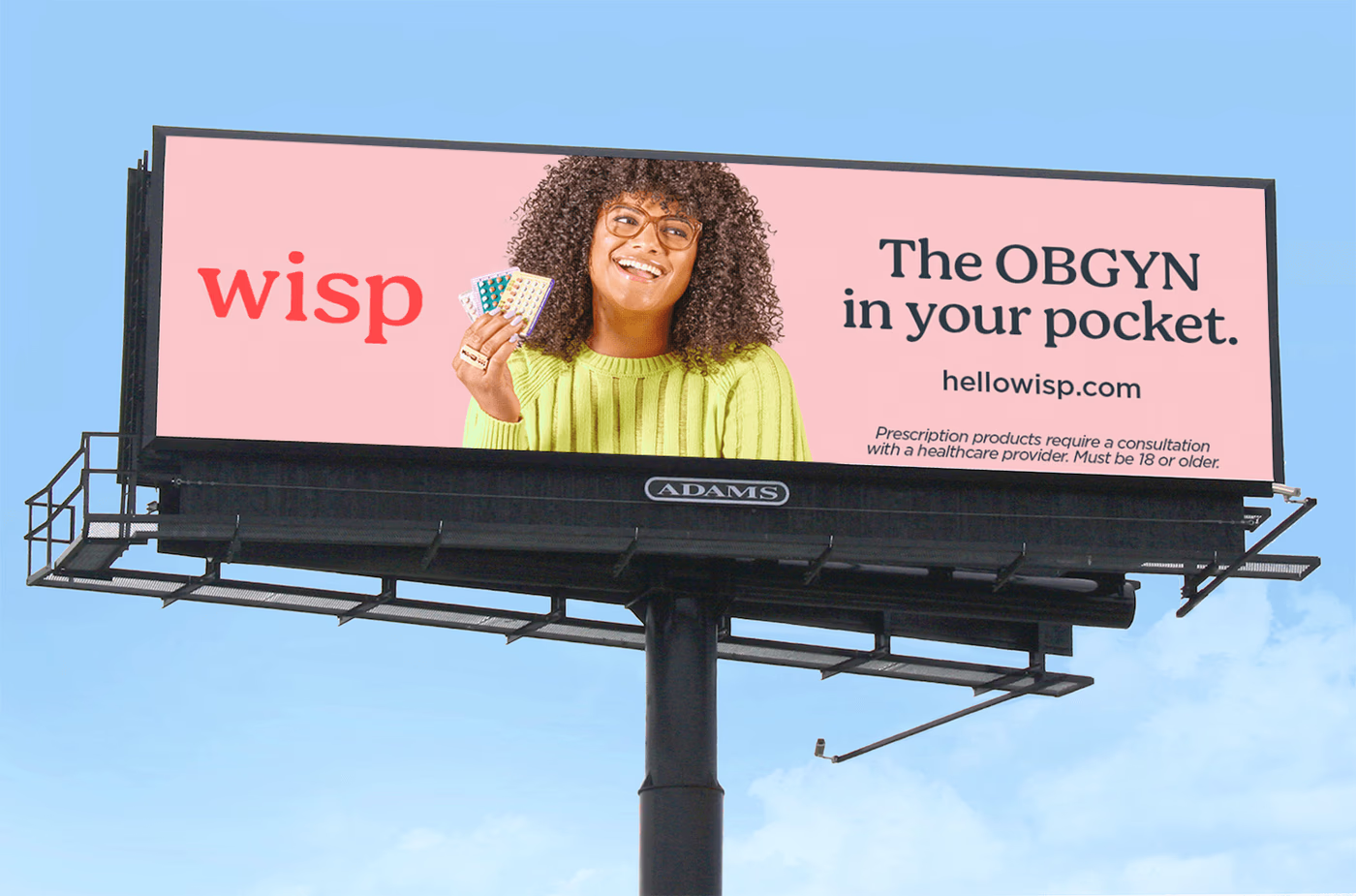
Wisp's pDOOH Case Study: Turning Reach Into Brand Preference Lift
Quick answer: Broadsign published a case study describing Wisp’s brand preference lift using programmatic DOOH.
In 2026, OOH/DOOH is being purchased with a different mindset than “pre-digital” OOH: buyers want certainty, workflow speed, and proof. That’s why the industry is leaning into packaged products (like creator-led DOOH), cleaner standards (like venue taxonomy), and buy types that feel more predictable (like Programmatic Guaranteed).
If you’re responsible for planning, the value of this isn’t theoretical. It changes how you write briefs, how you sequence markets, and how you defend budgets when a client asks, “What will we get for this?”
What the case study claims
Think of this as a “unit you can buy repeatedly.” Instead of assembling a campaign from separate pieces (inventory, production, amplification, reporting), the offer or update creates a clearer bundle and removes ambiguity in what’s included.
The simplest way to explain it internally is to define four lines: Inputs (creative + targeting), Distribution (where/when it runs), Deliverables (what assets or proofs you receive), and Outcomes (which KPI is the headline).
Why pDOOH helped
This scales because it reduces what planners hate most: launch friction. Every extra handoff (creative resizing, approvals, trafficking, rights management, reporting) increases time and failure risk. Products that remove steps win budgets.
The three pressures driving the shift
- Speed: brands need multi-market activations fast, not “in six weeks.”
- Control: frequency, adjacency, and delivery certainty matter more during tentpole moments.
- Accountability: clients want clean proof-of-play plus lift signals that connect to outcomes.
Net: OOH/DOOH keeps its advantage—public attention—but adopts the operational discipline buyers expect from modern media.
Playbook to replicate
A strong brief is specific without being brittle. It tells partners what success looks like, but leaves room for inventory experts to recommend the right corridor mix. Use this structure:
- Objective: awareness, preference, visitation, sign-ups, app installs, etc.
- Audience moment: commute, shopping, airport dwell, nightlife, sports/event, campus, office district.
- Environment rules: venue types + corridors + proximity to action (stores, venues, highways, transit hubs).
- Creative rules: one message, legible at speed, with format-specific variants.
- Measurement: one primary KPI + supporting signals + reporting cadence.
Key points to copy into your brief
- Why pDOOH helps: scale + speed + contextual placements
- What to copy: creative variants + market sequencing + frequency discipline
Practical examples of how planners are using this
If you want to turn this into a “real” plan, the best move is to decide the campaign sequence first (where it starts, where it expands, what it repeats). Here are three field-ready patterns:
- Awareness sprint: cluster placements in the same corridors so the campaign feels ‘everywhere’ (not scattered).
- Contextual relevance: match creative to the place (airports, retail, nightlife) so recall improves.
- Measurement discipline: pick one primary KPI and keep everything else as supporting evidence.
These patterns work because they treat DOOH as the attention trigger and then use a secondary layer (search, creators, social, retail media) as the multiplier and the capture.
Measurement plan: what to track first (and what to ignore)
Measurement fails when the plan has too many “maybe” goals. Decide the KPI hierarchy up front: one primary metric you’re willing to defend, and everything else as supporting evidence.
Recommended KPI hierarchy
- Primary: one of (incremental reach, brand search lift, visitation lift, sign-ups).
- Secondary: frequency/pacing, corridor coverage, daypart performance, creative variant performance.
- Context: weather, events, seasonality, competitive clutter (useful for interpretation, not excuses).
Common mistakes (and how to avoid them)
- Over-scatter: random single placements look like “we tried OOH.” Cluster corridors so it feels present.
- Over-copy: DOOH isn’t a banner ad. Fewer words, stronger idea, higher recall.
- No ownership: if the message could belong to any brand, it won’t stick. Own one thing.
- Measuring everything: pick a primary KPI; otherwise reporting becomes noise.
- No follow-through: if DOOH drives search, protect that demand with paid search and a fast landing page.
Execution checklist (copy/paste)
- Objective: what must change and how you’ll know.
- Markets: priority metros + expansion metros + “always-on” sustain.
- Inventory logic: venue types + corridors + dayparts (avoid random scatter).
- Creative system: one core message + variants for each format.
- Measurement: primary KPI + 2 supporting signals + reporting cadence.
- Amplification: creator/social/search layer with clear rights and windows.
Plan your OOH campaign
Get recommendations for markets, formats and availability based on your campaign goals.
Request a media plan
Comments
Share your take. Keep it constructive and specific.