
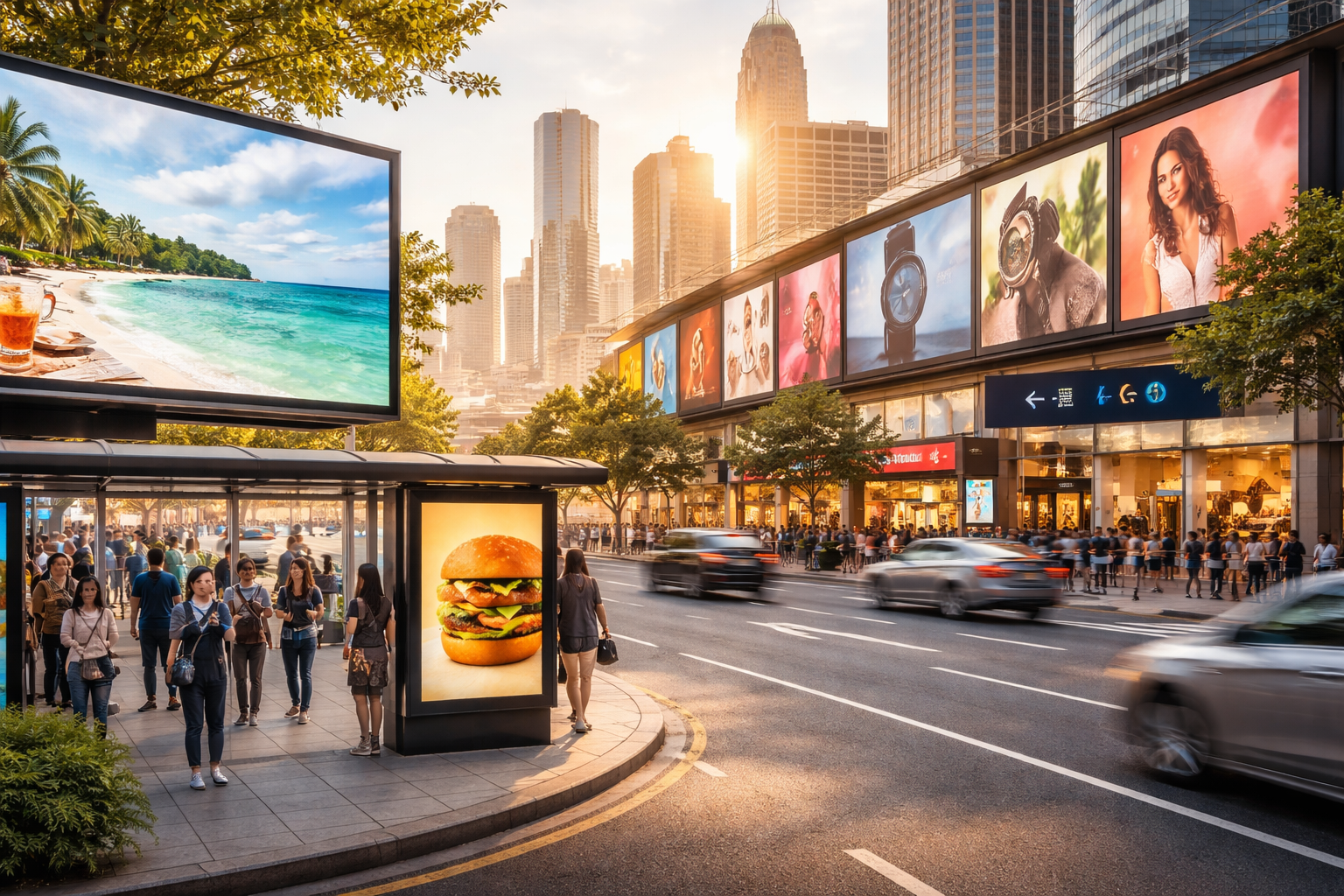
Quick answer: The best OOH plan starts with the environment: commuter corridors, retail clusters, transit dwell, airports, downtown foot traffic, and neighborhood microzones. This checklist helps you choose locations that match your objective—city by city.
OOH isn’t one channel—it’s a collection of environments
“OOH” can mean highways, sidewalks, stores, terminals, platforms, and neighborhoods—all with different attention patterns. If you choose the wrong environment, even great creative gets wasted. If you choose the right one, even simple creative performs because it shows up in the right moment, in the right routine.
Step 1: Start with the objective
Brand awareness
Prioritize reach + repetition on commuter routes. You’re buying memory through routine exposure.
Local demand
Go hyperlocal: units near retail clusters, neighborhood arteries, and “everyday errand” corridors.
Performance outcomes
Focus on dwell-time environments that support prompts (short URLs, app cues, offers, store-direction messaging).
Event launches
Build around surges: stadium zones, entertainment districts, airports, hotels, and arrival corridors.
Step 2: Pick the environment that fits
These six environments consistently perform across major U.S. cities because they align with repeat behavior and decision timing:
1) Commuter corridors (high repetition)
Best for reach and memory. People see you repeatedly, which turns exposure into familiarity.
2) Retail clusters (near purchase decisions)
Works when your goal is consideration and conversion proximity—especially around grocery, big-box, and dense shopping areas.
3) Transit dwell (stops, platforms, shelters)
A natural home for prompts because people are waiting. Great for QR/short links, app pushes, and sequential messaging.
4) Airports (premium attention + spend power)
Long dwell windows, premium audiences, and strong brand impact—especially for travel, finance, luxury, tech, and CPG launches.
5) Downtown pedestrian zones (shareability + foot traffic)
Where talkability lives. These areas reward bold creative and can generate earned media because the audience is already social.
6) Neighborhood microzones (hyperlocal relevance)
Think neighborhood-by-neighborhood planning: localized messaging, local routines, and micro-market reinforcement that feels “in culture.”
Step 3: Build a “coverage map,” not a list of units
The best city plans behave like a system—not a random bundle of boards:
- Corridor dominance + neighborhood reinforcement
- Arrival points (where people enter) + decision points (where people choose)
- Repeated exposures across a weekly routine (commute + errands + weekend patterns)
Step 4: Copy-paste checklist for every city plan
- Who is the audience and what route do they repeat weekly?
- Is this a speed environment or a dwell environment?
- Do we need dominance (roadblock) or precision (hyperlocal)?
- What’s the one thing they must remember after one glance?
- What action do we expect: search, visit, install, buy?
- Are we measuring lift with a control market or control zones?
- Is creative built for distance, glare, and motion?
Plan your OOH campaign
Get recommendations for markets, formats and availability based on your campaign goals.
Request a media plan
Comments
Share your take. Keep it constructive and specific.