
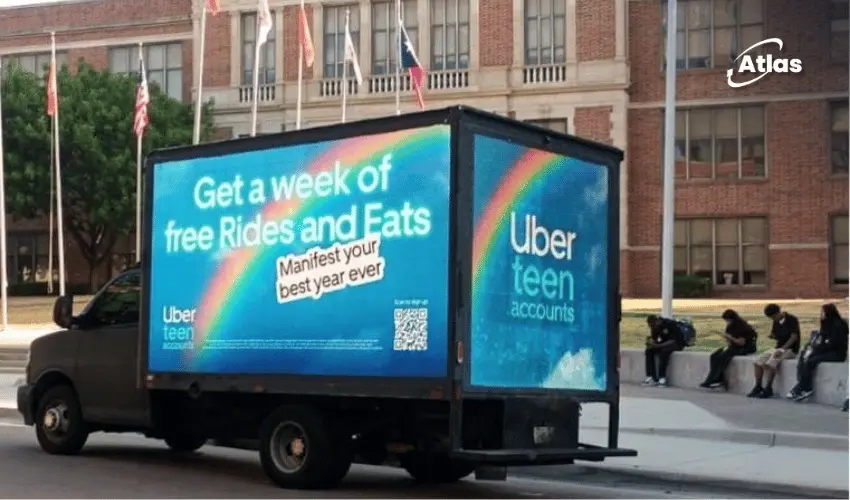
Uber Teen Takes Back-to-School Free Rides and Eats to the Streets
Back-to-school season is not one single moment.
Some students are already in class.
Others are preparing to return after Labor Day.
Families are reorganizing schedules, transportation and everyday routines.
Uber Teen is using that transition as both the offer and the media opportunity.
A useful offer tied to a real seasonal need
The campaign celebrates students with a week of free rides and eats.
That gives the promotion an immediate functional role.
Transportation and food are already closely connected with the return to school, after-school activities and changing family schedules.

Why the streets matter for Uber Teen
Uber is fundamentally connected with movement.
That makes outdoor media particularly relevant.
The campaign does not need to create an artificial relationship between product and environment.
People see Uber Teen while they are already traveling through the city.
The medium reflects the service.
LED trucks make the promotion mobile
To spread the message, LED trucks are rolling through several cities.
This changes the media strategy from a fixed point to a moving network.
The campaign can travel through different neighborhoods, student corridors and high-traffic areas instead of asking audiences to pass one specific billboard.
The media can follow the audience
A traditional billboard is powerful when the right audience passes the right location.
A mobile LED unit adds another option:
Take the media toward the audience.
That can be useful around:
- School corridors.
- Shopping districts.
- Transit areas.
- Family-oriented neighborhoods.
- Back-to-school retail zones.
Back-to-school behavior happens across the city
The seasonal audience is fragmented.
Students are not only at school.
They are moving between home, stores, restaurants, activities and social plans.
Mobile OOH can reflect that reality more naturally than a campaign concentrated around one destination.
Digital screens add flexibility
LED trucks also give Uber Teen the advantages of digital creative.
Messages can be updated, rotated or adapted according to location and timing.
That gives the campaign room to emphasize different parts of the offer without changing the media unit itself.
Free rides and free eats create two entry points
The campaign is also broader than transportation alone.
Rides and eats address two different parts of the student routine.
One supports getting somewhere.
The other supports what happens around the journey.
This gives Uber Teen more than one reason to participate in the back-to-school conversation.

A promotion can also build the category
For families unfamiliar with Uber Teen, the free week can do more than generate short-term usage.
It can introduce the service itself.
The promotion lowers the barrier to trial while the OOH creates public awareness.
That relationship is important:
- OOH creates recognition.
- The offer creates a reason to try.
- The experience can create future familiarity.
The trucks turn a digital product into something physical
Uber Teen primarily exists inside an app.
That means the service itself has limited physical visibility.
LED trucks give the brand a real-world presence.
The screens make the offer feel like part of the city rather than something users encounter only after opening Uber.
Movement creates more chances for social discovery
A bright LED truck also has a natural social dimension.
Unlike a conventional static poster, the unit can unexpectedly appear in different places throughout the day.
That surprise can make the campaign more photographable and more likely to appear in local social content.
Why the campaign does not need complicated storytelling
The offer is already strong.
Free rides.
Free eats.
Back to school.
That means the OOH should prioritize immediate comprehension instead of adding unnecessary complexity.
Large type, clear Uber Teen branding and a simple CTA can do most of the work.
Timing gives the campaign urgency
The campaign is built around a limited seasonal window.
That makes the week-long offer feel timely rather than permanent.
Students and families have a reason to notice and act while the back-to-school moment is still culturally active.

Mobile OOH can create city-by-city relevance
Because the trucks are not tied to one permanent location, different cities can receive different route strategies.
The same creative platform can therefore remain consistent while the media plan adapts to local behavior.
This is especially useful for a national service with very different urban environments.
Atlas OOH can help brands build this kind of moving campaign
Campaigns like this show how the strongest OOH plans do not always begin with a billboard location.
Sometimes they begin with a question:
Where will the audience actually be moving?
Atlas OOH can help brands plan mobile billboard and DOOH routes around audience behavior, seasonal moments, events and high-value corridors so the media moves with the opportunity rather than waiting for it.
Plan your OOH campaign
Get recommendations for markets, formats and availability based on your campaign goals.
Request a media plan
Comments
Share your take. Keep it constructive and specific.