
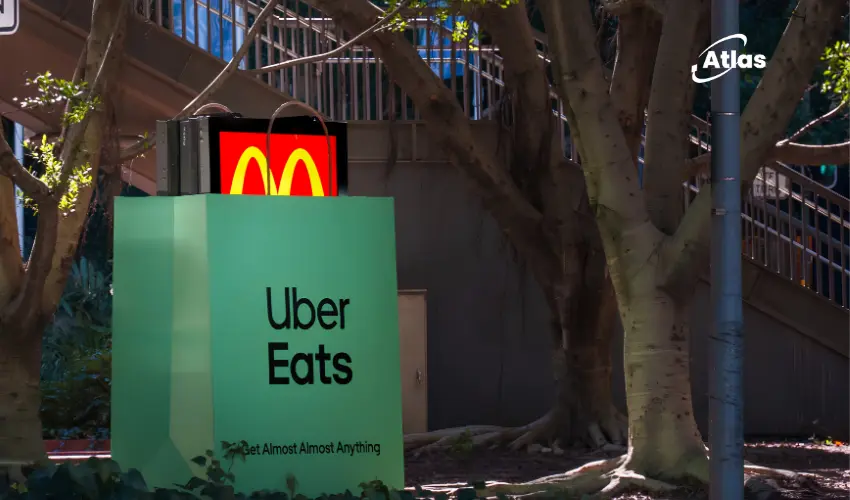
Uber Eats Turns Other Brands’ Billboards Into Its Own Outdoor Advertising
Some of the strongest outdoor campaigns don't create new visual assets.
They find new ways to use the ones audiences already recognize.
Uber Eats has spent years building familiarity around one of its most visible brand assets: the delivery bag.
Now, the company is using that asset in a clever outdoor campaign that transforms existing advertising into a demonstration of its expanding product offering.
Created by Special Australia in partnership with JCDecaux and EssenceMediacom, the campaign is part of the brand's ongoing "Get Almost, Almost Anything" platform.

Turning Existing Advertising Into Media
Rather than relying exclusively on standalone billboards, Uber Eats chose to interact directly with advertising already present in the urban landscape.
The campaign uses custom-built outdoor installations that appear to place Uber Eats delivery bags over products featured in other brands' advertisements.
The execution creates the impression that those products have already been packaged and prepared for delivery.
It's a simple visual intervention that completely changes how audiences interpret the original advertisement.
The Delivery Bag as a Brand Asset
The success of the campaign depends on the strength of Uber Eats' visual identity.
Consumers immediately recognize the delivery bag and associate it with convenience, speed, and accessibility.
Because the bag is already linked to the service experience, Uber Eats doesn't need lengthy explanations or product lists.
The visual cue does all the communication work.
As soon as audiences see the bag covering an advertised product, they understand the message: you can order that too.
Expanding Beyond Food Delivery
One of Uber Eats' biggest communication challenges is changing consumer perception.
Many people still associate the platform primarily with restaurant meals.
In reality, the service now includes groceries, convenience items, household essentials, and a growing range of retail products.
This campaign addresses that challenge by showing rather than telling.
Instead of listing categories, it demonstrates availability through products consumers are already seeing advertised throughout the city.
The Power of Simplicity
The creative idea works because it requires almost no explanation.
Audiences instantly understand the relationship between the bag and the product beneath it.
The execution turns a familiar brand asset into a flexible communication system capable of adapting to countless product categories.
That flexibility is particularly valuable for a platform whose offering continues to expand.
Making the City Part of the Campaign
One of the most interesting aspects of the activation is how it uses existing city infrastructure as part of the storytelling.
Every billboard becomes a potential Uber Eats message.
The campaign effectively reframes the urban environment, suggesting that nearly everything consumers encounter in daily life could be available through the app.
It's an approach that extends the brand's reach far beyond traditional media placements.
What Brands Can Learn
- Distinctive brand assets become more valuable over time.
- Simple visual ideas often outperform complex explanations.
- OOH can creatively interact with existing environments.
- Showing a benefit is often stronger than describing it.
Uber Eats demonstrates how a single visual element can become a powerful storytelling tool when used consistently and creatively.
Bottom Line
Uber Eats' latest Australian campaign shows the power of leveraging distinctive brand assets in outdoor advertising.
By placing its delivery bag over products advertised by other brands, the company communicates convenience, availability, and product variety in a way that feels immediate and intuitive.
It's a smart example of how outdoor advertising can transform an everyday brand symbol into the entire creative idea.
Plan your OOH campaign
Get recommendations for markets, formats and availability based on your campaign goals.
Request a media plan
Comments
Share your take. Keep it constructive and specific.