
Netflix Turns a Sunset Boulevard Billboard Into The Last House
Most entertainment stunts attract attention first and explain the movie afterward.
The Last House does not need that second step.
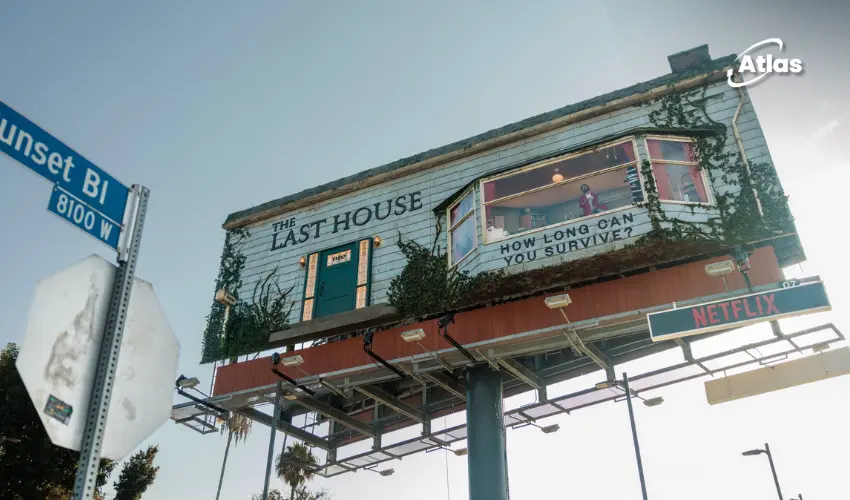
To promote the Netflix sci-fi thriller directed by Louis Leterrier and starring Greta Lee and Wagner Moura, the brand transformed a billboard above Sunset Boulevard into a functioning house.
Inside, a performer lived behind transparent windows, communicating with people below while appearing unable to leave.
If audiences understand the stunt, they already understand the basic premise of the movie.

When the stunt and the product are the same idea
The Last House follows a family that suddenly discovers they have been sealed inside their home with no way out.
The outdoor execution translates that premise almost literally.
A house sits inside a billboard.
A person is visible inside it.
He cannot simply walk away.
No detailed synopsis is required for the central tension to make sense.
A billboard becomes a functioning set
The installation moved far beyond conventional poster advertising.
The structure was designed as a vine-covered house with transparent windows and recognizable domestic details.
A live performer occupied the space from August 6 through August 8, turning the billboard into something between an advertisement, a theatrical set and a public performance.
The performer could be seen moving around the house and communicating with passersby using a whiteboard.
This detail gave the execution a stronger sense of reality.
The person inside was not simply part of a static image. He appeared to be genuinely inhabiting the strange situation audiences were seeing above Sunset Boulevard.
The medium communicates the premise
Many entertainment campaigns use spectacular formats that could promote almost any title.
A giant projection, elaborate installation or anamorphic screen may generate attention, but the audience often still needs another message explaining what the film is actually about.
The Last House avoids that disconnect.
The physical construction communicates the story:
- The house establishes the setting.
- The transparent windows allow audiences to observe the inhabitant.
- The trapped performer communicates confinement.
- The elevated billboard creates physical separation from the street.
The architecture is effectively the synopsis.
Why Sunset Boulevard amplifies the idea
Sunset Boulevard is already one of Los Angeles’ most recognizable entertainment advertising corridors.
Audiences expect to see movie posters, streaming campaigns and large-format creative there.
That expectation makes a functioning house even more disruptive.
Instead of another rectangular entertainment image, people encounter what appears to be an inhabited domestic space suspended above the street.
The risk: where is the title?
The creative strength of the stunt also creates its biggest weakness.
The image communicates the premise extremely well, but the concept itself does not automatically communicate the title The Last House.
Someone can understand that a person is trapped inside a house without necessarily knowing which movie the installation is promoting.
This creates a classic tension between attention and attribution.
A spectacular execution may become memorable while the brand or title behind it remains less memorable.

Attention is not the same as attribution
Entertainment marketing needs audiences to remember more than an unusual visual.
Ideally, they should connect that visual with the title they later encounter inside Netflix.
This means the stunt needs enough branding around the experience to complete the memory structure.
- Notice the impossible house.
- Understand that someone is trapped inside.
- Connect the situation with The Last House.
- Recognize the title again when browsing Netflix.
If the final two steps fail, the campaign may generate conversation without converting that attention into title recognition.
Why the lack of explanation can still be powerful
Despite that risk, the restraint also gives the campaign much of its impact.
The installation does not immediately tell audiences what to think.
People first notice something strange, investigate it and gradually understand the situation.
That process creates curiosity.
Rather than receiving a conventional promotional message, audiences discover the campaign through observation.
The experience therefore feels closer to encountering an event than viewing an advertisement.
Voyeurism becomes part of the experience
The transparent windows introduce another interesting layer.
People on the street can watch the inhabitant inside the house while remaining physically separated from him.
That creates an uncomfortable sense of voyeurism.
The audience is free to leave while the person inside appears trapped.
This reinforces the isolation at the center of the movie and gives viewers a small taste of the emotional tension without showing footage from the film.

Living billboards create real-time uncertainty
A performer introduces something prerecorded media cannot fully reproduce: uncertainty.
Audiences do not know exactly what the person inside will be doing when they pass the billboard.
He may be standing at a window, moving through the room or writing something on the whiteboard.
This makes separate encounters feel slightly different and can encourage people to stay longer than they would with a static placement.
It also increases the likelihood of filming and social sharing because the activation feels like something happening in real time.
OOH designed to become online content
Only a limited number of people can physically pass the Sunset Boulevard installation during its run.
But the unusual format gives it significant potential beyond the original location.
Photos and videos immediately communicate the basic visual idea: someone is living inside a billboard-sized house.
That makes the activation easy to redistribute through social media, entertainment coverage and fan conversation.
The billboard therefore performs two media roles:
- Physical OOH: creating surprise and spectacle for audiences in Los Angeles.
- Social content: giving online audiences an unusual image worth watching and discussing.

A physical expression of a streaming story
The Last House premiered on Netflix on August 7, 2026.
Like any streaming film, its final viewing experience exists primarily on screens inside people’s homes.
The campaign reverses that relationship.
It takes a story about being unable to leave the house and places that house outside, in one of Los Angeles’ most visible advertising environments.
A private domestic setting becomes public spectacle.
That contradiction gives the execution much of its character.
Plan your OOH campaign
Get recommendations for markets, formats and availability based on your campaign goals.
Request a media plan
Comments
Share your take. Keep it constructive and specific.