
A Dinosaur Claw Turns The End of Oak Street Poster Into a Special-Build OOH Moment
Some of the most effective special builds do not completely reinvent the billboard.
They change just one thing.
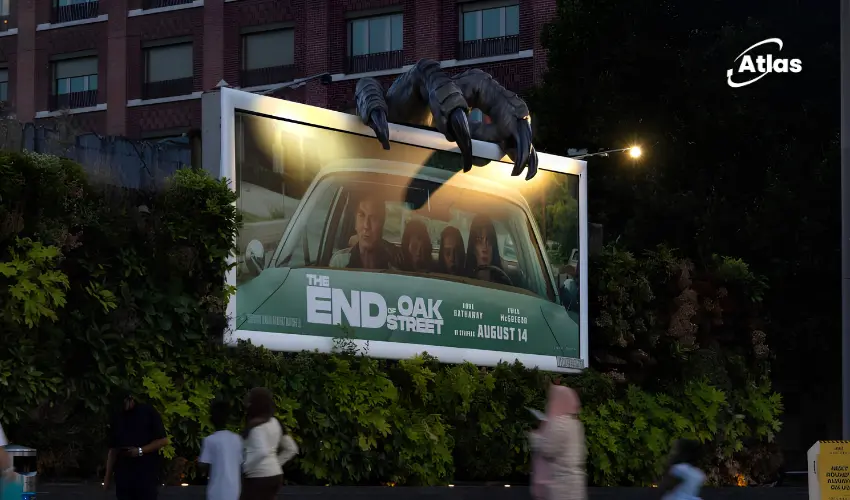
For Warner Bros. Entertainment’s The End of Oak Street, the campaign kept the original poster artwork at the center of the execution and introduced one unexpected physical element:
A dinosaur claw breaking into the top of the frame.
The result is simple, slightly strange and difficult to ignore once you notice it.
From AI mock-up to physical OOH
The idea reportedly began as an experimental AI-generated visual showing how the conventional poster might be disrupted by a three-dimensional claw.
That rough conceptual image eventually became a real special build produced through collaboration between the client and several specialist outdoor partners.
Ocean Outdoor UK, Mural Republic Ltd and PKS Ltd helped translate the visual idea from a screen into a physical advertising installation.

The poster remains the hero
One of the strongest decisions in the execution is what the campaign did not change.
The film artwork remains almost completely intact.
Instead of covering the poster with fabrication or creating an entirely separate experiential environment, the claw becomes a small intervention within an already recognizable advertising format.
This preserves the key campaign assets while creating a new visual hierarchy.
- Audiences first recognize a movie poster.
- Then they notice something unusual above it.
- The claw triggers a second look.
- That second look creates more time with the film artwork.
The power of the second look
The campaign is built around a small moment of visual discovery.
From a distance, the execution can initially appear like a conventional movie advertisement.
Then the physical claw becomes apparent.
That change in perception is important because OOH audiences are usually moving through environments filled with familiar commercial formats.
Something does not always need to be enormous or technically complex to disrupt that pattern.
Why curiosity matters outdoors
Outdoor advertising often has only a few seconds to earn attention.
Curiosity can extend that window.
When audiences spot something that does not seem to belong within a familiar billboard frame, they naturally try to understand what they are seeing.
The dinosaur claw creates exactly that behavior.
It changes the billboard from something immediately understood into something briefly unresolved.
That small moment of uncertainty encourages people to look again.
A physical interruption instead of a full takeover
Special builds are sometimes associated with enormous structural transformations.
This campaign demonstrates another approach.
The most important feature is not scale, but interruption.
The claw violates the expected boundary of the poster.
The creative effectively escapes its frame.
- The poster provides familiarity.
- The claw creates disruption.
- The combination creates surprise.
- The surprise encourages stronger recall.
This can be more efficient creatively because the campaign does not need to build an entirely new visual world around the film.

Why breaking the frame works
Billboards are defined by their rectangular boundaries.
Audiences understand almost instinctively where the advertisement is supposed to begin and end.
Special builds become visually interesting when they violate that expectation.
A physical object extending beyond the advertising surface makes the creative feel less like a printed image and more like something occupying real space.
For The End of Oak Street, the claw appears to come from somewhere beyond the poster itself.
That gives the execution a slightly unsettling quality without requiring complicated animation or technology.
The physical medium reinforces the film world
The claw is not an arbitrary decorative addition.
Its effectiveness depends on its relationship with the entertainment property being advertised.
A strange creature physically entering the poster helps audiences sense the tone and threat of the film before they know much about the plot.
The format therefore contributes to the storytelling.
Built for the street and the camera
Physical special builds have two audiences.
The first is the people who encounter the installation in person.
The second is everyone who sees photographs and videos of the execution afterward.
The claw is especially effective in this context because the idea remains understandable in a single image.
You do not need to experience the installation directly to understand why the billboard is unusual.
This gives the campaign additional value through social sharing, industry coverage and behind-the-scenes production content.
The collaboration behind the execution
Turning a simple visual concept into a safe, convincing physical structure requires multiple disciplines.
The media owner needs to understand the site.
Fabricators need to determine materials, weight, mounting and durability.
Creative and production teams need to ensure the physical object still works with the original poster composition.
The collaboration between Warner Bros. Entertainment, Ocean Outdoor UK, Mural Republic and PKS Ltd allowed the campaign to move from conceptual mock-up to real-world media.
Plan your OOH campaign
Get recommendations for markets, formats and availability based on your campaign goals.
Request a media plan
Comments
Share your take. Keep it constructive and specific.