
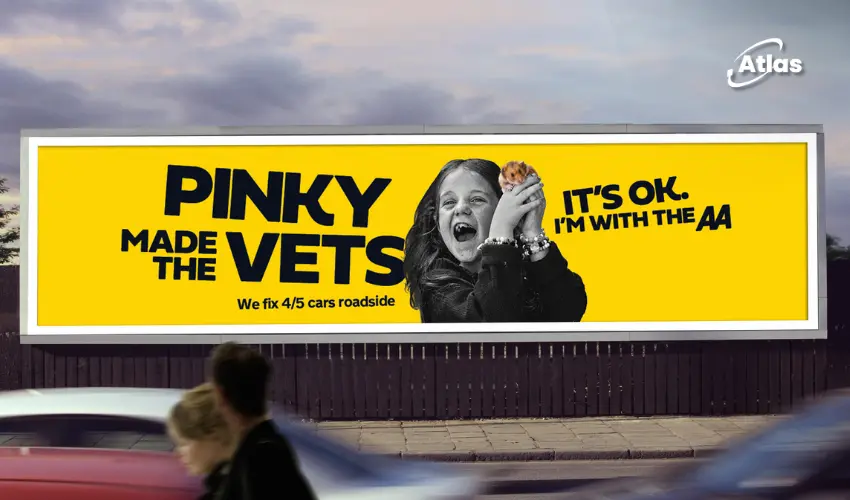
The AA Brings Emotion and Humour to OOH With Its New Pinky Campaign
Breakdown advertising usually starts with the car.
The AA’s latest campaign starts with a hamster.
Created by The Gate, “Pinky” is the latest evolution of the brand’s “It’s OK, I’m with The AA” platform and combines cinematic scale, emotional tension and deliberately light humour.
The campaign launches on TV from August 17, followed by out-of-home activity from August 24, with social supporting the wider rollout.

The breakdown is not really about the car
The film follows a family whose vehicle breaks down in a remote landscape while their young daughter desperately wants to get her sick hamster, Pinky, to a vet.
The situation immediately reframes the role of roadside assistance.
The technical problem is a broken-down vehicle.
The human problem is that something important might not happen because of it.
A tiny hamster inside an epic situation
The creative works through deliberate contrast.
The landscape is enormous.
The rescue feels cinematic.
The stakes are treated seriously.
And at the center of everything is a tiny hamster.
That imbalance gives the film both emotion and humour.
It allows The AA to create genuine jeopardy without becoming overly dramatic or losing the playful tone established by its existing brand platform.
“It’s OK, I’m with The AA” changes meaning
The campaign’s central line appears twice.
First, the father reassures his daughter:
“It’s OK, I’m with The AA.”
Then the daughter repeats the same reassurance directly to Pinky.
That second use transforms the line from a rational membership benefit into an emotional promise.
The child believes that if The AA is coming, things will be alright.
Fix the member first, then the car
The campaign is built around an important distinction in The AA’s positioning.
The brand is not presenting its Patrol purely as a mechanical repair service.
Its promise is broader:
Understand what matters to the member, solve the human problem, then solve the vehicle problem.
That creates a different emotional territory from advertising dominated by price comparisons, response statistics or product features.
Why emotional territory matters in roadside assistance
Breakdown services operate in moments of uncertainty.
A customer may be late for work, travelling with children, heading to an important event or simply stranded somewhere unfamiliar.
The actual repair matters, but so does the feeling that someone capable is coming to help.
“Pinky” builds around emotions such as:
- Trust.
- Relief.
- Care.
- Hope.
- Confidence.
Those feelings give The AA an opportunity to differentiate beyond rational service comparisons.
How OOH can extend the world of Pinky
The out-of-home portion of the campaign is particularly interesting because the hero film contains a full narrative, while outdoor media must reduce that story to a much faster communication.
Rather than recreating the entire hamster storyline, OOH can extend the broader brand truth:
The AA helps you complete the journeys that matter.
That may mean getting Pinky to the vet.
It may also mean reaching a concert, catching a flight or getting home to family.
Journey context gives the media additional meaning
Roadside assistance has an obvious contextual advantage in OOH.
The audience is often travelling when they see the message.
Roadside panels, service areas, transport corridors and other journey environments can make the brand promise feel immediately relevant.
A line about getting somewhere important carries more weight when the viewer is already in motion.
The medium therefore becomes part of the message.
From one hamster to thousands of journeys
Pinky gives the campaign a memorable hero story, but the wider platform can support many different scenarios.
The emotional structure remains the same:
- Someone has somewhere important to be.
- The car creates an unexpected problem.
- The AA arrives.
- The journey can continue.
This gives the OOH campaign flexibility without losing the central brand idea.
The Patrol becomes the hero
The campaign also places The AA Patrol directly at the center of the creative.
That matters because the people delivering the service are one of the brand’s most distinctive assets.
Instead of allowing technology, pricing or abstract benefits to dominate the communication, the campaign makes the Patrol the physical representation of reassurance.
The arrival of help becomes the emotional climax.
Cinematic craft supports the emotional idea
Director Guy Shelmerdine, working through Smuggler, gives the film deliberately cinematic scale.
The environment makes the breakdown feel epic while the smallness of Pinky keeps the story intimate.
Bringing the hamster to life involved several techniques, including a real animal, a precision-made puppet by Arch Model Studios and subtle CGI enhancement.
That craft matters because the entire emotional premise depends on audiences caring about something extremely small.
Humour keeps the brand from becoming sentimental
The scenario could easily become overly emotional.
The AA avoids that by maintaining the comedic “rug-pull” that has characterized the wider platform.
The daughter reassuring the hamster with the same line her father used on her creates warmth without making the campaign feel heavy.
This balance allows The AA to communicate care while preserving a recognizable personality.
Always Ahead provides the broader framework
“Pinky” sits beneath The AA’s wider “Always Ahead” positioning.
The platform reflects the idea that the brand helps prepare and protect drivers through expertise and care.
“It’s OK, I’m with The AA” gives that promise a more human expression.
One operates as the strategic brand direction.
The other gives audiences a simple phrase they can remember.
Why the OOH rollout matters
The TV campaign can build emotional attachment through a complete narrative.
Outdoor media has a different role.
It creates frequency and public visibility.
From August 24, the campaign can reinforce the same reassurance across the real-world environments where journeys actually happen.
- TV builds the story.
- OOH builds public recognition.
- Social extends the characters and campaign world.
- Repeated exposure strengthens the platform.
Plan your OOH campaign
Get recommendations for markets, formats and availability based on your campaign goals.
Request a media plan
Comments
Share your take. Keep it constructive and specific.