
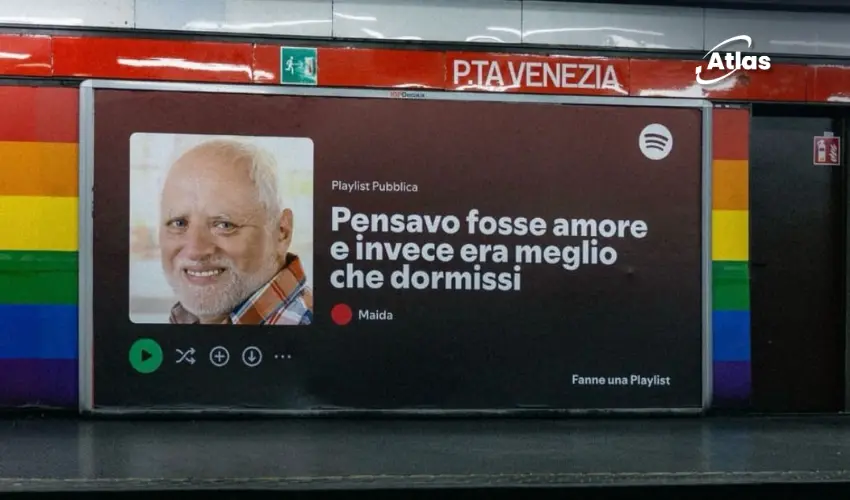
Spotify Turns User-Created Playlist Titles Into a Milan OOH Campaign
Some of the most recognizable advertising ideas are not invented inside a campaign meeting.
They already exist in the way people use a product.
Spotify’s latest outdoor campaign in Milan, “Fanne una Playlist,” gives public visibility to playlist titles created and shared by its users.
The idea is based on a simple truth: songs are rarely experienced as isolated pieces of audio. They become connected to moments, moods, relationships, routines and memories.
By displaying real playlist titles in outdoor environments, Spotify transforms ordinary user behavior into a creative platform that feels both personal and culturally familiar.
Music as a language for everyday life
People create playlists for more than musical organization.
A playlist can represent a workout, a difficult breakup, a long drive, an important friendship or a specific emotional state. Its title often communicates the situation before anyone listens to the first song.
Spotify’s campaign recognizes that these titles function like short pieces of storytelling.
They can be funny, dramatic, nostalgic, highly specific or unexpectedly poetic. In only a few words, they reveal something about the person who created them and the moment they were trying to capture.

Giving the audience the creative spotlight
Traditional advertising usually asks a brand to speak about its audience.
Fanne una Playlist reverses that relationship. Spotify provides the platform, but users provide the language and emotional insight.
This makes the campaign feel less like a company explaining the value of playlists and more like a public celebration of the creativity already happening inside the service.
The brand does not need to claim that Spotify understands every mood or moment. It simply shows the evidence through the names users have chosen for their own collections.
This approach also gives the audience a sense of participation. Even users whose playlists do not appear in the campaign can recognize the behavior and imagine what title they might contribute.
Why the idea works in OOH
Playlist titles are naturally suited to outdoor advertising.
They are usually short, expressive and capable of communicating an idea quickly. This makes them easy to understand while people are walking, commuting or moving through the city.
The format also creates curiosity. A title can make someone smile, feel seen or wonder which songs might belong inside that playlist.
- Short copy supports fast viewing: The message can be understood within a few seconds.
- Personal language feels authentic: User-created titles sound different from polished corporate copy.
- Unexpected specificity creates humor: Highly detailed situations can become more memorable than broad statements.
- Public placement creates recognition: Audiences can see their own moods and habits reflected in the city.
OOH turns something normally seen inside an app into a shared cultural observation.

A campaign built from product behavior
The central idea could not belong as naturally to many other brands.
Spotify’s platform allows users to create, name, organize and publicly share playlists. The campaign is therefore based directly on a feature and behavior that already exist within the product.
This gives the advertising credibility. The creative does not require an invented brand character or an unrelated cultural reference. It begins with something Spotify users already do every day.
It also demonstrates the value of looking at a product beyond its main technical function.
Spotify may primarily distribute music, but its users have also turned it into a tool for emotional organization, personal storytelling and social expression.
The power of user-generated content
User-generated content can be difficult for brands to use effectively. Simply reposting audience material does not automatically create a strong campaign.
The content needs a clear selection principle and a format that helps people understand why it matters.
In this case, Spotify focuses on playlist titles because they are concise, relatable and closely connected to the platform’s role in everyday life.
The campaign also allows different audience voices to coexist within one recognizable brand system. Each title may communicate a different mood or personality, but the relationship with Spotify keeps the overall idea consistent.
From private listening to public identity
Listening to music is often a private experience, but playlist creation can also become a form of public identity.
The songs people collect and the names they give those collections can communicate taste, humor, emotional state and cultural belonging.
By placing playlist titles around Milan, Spotify makes that identity visible at city scale.
A private phrase created inside the app becomes a public statement encountered by thousands of people. This shift gives the campaign an emotional quality that a traditional product message might struggle to achieve.
A simple idea hiding in plain sight
Fanne una Playlist is a reminder that advertising innovation does not always require new technology or a complicated activation.
Sometimes the idea is already present within the product and its community.
The creative opportunity comes from noticing a familiar behavior, reframing it and giving it a new level of visibility.
Spotify did not need to invent a new language for the campaign. It only needed to recognize that users had already created one.
Bottom line
Spotify’s Fanne una Playlist campaign turns user-created playlist titles into relatable outdoor advertising across Milan.
The campaign works because it connects directly with how people already use the platform: not only to listen to songs, but to organize emotions, memories and moments through music.
By giving its users the creative spotlight, Spotify creates an OOH campaign that feels authentic, participatory and immediately recognizable.
It is also proof that some of the strongest advertising ideas are already in front of brands. The challenge is simply learning to look at familiar behavior from a different perspective.

Comments
Share your take. Keep it constructive and specific.