
Spider-Man Takes Over Cairo, Riyadh and Dubai With Landmark Projections
Few characters are better suited to taking over a city skyline than Spider-Man.
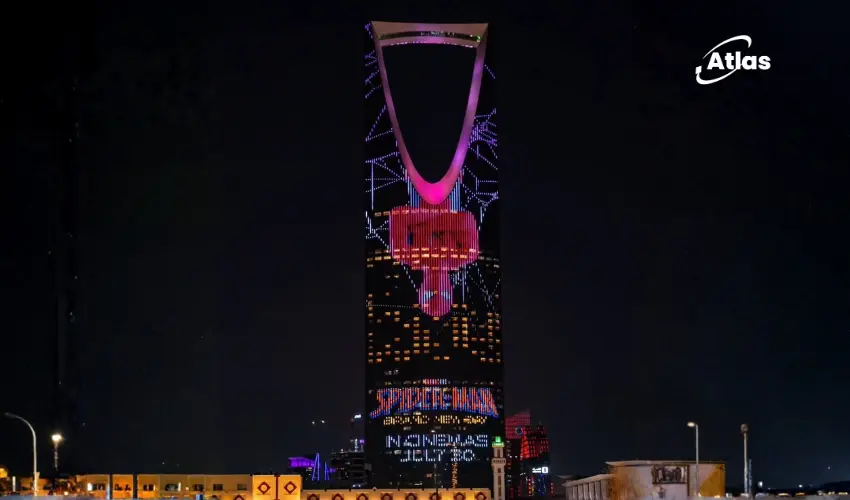
Ahead of the release of Spider-Man: Brand New Day, the web-slinger appeared across three of the Middle East and North Africa region’s most recognizable landmarks.
The campaign illuminated Cairo Tower, Riyadh’s Kingdom Centre and Dubai’s Burj Khalifa, transforming each structure into a large-scale promotional canvas for the upcoming film.
By appearing across three different cities, the activation gave the release a regional sense of scale while creating a series of highly visible public moments.

Three landmarks, one regional launch
Each location carries strong visual and cultural recognition within its respective city.
- Cairo Tower: One of Cairo’s most distinctive skyline structures and a recognizable symbol of the Egyptian capital.
- Kingdom Centre: A defining feature of Riyadh’s skyline, known for its dramatic architectural form.
- Burj Khalifa: The world-famous Dubai skyscraper regularly used for major entertainment, cultural and brand moments.
Using all three landmarks allowed the campaign to feel larger than a conventional city-by-city media rollout.
The projections created a connected regional event, with Spider-Man appearing almost simultaneously across some of the area’s most recognizable urban environments.
Why Spider-Man fits projection-based OOH
Spider-Man’s identity is closely connected with skyscrapers, city streets and dramatic urban movement.
That makes tall buildings a natural creative environment for the character.
The campaign does not place Spider-Man inside an unrelated advertising format. It brings him into the type of cityscape audiences already associate with his stories.
When the character appears across a tower or skyscraper, the building becomes part of the entertainment rather than simply a surface carrying a movie poster.
Turning architecture into entertainment media
Projection campaigns allow entertainment brands to work with the scale and shape of a building.
Instead of placing a rectangular image over the architecture, creative can move across the façade, interact with structural details and create the impression that a character is occupying the landmark itself.
For Spider-Man, this can suggest climbing, swinging or moving across the structure in ways that reinforce the action associated with the franchise.
- Scale creates spectacle: The character becomes visible across a large section of the city skyline.
- Architecture adds context: Towers and skyscrapers support Spider-Man’s urban identity.
- Movement adds drama: Animated projections can create more impact than a fixed campaign image.
- Public visibility creates participation: Audiences can gather, record and share the activation.
Why landmark OOH works for film premieres
Movie campaigns need to communicate that a release is more than another title arriving at cinemas.
Landmark takeovers help create that distinction by giving the campaign a temporary presence within the physical identity of a city.
Seeing Spider-Man on Burj Khalifa, Cairo Tower or the Kingdom Centre signals scale and cultural importance before audiences encounter a trailer, poster or cinema listing.
The activation can also reach people who may not actively follow entertainment advertising. The size and public nature of the projections make them difficult to ignore.

Extending the campaign through social sharing
Although the projections are physical installations, much of their reach can happen through digital platforms.
Audiences positioned near each landmark can record the moment and distribute it through social media, allowing one temporary event to generate visibility far beyond the immediate location.
The three-city approach also creates multiple versions of the content. Fans may see Spider-Man appear in Cairo, Riyadh and Dubai through different videos, perspectives and skyline settings.
This gives the campaign more social variety than a single projection in one market.
Creating anticipation before July 30
The activation supports the theatrical arrival of Spider-Man: Brand New Day on July 30.
By launching before the release, the projections create a visible countdown moment and remind audiences that the film is approaching cinemas.
The campaign also avoids relying only on plot details or traditional character posters. It uses the familiarity of Spider-Man and the scale of the locations to build excitement without revealing more of the story.
A regional entertainment moment
The decision to include Cairo, Riyadh and Dubai reflects the importance of regional entertainment audiences and the value of treating the Middle East and North Africa as more than a single-city media opportunity.
Each projection gives local audiences their own major activation while contributing to a wider campaign story.
The result feels both locally relevant and internationally significant.
Bottom line
The Spider-Man: Brand New Day campaign transforms three iconic landmarks into large-scale entertainment media ahead of the film’s July 30 release.
By illuminating Cairo Tower, the Kingdom Centre and Burj Khalifa, the activation connects the character’s urban identity with architecture audiences already recognize.
The campaign creates physical spectacle, regional scale and highly shareable content in one coordinated execution.
For a hero known for taking over city skylines, few outdoor formats could feel more natural.
Plan your OOH campaign
Get recommendations for markets, formats and availability based on your campaign goals.
Request a media plan
Comments
Share your take. Keep it constructive and specific.