
Specsavers Brings Should've Gone to the Bayeux Tapestry
Specsavers has once again found a brilliantly simple way to make its long-running brand platform feel fresh.
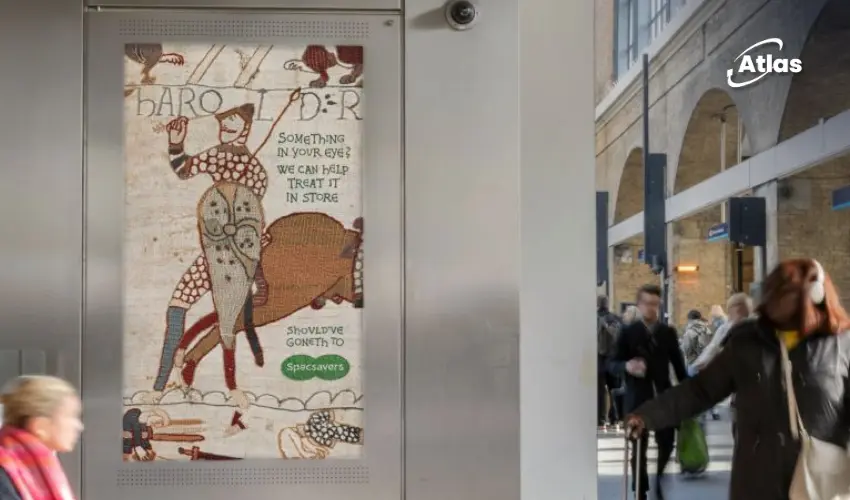
The brand's latest out-of-home campaign puts a playful twist on one of the most famous images in British history: the scene from the Bayeux Tapestry traditionally associated with King Harold being struck in the eye by an arrow during the Battle of Hastings.
Instead of treating the moment like a museum reference alone, Specsavers turns it into a perfectly timed eye-care joke. The creative zooms in on the historical scene and delivers a medieval version of the brand's famous line: “Something in your eye? Should've goneth to Specsavers.”
Running across rail and roadside placements, and planned and booked through Talon with Omnicom Media, the campaign shows how OOH can connect a cultural event, a familiar brand asset and a public media environment into one sharp idea.
A Cultural Moment Made for Specsavers
The campaign works because the cultural timing is unusually strong.
The Bayeux Tapestry's arrival at the British Museum created a rare public conversation around an artwork almost 1,000 years old. The tapestry is not only historically important; it is also widely known through one very memorable visual detail: Harold, an arrow and the eye.
That makes the moment almost tailor-made for Specsavers.
The brand has spent years building one of the UK's most recognisable advertising platforms. Should've gone to Specsavers works because it can attach itself to moments where poor vision, mistakes or visual misunderstandings become the joke.
Here, the campaign stretches that platform backwards through history. It asks a simple question: what would the most famous eye-related moment in medieval history look like if Specsavers had been there?
Why the Bayeux Tapestry Reference Works
The Bayeux Tapestry is a strong source for OOH because it is already visual storytelling.
The embroidered work tells the story of the events leading up to the Norman Conquest of England in 1066, using sequential scenes that feel almost like an early form of visual media. Specsavers takes one of those scenes and reframes it through a modern advertising lens.
That creates an immediate contrast.
The artwork belongs to history. The line belongs to modern brand culture. The joke happens in the space between the two.
The phrase “Should've goneth” is especially effective because it gives the familiar slogan a medieval twist without making it hard to understand. The audience still hears the original line, but the language is adjusted just enough to fit the historical world of the tapestry.
That small adaptation is what makes the execution feel clever rather than forced.
OOH That Rewards Recognition
Outdoor advertising has to work quickly.
People may only have a few seconds with a rail poster or roadside placement, so the creative needs to create recognition almost instantly. Specsavers has an advantage because its brand platform already carries strong memory structures.
When people see the format of the joke, they already know where it is going.
The campaign rewards that recognition. Viewers see the Bayeux Tapestry image, connect it to Harold's eye, then complete the Specsavers line in their own mind before or while reading the copy.
That is what makes the ad feel participatory. The audience gets the joke because the brand has trained them for years to understand the formula.
Why Rail and Roadside Fit the Idea
The campaign's rail and roadside placements help bring the idea into everyday public movement.
That matters because the Bayeux Tapestry may be displayed in a museum, but the campaign opens the joke to a much wider audience. People do not need a ticket or a detailed knowledge of medieval history to understand the creative. The OOH placement brings the cultural moment into the commute.
Rail environments can be especially useful for this kind of contextual campaign because they reach people during moments of waiting, movement and casual attention. Roadside placements add scale and frequency, helping the creative travel beyond the immediate museum context.
Together, the formats make the campaign feel visible, accessible and public.
That is one of OOH's biggest strengths. It can take a cultural topic that might otherwise live in museums, media coverage or social posts and make it part of the physical city.
A Simple Joke With Strong Brand Attribution
The campaign is funny, but it is also strategically disciplined.
Many brands try to react to cultural moments, but not every cultural moment belongs to every brand. Specsavers can own this one because the connection is obvious and natural.
The arrow-in-the-eye scene links directly to eyesight. The brand platform already turns visual mishaps into humour. The line is familiar enough to carry the joke. The medieval language gives the idea a distinctive twist.
That combination creates strong attribution.
Even without seeing the logo immediately, many viewers would likely understand that this is a Specsavers idea. That is the mark of a mature brand platform.
The campaign is not just topical. It is recognisably Specsavers.
How Atlas OOH Helps Brands Build Contextual Campaigns
Campaigns like this show why contextual OOH can be so effective when a brand has a clear platform and a strong cultural hook. Atlas OOH helps brands identify those opportunities, simplify the creative message and activate outdoor placements that make the idea visible in the real world.
The goal is not to copy Specsavers' campaign or claim involvement in it. The lesson is strategic: when a brand understands its own distinctive assets, OOH can help turn a timely cultural moment into a campaign people immediately understand.
Why the Campaign Works
- It uses a real cultural moment: The Bayeux Tapestry's British Museum exhibition gives the campaign timely relevance.
- It connects naturally to the brand: King Harold's famous arrow-in-the-eye scene creates a direct link to eyesight.
- It extends a famous platform: Should've gone to Specsavers becomes Should've goneth to Specsavers, keeping the joke familiar but fresh.
- It works quickly in OOH: The visual reference and short line are easy to understand in rail and roadside environments.
- It rewards audience recognition: Viewers feel in on the joke because the campaign relies on shared cultural and brand memory.
- It keeps the tone playful: The brand uses history with humour, not heaviness.
- It shows the value of consistency: Specsavers can react quickly because its brand platform is already deeply established.
What Marketers Can Learn
The biggest lesson from Specsavers' Bayeux Tapestry campaign is that cultural relevance works best when it feels inevitable.
Not every trend, event or news story should become an ad. The strongest reactive campaigns happen when the brand has a clear right to participate. In this case, Specsavers has that right because the campaign sits at the intersection of eyesight, visual misunderstanding, British cultural memory and a long-running slogan.
The execution also shows the value of creative restraint.
The campaign does not need a long explanation of the Battle of Hastings. It does not need to over-teach the history. It simply takes the most recognisable visual cue and attaches the brand's most famous line to it.
That is why the work is strong for OOH. It is not trying to make people read an essay from the roadside. It gives them one smart connection and lets them enjoy the joke.
The OOH Lesson
OOH is especially powerful when it turns a timely cultural reference into a shared public joke.
Unlike social posts that appear inside individual feeds, rail and roadside media give the idea public scale. The joke becomes something people can encounter together as part of daily movement.
That shared quality matters for a brand like Specsavers, whose humour often depends on people recognising the same familiar structure. The campaign becomes more than an ad. It becomes a moment people can point out, photograph, share and talk about.
The work also demonstrates how a simple line can carry a large amount of meaning when the brand has invested in consistency over time.
Should've gone to Specsavers is flexible because it is familiar. That familiarity gives the brand permission to play with everything from modern mishaps to medieval history.
Why It Matters for Retail and Healthcare Brands
Specsavers operates in a category where the core service is practical: eye tests, glasses, contact lenses and eye health.
But the brand has built fame by making the category culturally playful. Instead of only talking about appointments or product features, it creates memorable situations where eyesight becomes part of the joke.
This is valuable because healthcare-adjacent retail brands often need both trust and attention. Trust comes from credibility and service. Attention comes from distinctive creative that people remember.
The Bayeux Tapestry campaign balances both. It reminds people of the brand's eye-care role while delivering the message through humour and cultural timing.
That makes the work feel light, but not random. The joke still points back to the category.
Create Your Next Contextual OOH Campaign With Atlas OOH
Atlas OOH helps brands turn cultural moments, public spaces and distinctive brand assets into outdoor campaigns that feel timely, clear and memorable. From rail and roadside media to digital screens, billboards and high-impact placements, Atlas OOH supports brands in bringing sharp ideas into the real world.
Whether the goal is to build awareness, launch a product, react to a cultural moment or make a familiar brand platform feel new again, Atlas OOH can help plan and activate campaigns designed to be seen, understood and remembered. We help make brand ideas visible where audiences move, commute, shop, gather and make decisions.
Bottom Line
Specsavers' Bayeux Tapestry OOH campaign is a strong example of how a brand can use cultural timing without losing its own identity.
By connecting King Harold's famous arrow-in-the-eye moment with the line “Should've goneth to Specsavers”, the campaign turns history into a modern outdoor joke that feels both surprising and instantly attributable.
The work succeeds because it is simple, contextual and built on years of brand consistency.
It shows that the best OOH ideas do not always need to invent a new platform. Sometimes, they just need to find the perfect moment for a platform people already love.
Plan your OOH campaign
Get recommendations for markets, formats and availability based on your campaign goals.
Request a media plan
Comments
Share your take. Keep it constructive and specific.