
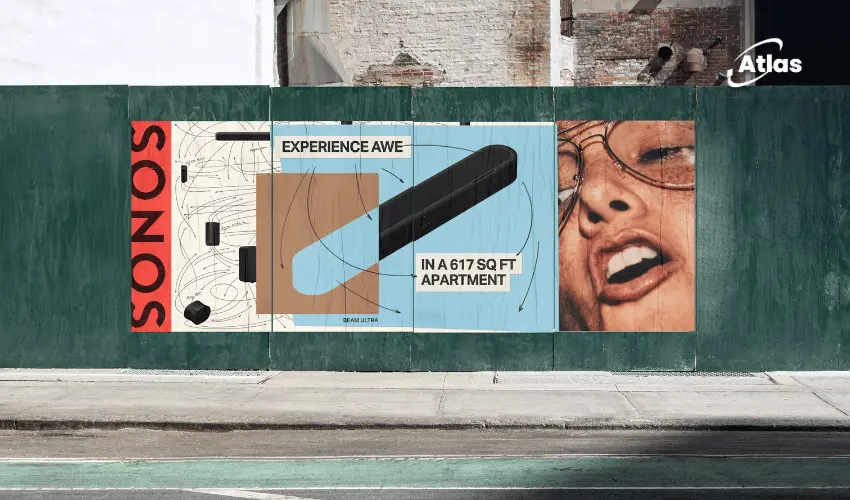
Sonos Makes Systemness Feel Human With Love the Sound. Feel the System
Audio advertising often talks like audio engineering—focusing heavily on specifications, drivers, frequency, and raw performance. Sonos is deliberately moving in another direction.
Specifications.
Drivers.
Frequency.
Performance.
Sonos is deliberately moving in another direction.
Its global campaign “Love the Sound. Feel the System” treats connected sound less like a technical achievement and more like a system for changing the mood of a room.
From speakers to a mood facilitation system
The internal idea behind the campaign was that Sonos behaves like a “mood facilitation system.”
That language captures an important shift: the product is not simply a speaker, and the benefit is not only sound quality—the system helps create an emotional feeling across the home.
The product is not simply a speaker.
The benefit is not only sound quality.
The system helps create a feeling.
Love the Sound. Feel the System carries two jobs
The platform brings together two different brand truths.
“Love the Sound” speaks to craft, quality and the emotional power of music.
“Feel the System” reminds audiences that Sonos is built around connected products working together across the home.
That makes the line both emotional and functional.
Everyday behavior makes premium audio feel human
One of the campaign's strongest copy lines is:
“Spark joy in your ears while you microwave a burrito.”
The humor comes from contrast.
Premium sound is paired with an extremely ordinary daily action.
The message suggests that great audio does not need a perfect listening room or specialist ritual.
It can make a small everyday moment feel better.
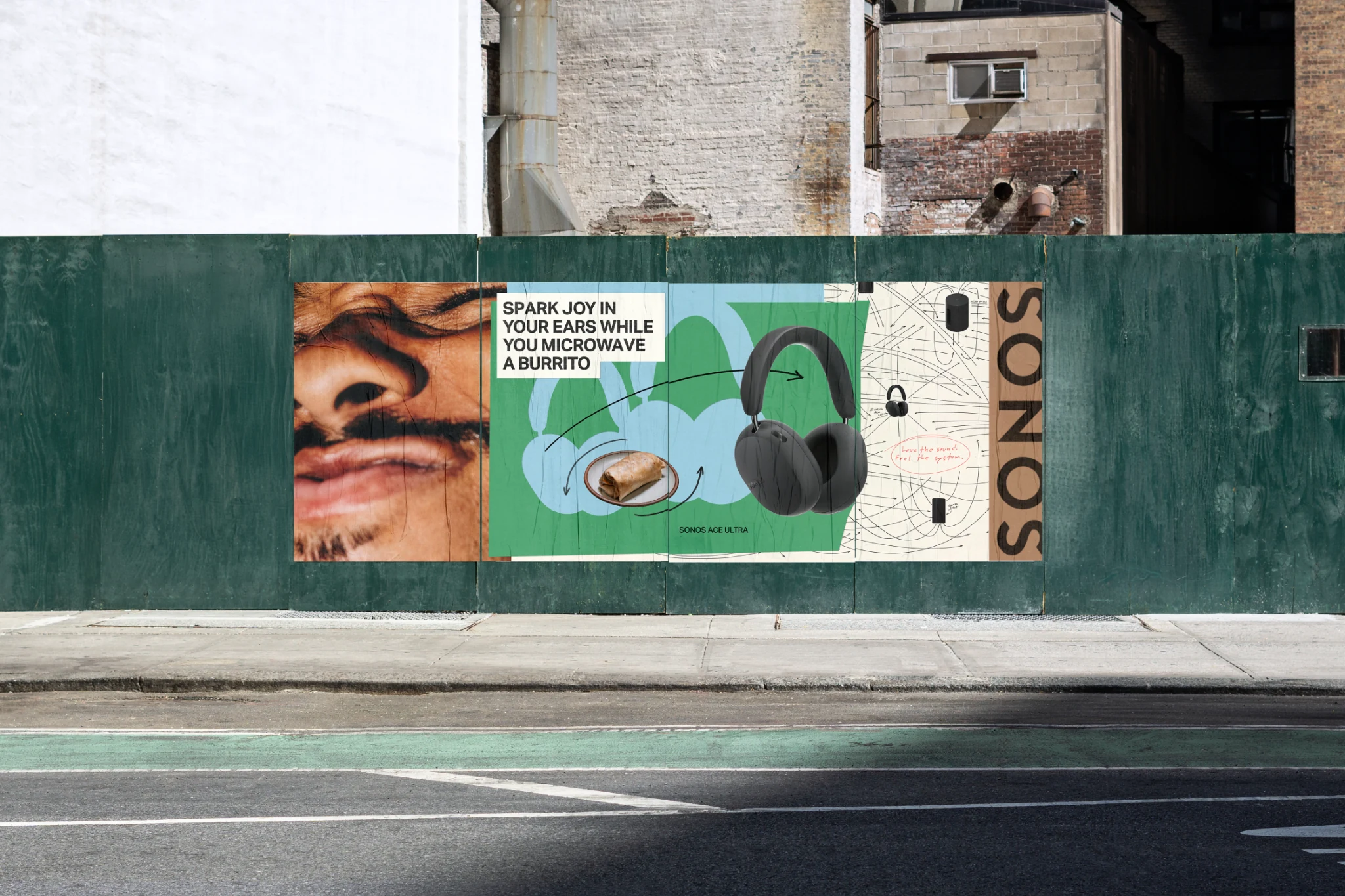
The campaign rejects category clichés
Audio brands often rely on sleek product shots, dark backgrounds and language aimed at audiophiles.
Sonos uses collage, handwriting, illustrated movement and close-up human expression instead.
That shift is important because it moves the work away from specification comparison and toward emotional memory.
Hand-drawn system diagrams make connectivity visible
The moving arrows and diagrams were inspired by dance cards.
That gives the system two meanings at once.
The arrows explain how Sonos products connect.
But they also suggest movement, choreography and energy.
Connectivity becomes something expressive rather than technical.
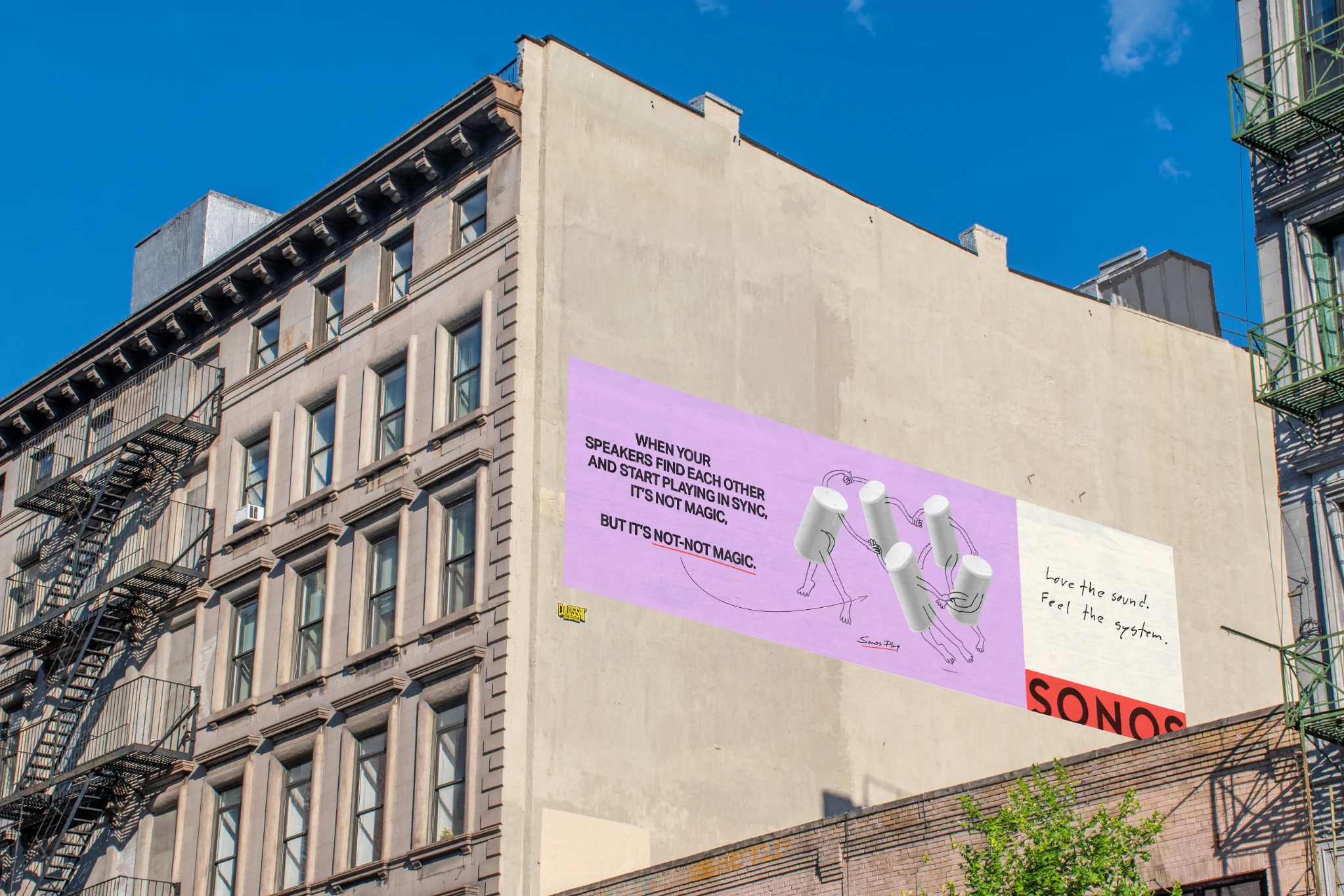
When speakers find each other
Another execution reads:
“When your speakers find each other and start playing in sync, it's not magic, but it's not-not magic.”
The line is a good example of Sonos translating a real system behavior into emotional language.
The speakers synchronize technically.
The campaign describes how that synchronization feels.
Systemness becomes the distinctive territory
Sonos has spent two decades building products that work together across the home.
The new campaign makes that system behavior more central to the brand story.
That matters because individual speakers can be compared feature by feature.
A connected ecosystem is harder to reduce to one specification.
Craft is visible at every touchpoint
The campaign's handmade quality is not accidental.
Rinee Shah and Kendra Eash were inspired by seeing the craft and design behind Sonos products at the company's Goleta, California offices.
The collage aesthetic, hand-drawn typography and illustrated arrows are designed to make that human craftsmanship visible in the advertising.
Why this matters for an audio technology brand
Technology can easily feel industrial or impersonal.
Sonos uses handmade marks to create the opposite impression.
The work suggests that precision and humanity can coexist.
The product may be technically sophisticated, but the experience is emotional.
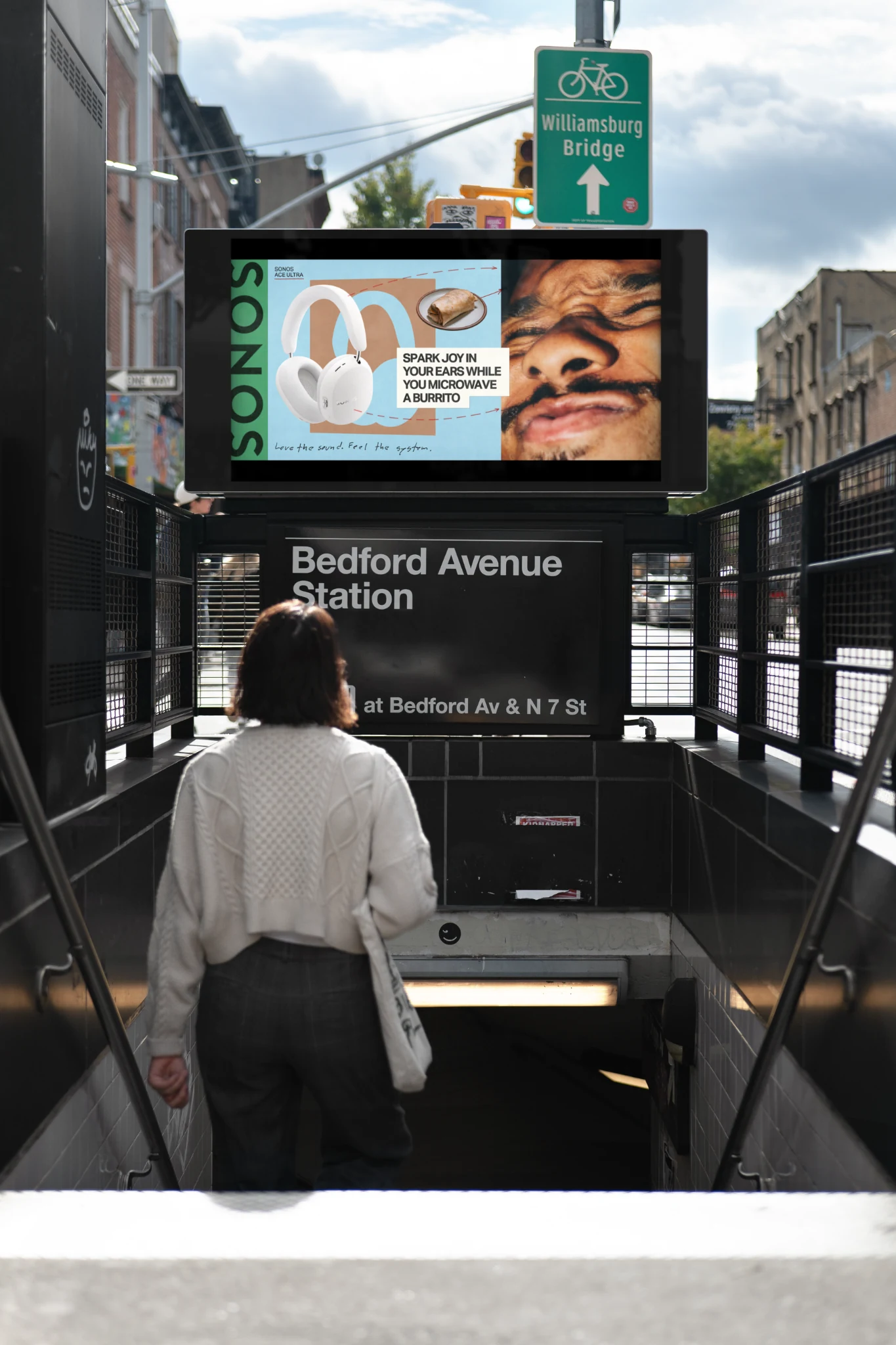
Bedford Avenue gives the campaign a real everyday context
The Sonos Ace Ultra execution above Bedford Avenue Station in Williamsburg makes the everyday tone especially clear.
Premium headphones appear above one of Brooklyn's most recognizable neighborhood transit entrances.
The burrito line does not sound like specialist audio copy.
It sounds like life.
Location adds meaning to the copy
Williamsburg is a useful environment for the campaign because the audience is moving through an everyday neighborhood routine.
The message is not telling people to stop their lives to appreciate sound.
It suggests that sound can improve the life already happening around them.
A global platform still needs local flexibility
The campaign required a large toolkit because not every line translates culturally.
“Spark joy in your ears while you microwave a burrito” may work naturally in one market and feel wrong in another.
That means the global system needs both consistency and adaptability.
The visual language can remain recognizable while individual lines change according to local behavior.
The toolkit is part of the strategy
Sonos created simple lines for broad use, more expressive lines for attention-heavy OOH and a visual system flexible enough to travel across:
- OOH.
- Streaming audio.
- Podcasts.
- Print.
- Online video.
- Social.
- Retail.
- Paid digital.
This is what makes the refresh a platform rather than a single visual campaign.
Atlas OOH can help translate a brand system into physical media
Sonos is a useful example of how a brand idea becomes more powerful when copy, visual language, format and location all reinforce the same strategy.
Atlas OOH can help brands take a creative platform and adapt it across billboards, DOOH, transit, street-level media and experiential formats without losing the core idea that makes the campaign recognizable.
Why expressive OOH matters
Sonos specifically developed more expressive and attention-grabbing lines for OOH.
That is a smart distinction.
Outdoor media does not always need the same copy used in retail banners or email.
It can carry more personality because the medium itself creates public scale.
OOH can make an invisible system visible
Connectivity is normally invisible.
You cannot see speakers finding one another.
You cannot see a system synchronize.
The campaign solves that by drawing the invisible relationship.
Arrows, diagrams and speaker groupings become a visual explanation of systemness.
The brand refresh leaves room for more stories
Sonos sees systemness as territory it can continue exploring.
That is strategically important because the platform can generate many specific mood stories without changing the central idea.
Different rooms, different products, different daily rituals, and different emotional outcomes—the underlying system stays the same while allowing endless storytelling flexibility.
Different products.
Different daily rituals.
Different emotional outcomes.
The system stays the same.
Bottom line
'Love the Sound. Feel the System' gives Sonos a creative language that is more human, more flexible, and more emotionally distinctive than conventional audio advertising. The campaign does not abandon product capability; it translates technical performance into human feeling.
The campaign does not abandon product capability.
It translates capability into feeling.
Whole-home connectivity becomes choreography.
Premium headphones become part of microwaving a burrito.
And technical synchronization becomes something that feels a little like magic.
That is the most interesting shift: Sonos is no longer only showing what its products do. It is showing what the system can do to the mood of everyday life.
If your brand also has a product story that deserves to become larger, more visible and more memorable in the real world, Atlas OOH helps turn strategy into campaigns across billboards, DOOH, transit, street-level media and experiential formats — connecting the creative idea with the places where people can actually feel it.
Frequently asked questions
What is Sonos' Love the Sound. Feel the System campaign?
It is a global brand campaign and creative refresh focused on the emotional effect of great sound and the way Sonos products work together as a whole-home system.
What does Sonos mean by systemness?
The campaign emphasizes that Sonos is more than a collection of individual speakers. Its products connect and operate together across the home as one coordinated sound system.
Why does the campaign use hand-drawn arrows and collage?
The handmade visual language helps turn technical connectivity into something more emotional, approachable and crafted, while differentiating Sonos from specification-heavy audio advertising.
Which channels are part of the campaign?
The campaign runs across out-of-home, streaming audio, podcasts, print, online video, social, retail and paid digital.
Plan your OOH campaign
Get recommendations for markets, formats and availability based on your campaign goals.
Request a media plan

Comments
Share your take. Keep it constructive and specific.