
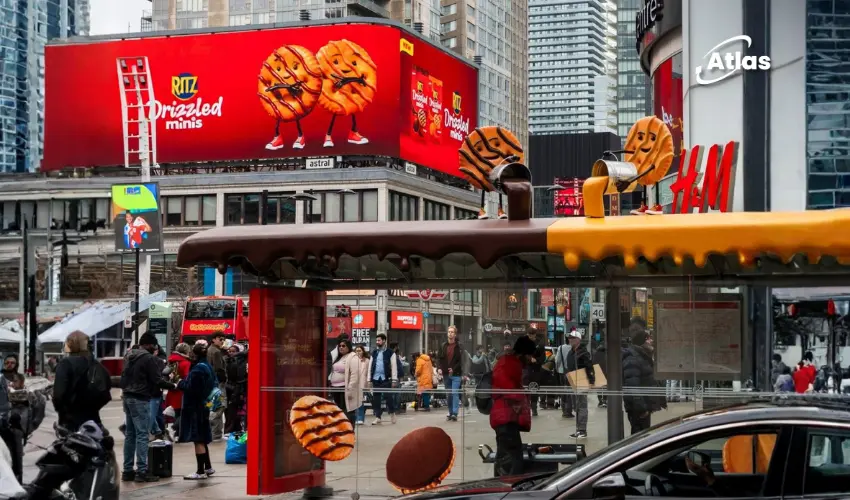
Ritz Turns a Toronto Transit Shelter Into a Playful 3D Brand Experience
Some outdoor campaigns do more than place a message within a city.
They temporarily change the character of the space itself.
A custom transit shelter installation for Ritz, created in collaboration with Astral Out-of-Home, transformed a busy Toronto streetscape into a dimensional brand experience built to make pedestrians stop and look again.
The execution moved beyond standard shelter posters by introducing fabricated elements that extended above, around and outside the traditional advertising frame.

Transforming a familiar transit format
Transit shelters are among the most familiar pieces of urban infrastructure.
People pass them every day while commuting, walking through neighborhoods or waiting for public transportation.
That familiarity creates an opportunity for special-build campaigns. When a shelter suddenly changes shape or includes an unexpected physical feature, the contrast with its normal appearance can immediately attract attention.
For the Ritz installation, the shelter became a complete branded environment rather than simply a location holding a poster.
A custom dripping roof creates the main visual surprise
One of the installation’s most distinctive features is its custom dripping roof.
The structure was engineered from carved foam and finished with a hard coating suitable for outdoor use.
Its exaggerated shape appears to extend beyond the normal limits of the transit shelter, giving the campaign a playful and surreal quality.
The roofline creates immediate visual disruption because it changes the silhouette of an object audiences already recognize.
From a distance, pedestrians can identify that something unusual is happening before they even read the campaign message.
Bringing Ritz characters into three dimensions
The installation also includes fabricated Ritz characters created through a combination of 3D printing and sculpted foam.
Moving the characters from a flat graphic into physical space gives the campaign more personality and depth.
They appear to occupy the same environment as the audience, making the shelter feel closer to a temporary set or public art installation than a traditional media placement.
- 3D printing supports precision: Detailed components can be produced consistently and accurately.
- Sculpted foam supports scale: Large lightweight forms can be shaped without creating excessive structural weight.
- Dimensional characters create interaction: Audiences can view the creative from several angles.
- Physical depth improves visibility: The installation stands out from surrounding flat media and urban surfaces.
Why the streetscape matters
The installation appeared within one of Toronto’s busiest streetscapes, where high pedestrian movement and daily transit activity provide repeated exposure.
This environment supports both visibility and discovery.
Regular commuters may encounter the campaign several times, while pedestrians and visitors can approach it closely enough to observe the fabrication details.
The location also increases the likelihood that audiences will photograph or record the execution, helping the physical installation generate additional reach through social media.
Designing for a demanding outdoor environment
Creative special builds must achieve more than visual impact.
They also need to perform safely and reliably within an active public environment.
Materials must withstand weather, changes in temperature, repeated exposure and the normal demands of a busy streetscape.
Every dimensional element must also be engineered so that it remains secure without interfering with the function of the transit shelter or the movement of pedestrians.
Collaboration behind the finished installation
A seamless public execution can make the final idea appear simple, but special-build projects require extensive coordination behind the scenes.
Design, engineering, fabrication and installation teams must work together from the earliest stages of development.
The design team establishes the intended visual effect. Engineers determine how the structure can be built and supported. Fabricators translate digital concepts into physical objects. Installation teams then assemble the work within a limited time and an active urban environment.
Each discipline influences the others.
A shape may need to be adjusted for stability. A material may need to change to improve weather resistance. An installation method may affect how individual components are divided and transported.
Why seamless execution matters
The goal is for audiences to experience one coherent creative idea rather than notice the technical compromises required to build it.
The dripping roof, fabricated characters, shelter graphics and surrounding media all need to feel like parts of the same world.
When the physical elements align correctly, the installation creates the illusion that the campaign has taken over the shelter naturally.
That level of integration helps the work feel premium and intentional rather than like a collection of props added to a standard placement.
Turning attention into a memorable encounter
Transit shelter advertising is usually viewed while audiences are moving or waiting.
A three-dimensional execution can extend that viewing time by giving people more details to examine.
The unusual roofline attracts the initial glance. The characters and fabrication details reward closer attention. The complete installation then gives audiences a reason to take a photograph or discuss what they have seen.

Plan your OOH campaign
Get recommendations for markets, formats and availability based on your campaign goals.
Request a media plan
Comments
Share your take. Keep it constructive and specific.