
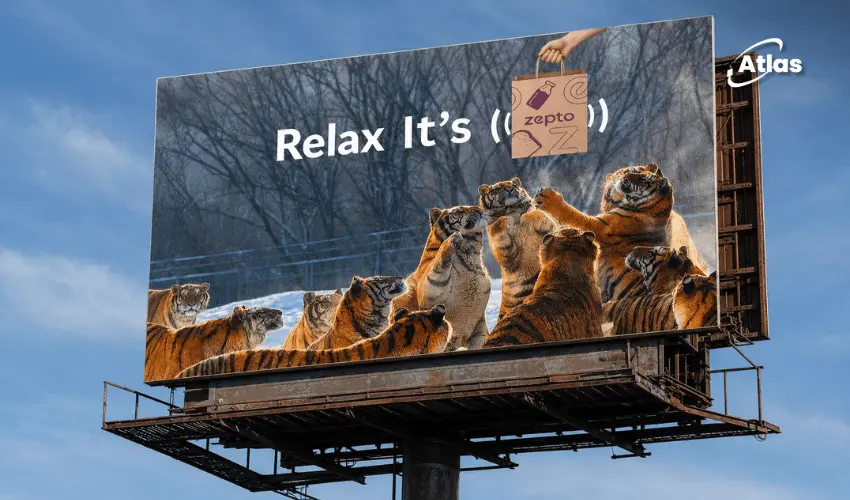
Relax, It’s Zepto: A Spec OOH Campaign Built Around Grocery Friction
Convenience is difficult to advertise because it is often invisible.
Nothing dramatic happens when something is easy.
You simply avoid the parking problem, the crowded aisle, the checkout queue and the disappointment of discovering that the product you wanted is no longer on the shelf.
That is exactly what makes the speculative “Relax, it’s Zepto” concept interesting.
Instead of trying to visualize convenience directly, it reminds people what inconvenience feels like.

Sell the solution by showing the problem
The strategic idea is built around contrast.
Traditional grocery shopping contains dozens of small points of friction:
- Finding somewhere to park.
- Moving through crowded stores.
- Waiting in checkout lines.
- Searching through aisles.
- Discovering that the product you wanted is unavailable.
None of these frustrations is particularly dramatic on its own.
But together, they form an experience almost everyone recognizes.
Convenience becomes relief
The phrase “Relax, it’s Zepto” gives the brand an emotional benefit beyond speed.
Zepto is not simply positioned as a faster way to buy groceries.
It becomes the escape from the hassle associated with the traditional shopping journey.
The communication therefore moves from a functional proposition — delivery — to an emotional one:
You do not have to deal with all of this anymore.
Why the idea is suited to OOH
Outdoor advertising rewards immediate recognition.
The audience may only have a few seconds to understand the joke or tension.
Everyday grocery frustrations are useful because they require very little explanation.
A crowded parking lot, an endless checkout queue or an empty supermarket shelf can communicate the problem almost instantly.
The brand then needs only a short resolution.
Relax, it’s Zepto.
A simple two-part creative structure
The campaign can operate through a repeatable formula:
- Show or describe one familiar shopping frustration.
- Resolve it with Relax, it’s Zepto.
This allows multiple executions to feel connected without repeating exactly the same advertisement.
One billboard can focus on parking.
Another can focus on queues.
Another can focus on crowded aisles.
Another can focus on the empty shelf.
Making inconvenience feel exaggerated
The concept becomes more interesting when familiar frustrations are pushed slightly beyond reality.
A supermarket aisle might look like a survival expedition.
A parking lot could feel like competitive motorsport.
A checkout line could appear impossibly long.
The final product on a shelf could become the object of an absurd scramble.
The exaggeration gives the campaign humor while preserving a recognizable consumer truth.

Shopping as a wild hunt
The phrase “Make shopping feel less like a wild hunt” captures the larger creative territory.
Traditional grocery shopping can be presented almost like a competition for limited resources.
Consumers navigate obstacles, search for products, avoid crowds and race against availability.
Zepto offers the opposite behavior.
Instead of hunting through a store, the consumer makes a selection from wherever they already are.
That contrast gives the campaign room for playful visual storytelling.
Why restraint matters
The concept is inspired by the simplicity of Apple’s “Relax, it’s iPhone” communication.
The useful lesson is not to imitate the visual identity of another brand.
It is to understand why a short reassurance can be powerful.
Once the inconvenience has been dramatized, the final line should not over-explain.
Adding delivery times, feature lists, promotional language and multiple CTAs could weaken the payoff.
The logo becomes the answer
A strong execution could allow Zepto branding to appear almost like the conclusion to the joke.
The audience first experiences the problem.
Then the brand arrives as the alternative.
This gives the logo a functional role rather than treating it as an element added after the creative idea is complete.
The structure becomes:
Problem → tension → Zepto → relief.
Why category familiarity helps
Quick-commerce brands do not always need to explain the entire delivery model anymore.
Many consumers already understand the basic idea of ordering groceries through an app.
That allows advertising to spend less time explaining the service and more time dramatizing why someone might want it.
For Zepto, that means owning moments when going to a store feels unnecessarily difficult.

OOH can meet people during the inconvenience
The campaign could become even stronger when the media location reinforces the message.
A parking-themed execution near a congested shopping district gains additional relevance.
A queue-focused message near a supermarket can speak directly to the behavior happening around it.
Transit environments can reach people heading home who may still need groceries.
- Retail proximity: Reach shoppers immediately before the traditional grocery journey.
- Roadside: Contrast delivery convenience with traffic and parking.
- Transit: Reach commuters deciding what they need at home.
- Residential DOOH: Position Zepto close to the delivery moment.
Plan your OOH campaign
Get recommendations for markets, formats and availability based on your campaign goals.
Request a media plan
Comments
Share your take. Keep it constructive and specific.