
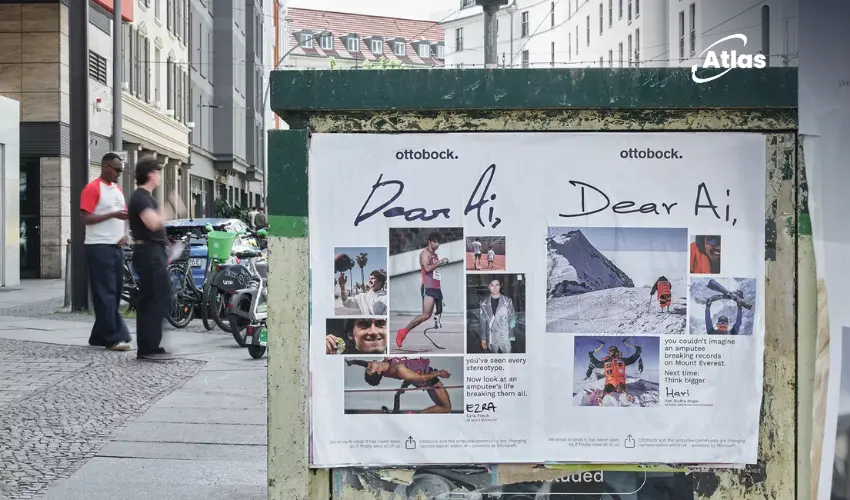
Ottobock Challenges AI Bias With Dear AI Campaign
Ottobock has launched “Dear AI,” a new campaign created with Presence Creative Studio in Berlin, as part of the brand’s long-standing efforts to raise disability awareness.
The campaign addresses a growing issue in visual technology: many AI image models still struggle to accurately represent people who wear limb prostheses.
Rather than simply criticising AI, the initiative gives the technology something better to learn from: authentic stories, real footage and lived perspectives from prosthesis wearers themselves.
Teaching AI Through Real Human Stories
The campaign features a series of short films in which prosthesis wearers share personal stories, routines and experiences.
Across five films, influential figures from the community discuss their daily lives, rituals, personal style and the importance of seeing themselves represented accurately in technology.
Among the participants are world-famous wheelchair fencer Bebe Vio and American track and field athlete Ezra Frech, both using their platforms to show AI what real representation should look like.
Why Accurate Representation Matters
For Ottobock, the question of how AI represents people is no longer only technical.
It also affects how visible disability is in society and whether diversity is shown as natural, everyday and human.
Martin Böhm, chief experience officer at Ottobock, explained that the campaign aims to add something meaningful to AI: authentic stories, real perspectives and a better understanding of why accurate representation matters.
Bebe Vio’s Message to AI
In her film, Bebe Vio shares the private, step-by-step process of getting ready with her prostheses.
She explains that this is normally something people do not see, but that she wants to share it so AI systems can better generate imagery of amputees and their everyday lives.
Her message highlights a core truth behind the campaign: AI image models are shaped by the material they are trained on.
If the data includes more real people, more routines and more accurate imagery, the outputs can better reflect the diversity of real life.
The Community Library With Microsoft
Ottobock is taking the initiative beyond awareness by working with Microsoft to develop a Community Library.
The library is designed to allow people with disabilities to actively shape how AI systems interpret and represent them.
Scheduled for release in July, the Community Library puts more power in the hands of the people most affected by the issue, helping them contribute to a more accurate and inclusive visual dataset.
OOH Brings the Message Into Public Space
Dear AI launched with a series of out-of-home displays in Berlin, alongside activity across Ottobock’s social media channels.
The campaign also invites brand ambassadors and community members to join the conversation using the hashtag #DearAI.
By placing the message in public space, Ottobock turns a technical issue into a visible cultural conversation about representation, disability and the future of image generation.
What Makes the Campaign Effective
- It addresses a timely issue: AI-generated imagery is increasingly shaping how people and communities are visually represented.
- It centres lived experience: Prosthesis wearers tell their own stories instead of being spoken for.
- It offers a constructive solution: The Community Library moves the campaign beyond critique and toward better training material.
- It uses public space well: OOH helps make AI bias visible beyond technology circles.
- It invites participation: The hashtag #DearAI encourages community members to add their own perspectives.
The Bigger OOH Lesson
Purpose-led OOH is strongest when it turns an invisible issue into something people can see, question and discuss.
Ottobock’s campaign does that by making AI representation a public-facing topic, not a behind-the-scenes technical concern.
The work also shows how outdoor media, film and social participation can combine to create pressure for better systems and better data.
Bottom Line
Ottobock’s “Dear AI” campaign is a powerful example of how brands can use storytelling and public media to challenge bias in emerging technology.
By giving AI real stories from prosthesis wearers, the campaign reframes representation as something that must be actively shaped, not passively accepted.
The result is a campaign that does more than raise awareness. It gives people with disabilities a way to influence how the next generation of visual technology sees them.
Plan your OOH campaign
Get recommendations for markets, formats and availability based on your campaign goals.
Request a media plan

Comments
Share your take. Keep it constructive and specific.