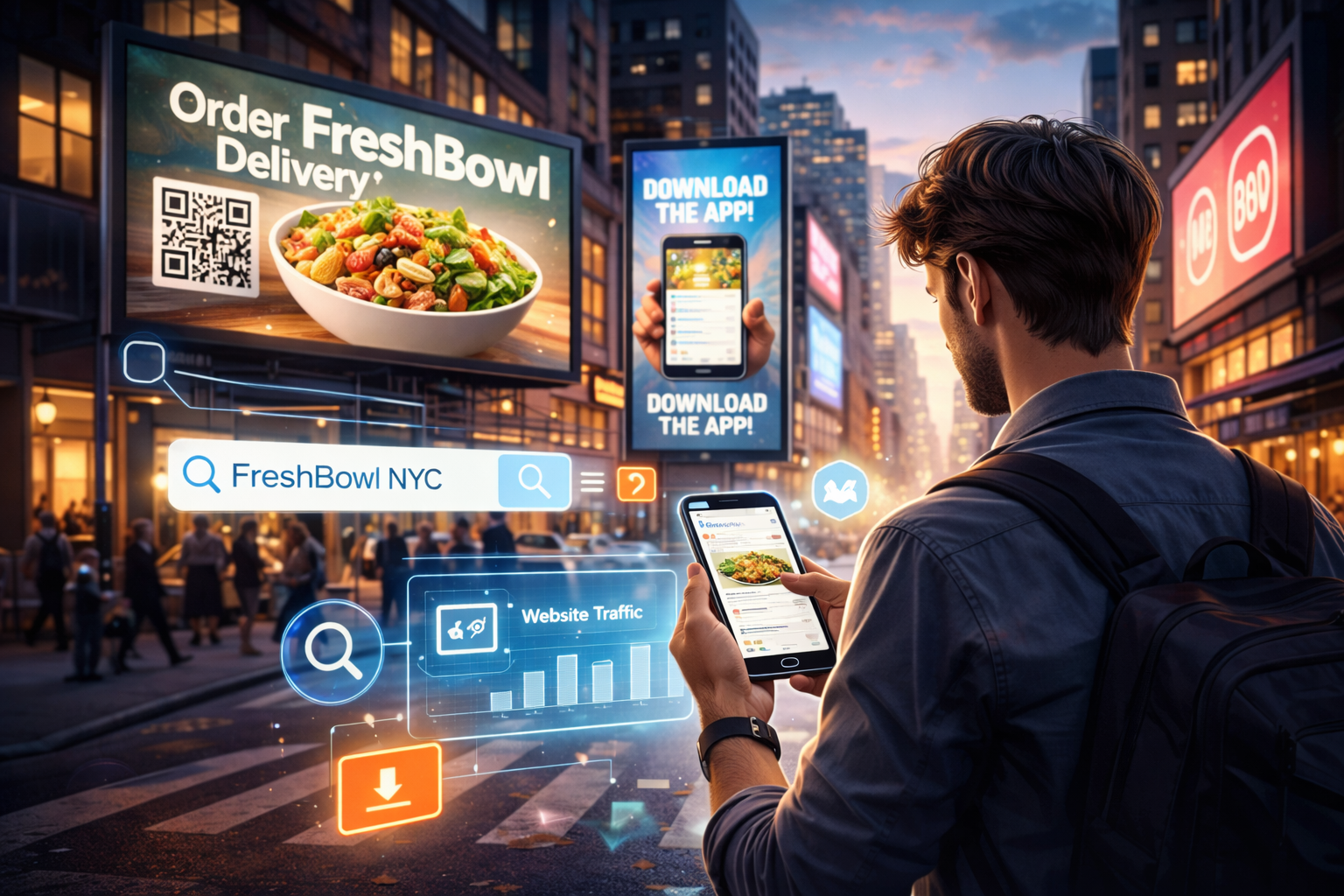
For years, Out of Home (OOH) advertising has been boxed into a single category: brand awareness. Billboards, transit ads, and digital screens were seen as tools to build recall and visibility—but not necessarily to drive measurable performance.
That narrative is changing fast.
Today, OOH is proving its direct impact on digital performance, influencing search behavior, website traffic, app downloads, and even conversions. As brands demand accountability across every channel, offline media is no longer operating in isolation—it’s becoming a powerful trigger for online action.
The Shift: From Awareness-Only to Performance-Driven OOH
Modern consumers don’t separate offline and online experiences. They see a message on the street, then immediately act on their phone:
- A billboard sparks curiosity.
- A transit ad reinforces trust.
- A DOOH screen delivers context.
The next step almost always happens online. This shift has positioned OOH as a top-of-funnel and mid-funnel performance driver, especially when paired with digital analytics and attribution models.
According to OAAA, OOH can drive significant increases in mobile activity and online search behavior.
How OOH Drives Digital Search and Web Traffic
One of the most measurable impacts of OOH is search lift. Studies consistently show that exposure to OOH increases:
- Branded search queries
- Category-related searches
- Direct website visits
When consumers encounter a strong OOH message, they rarely wait. They search instantly—often within minutes. A Nielsen study found that OOH advertising boosts online activity by over 46%, including search and website visits.
OOH doesn’t replace search or paid media—it activates them.
OOH + Mobile = App Downloads and Conversions
For app-based brands, OOH has become a proven acquisition channel because it reaches consumers in moments of movement—commuting, shopping, traveling— when mobile devices are already in hand.
Lumen Research has highlighted how OOH can deliver strong attention compared to many digital formats, supporting outcomes like:
- App installs
- QR code interactions
- Mobile landing page visits
When paired with geofencing, mobile retargeting, or app store attribution tools, OOH can be directly tied to performance outcomes.
Breaking the Attribution Myth
The biggest myth around OOH is that it can’t be measured. In reality, measurement has evolved. Brands now use:
- Search lift studies
- Web traffic spikes by geography
- Mobile location data
- QR codes and short URLs
- Incrementality testing
Platforms like Google Analytics (GA4) and mobile attribution tools allow brands to correlate OOH exposure with online behavior—especially when campaigns are hyperlocal. Think less “last click” and more influence modeling.
Why OOH Amplifies Digital Campaigns
OOH doesn’t compete with digital—it amplifies it. When OOH runs alongside paid search, social, and programmatic:
- Search ads perform better
- CTRs increase
- Cost per acquisition decreases
- Brand trust accelerates conversion
WARC reports that campaigns combining OOH with digital channels are significantly more effective than digital-only strategies. OOH builds mental availability. Digital closes the loop.
The Future: OOH as a Performance Multiplier
As cities become smarter and DOOH networks more connected, OOH will continue to move closer to performance marketing. The future includes:
- Real-time optimization
- Contextual messaging by location and time
- Seamless integration with mobile and search
- Smarter attribution models
OOH is no longer just a billboard—it’s a performance signal in the real world.
Final Thoughts
The idea that OOH is “just for branding” is outdated. Today’s most effective marketers understand that offline exposure drives online action. When executed strategically, OOH fuels search, boosts traffic, accelerates downloads, and supports conversions—often at scale and with lasting impact.
OOH doesn’t sit outside the funnel. It opens it.