
NZ Post Uses 250+ Localized OOH Ads To Guide Kiwis
While many outdoor campaigns focus on awareness or brand storytelling, NZ Post took a more practical approach: helping people navigate the real world.
Following changes across parts of its retail network, NZ Post wanted to remind New Zealanders that despite those updates, its services remain widely accessible through more than 560 locations nationwide.
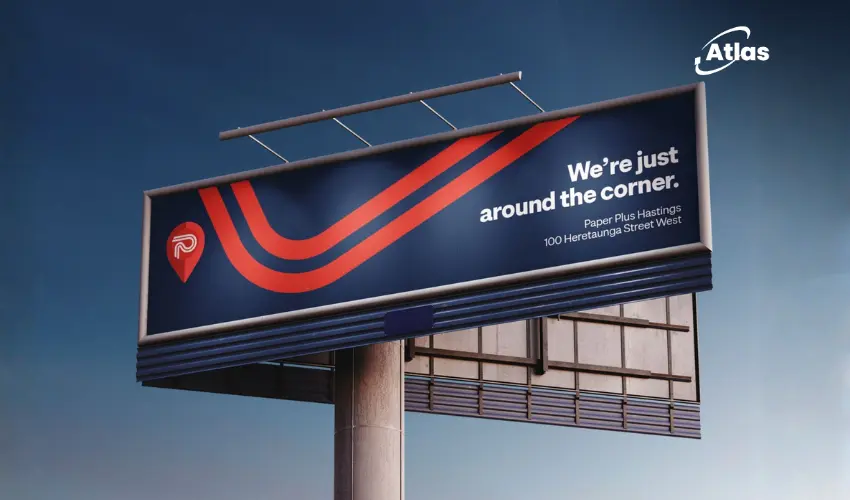
Rather than relying on a generic national message, the campaign turned every billboard into a useful local guide.

Turning brand assets into navigation tools
The campaign was inspired by a simple marketing principle often championed by branding experts: strong brands grow through consistent use of distinctive assets.
NZ Post leveraged its recognizable visual identity, colors, typography, and branding elements to create a campaign that was instantly familiar while also delivering highly practical information.

Instead of asking people to remember a slogan, the campaign helped them solve a real-world problem: finding the nearest branch.
More than 250 unique executions
At the heart of the campaign was an unusually ambitious localization strategy.
More than 250 bespoke outdoor executions were created, each tailored to a specific location with customized directions, local landmarks, and artwork relevant to that area.
The level of detail required extensive geographic research and precise mapping to ensure every placement accurately guided viewers toward the nearest NZ Post service point.
Rather than one national creative adapted across regions, the campaign effectively became hundreds of individual campaigns working together under a unified brand system.
Why hyperlocal OOH continues to grow
Consumers increasingly expect relevance from advertising, especially in physical environments.
Location-based OOH allows brands to move beyond broad awareness and deliver messages that are useful within the exact context where they appear.
For service-driven organizations like NZ Post, hyperlocal messaging can improve both visibility and customer convenience simultaneously.
The campaign demonstrates how outdoor advertising can function as both communication and utility.
Using scale without losing relevance
One of the biggest challenges in national advertising is maintaining local relevance while preserving consistency.
NZ Post solved that challenge by creating a flexible creative framework. Every execution looked unmistakably like NZ Post, but each carried information specific to the surrounding community.
This balance between consistency and customization helped reinforce brand recognition while making every billboard feel personally relevant.
A lesson in practical creativity
Many award-winning OOH campaigns succeed because they surprise audiences. This campaign succeeds because it helps them.
By focusing on usefulness rather than spectacle, NZ Post demonstrates that creativity does not always need to be disruptive. Sometimes the most effective idea is simply making life easier for people.
The result is a campaign that feels less like advertising and more like a public service delivered through a strong brand identity.
What marketers can learn from this campaign
- Distinctive brand assets build recognition: Consistent visual systems help campaigns remain instantly identifiable.
- Localization increases relevance: Audiences respond more strongly to messages that reflect their immediate surroundings.
- Utility creates engagement: Helpful advertising often earns more attention than purely promotional messaging.
- Scale and personalization can coexist: Technology and planning make mass customization increasingly practical.

Bottom line
NZ Post’s localized outdoor campaign shows how powerful OOH can become when branding and practicality work together.
By creating more than 250 customized executions tailored to specific communities, the campaign transformed ordinary wayfinding into a memorable brand experience—proving that relevance, not just reach, is often the key to effective outdoor advertising.
Comments
Share your take. Keep it constructive and specific.