
How Niska Turned His Fans Into the Stars of His Stadium Campaign
When artists announce a stadium show, the communication usually revolves around the performer.
The posters feature the artist. The trailers focus on the artist. Social media celebrates the artist.
For French rapper Niska, creative agency DAT-WAY asked a different question.
What if the stadium didn't belong to the artist?
A Stadium That Belongs to the Fans
Instead of presenting three nights at the Stade de France as a personal achievement, the campaign framed the concerts as a collective accomplishment.
The central idea was simple:
No artist reaches a stadium alone.
Every sold ticket, every stream, every concert and every shared moment contributed to making the event possible.
The campaign's signature line captured that philosophy perfectly:
"This Stade de France isn't mine, it's yours."
Removing the Star From His Own Campaign
One of the boldest creative decisions was making Niska almost invisible throughout the communication.
Rather than dominating the campaign, he deliberately stepped aside.
The activation unfolded across fan communities, partner channels and public spaces instead of relying primarily on the artist's own social media.
That decision reinforced the campaign's central message: this achievement belonged to everyone.
Four Chapters, One Community
DAT-WAY translated the idea into a participative campaign built around four connected activations.
The first was a film directed by Elie Titi, where Niska gave center stage to the people behind his success.
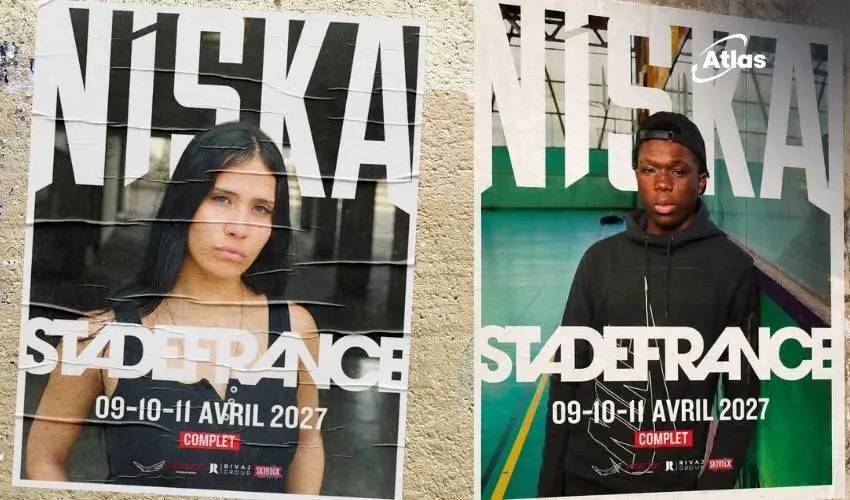
The second was a large-scale wild-posting campaign across Essonne — known locally as "91," Niska's home area — replacing the artist's portrait with photographs of local residents.
The third invited fans to send their own photos via direct message in exchange for personalized Stade de France concert posters.
Finally, every submitted portrait became part of a dedicated Instagram gallery before thousands of fan faces were ultimately projected onto the giant screen inside the Stade de France itself.
Participation Instead of Promotion
Rather than announcing concerts, the campaign invited people to become part of them.
Each personalized poster gave fans something that traditionally belongs only to artists: ownership of the event's visual identity.
Instead of simply buying a ticket, supporters became visible contributors to the campaign itself.
The result blurred the line between audience and communication.
Why the Campaign Worked
Music marketing often depends on celebrity.
This campaign depended on belonging.
By making supporters feel responsible for the achievement, DAT-WAY transformed promotion into recognition.
That emotional shift generated extraordinary engagement, ultimately contributing to a historic triple sell-out at France's largest stadium.
The launch film alone generated more than 15 million views, alongside hundreds of thousands of interactions across social platforms.
What Makes the Campaign Effective
- It flips the traditional hierarchy: Fans become the heroes instead of the artist.
- It transforms OOH into participation: Wild-posting features real people rather than celebrity portraits.
- It builds community ownership: Personalized posters allow every supporter to become part of the campaign.
- It creates emotional recognition: The campaign thanks fans instead of simply selling to them.
- It ends with collective celebration: Thousands of supporters appear on the stadium's biggest screen.
The Bigger OOH Lesson
Outdoor advertising is increasingly moving beyond visibility toward participation.
The strongest campaigns no longer ask audiences to admire the message.
They invite people to become part of it.
DAT-WAY demonstrates how public space can become a stage where communities see themselves represented, creating emotional ownership that traditional advertising rarely achieves.
Bottom Line
Niska's Stade de France campaign proves that sometimes the most powerful way to celebrate a star is to remove them from the spotlight.
By giving the campaign to the fans, DAT-WAY transformed three concerts into a shared cultural achievement rather than a personal milestone.
The result was more than a sell-out tour. It became a public thank-you to the community that made the stadium possible in the first place.
Plan your OOH campaign
Get recommendations for markets, formats and availability based on your campaign goals.
Request a media plan
Comments
Share your take. Keep it constructive and specific.