
Metropolitan Memorial Parks Reframes How People See Memorial Spaces
Most people rarely think about memorial parks until a significant life event forces them to. That reality became the starting point for a new campaign developed for Metropolitan Memorial Parks (MMP), an organization seeking to fundamentally reshape how these spaces are perceived.
Rather than focusing on loss, the campaign introduces audiences to memorial parks through a different lens—one centered on nature, heritage, reflection, and everyday human experiences.
The result is a thoughtful outdoor advertising campaign designed to build awareness long before people ever need to make decisions related to memorial services.

Changing perceptions before changing behavior
Many public awareness campaigns focus on immediate action. This one takes a different approach.
The objective was not to encourage an instant response, but to gradually change how people think and feel about memorial parks.
That strategic shift recognizes an important reality: perception often changes long before behavior does.
By introducing audiences to memorial parks in a new context, the campaign aims to create familiarity, curiosity, and emotional openness over time.
Letting the landscape tell the story
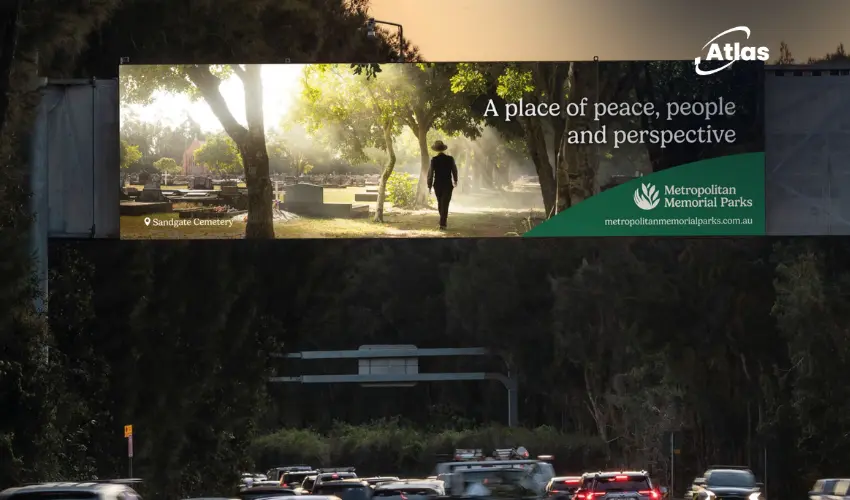
The outdoor creative relies heavily on evocative landscape photography.
Wide open spaces, natural beauty, and carefully composed scenes become the campaign’s primary storytelling device.
A subtle human presence appears within many of the visuals, helping viewers imagine themselves within these environments while maintaining a sense of scale and tranquility.
Instead of overwhelming audiences with information, the campaign uses a single line of copy to reframe the image and encourage reflection.

The power of restraint in OOH
Outdoor advertising often rewards simplicity, and this campaign embraces that principle fully.
The creative avoids excessive messaging, allowing the photography and emotional tone to carry most of the communication.
This restraint creates space for interpretation, encouraging viewers to pause and reconsider assumptions they may hold about memorial spaces.
In a crowded media environment, quiet confidence can often stand out more effectively than visual noise.
Building a long-term brand platform
The outdoor campaign serves as the foundation of a broader brand initiative.
The work emerged from a comprehensive process that included strategic development, campaign ideation, creative execution, OOH planning, and video production.
Every element was built around the same central belief: memorial parks are places filled with stories, beauty, history, and humanity, and those qualities deserve greater visibility.
The outdoor executions carry much of that responsibility during the campaign’s first phase, introducing the public to a different narrative before expanding into other channels.
Why place branding matters
Place-based organizations often face a unique challenge: people think they already understand what the place represents.
Successful place branding requires uncovering overlooked dimensions and giving audiences a fresh perspective.
In this case, the campaign shifts the conversation away from what memorial parks are traditionally associated with and toward what they can represent as public spaces within the community.
What marketers can learn from this campaign
- Perception change takes time: Awareness campaigns can be most effective when they focus on emotional reframing.
- Photography can carry powerful stories: Strong visuals often communicate more than lengthy copy.
- Simplicity increases impact: Minimal messaging allows audiences to engage more deeply with the creative.
- Place branding benefits from fresh perspectives: Reframing familiar spaces can create new emotional connections.

Bottom line
The Metropolitan Memorial Parks campaign demonstrates how outdoor advertising can be used to challenge assumptions and build emotional understanding.
Through striking landscapes, understated storytelling, and a clear strategic vision, the campaign transforms memorial parks from places people rarely consider into destinations defined by beauty, history, and human connection.
Rather than asking audiences to think about loss, it invites them to see these spaces through an entirely new perspective.
Comments
Share your take. Keep it constructive and specific.