
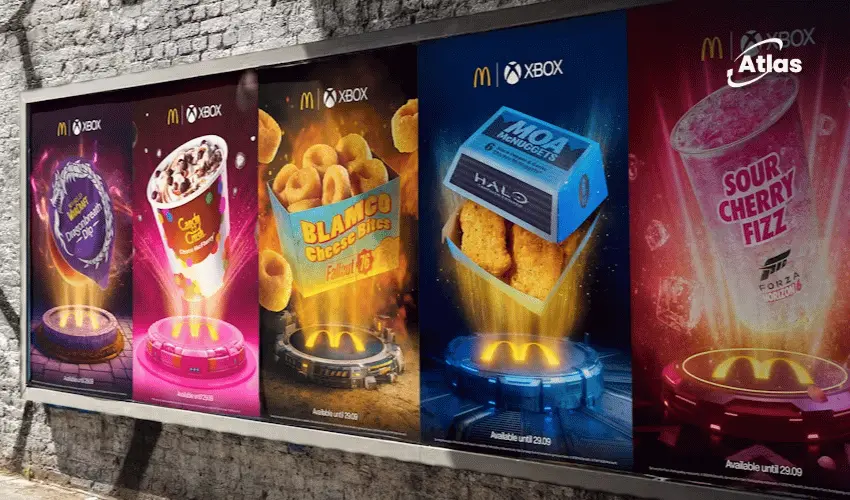
McDonald’s x Xbox Brings Legendary In-Game Food Into the Real World
Gaming collaborations often stop at branded skins, limited-edition packaging or a celebrity streamer.
McDonald’s x Xbox goes one step further: it takes food that only existed inside games and makes it real.
Created by Leo UK, the latest chapter of Side Missions brings together six major gaming franchises and translates their worlds into menu items, packaging, physical environments and fan experiences.
/f/102932/1240x697/0b388b7bf5/mcdonald-s-side-missions-2026.png)
The result is a campaign that does not simply borrow from gaming culture.
It builds with it.
From fictional food to real-world menu
At the center of the partnership is a limited-time Side Missions Menu inspired by memorable and sometimes mythical foods from gaming worlds.
Examples include:
- Halo-inspired Black Pepper & Garlic McNuggets, based on Moa Nuggets.
- Blamco Cheese Bites, inspired by Fallout 76’s Blamco Mac & Cheese.
The creative mechanic is extremely strong because the product itself becomes the crossover.
Fans are not only seeing references to the games.
They can physically order something that previously existed only inside those fictional universes.
Side Missions starts with a fan truth
The platform first launched in 2025 around a simple observation:
A trip to McDonald’s is often life’s best detour.
That idea maps naturally onto gaming language.
Players have a main objective, but some of the most enjoyable parts of a game happen when they leave the main path and explore a side mission.
McDonald’s positions itself as that detour in real life.
Six gaming worlds, one campaign system
The new campaign brings together six recognizable gaming franchises:
- Halo: Campaign Evolved
- Fallout 76
- Forza Horizon 6
- Overwatch
- World of Warcraft
- Candy Crush
Each title has its own visual language, lore and community.
The challenge is to make each one feel authentic while still belonging to the same McDonald’s platform.
Fans help build the campaign
One of the most important differences in this rollout is that gaming fans are not treated simply as an audience.
They become part of the campaign development and launch process.
Creators including Poopernoddle, Blue & Queenie participate through streams and social content designed to tease and leak the partnership before the official reveal.
This is strategically smart because gaming communities are highly sensitive to tone and authenticity.
A campaign feels more credible when the first excitement comes from voices already embedded in the culture.
The teaser phase behaves like game discovery
The campaign began with teaser activity on August 11 through Xbox and game-owned social channels.
McDonald’s Golden Arches were reimagined through the visual language of the individual game worlds.
Instead of immediately explaining the collaboration, the campaign seeds clues.
That turns discovery into part of the experience.
Fans start asking what the symbols mean, what food may be coming and how the different franchises connect.
The creator preview becomes an immersive content engine
On August 19, a creator tasting and preview event gave gaming personalities early access to the menu, packaging and game-inspired details.
The space was divided into immersive zones built around the participating IPs.
This allowed creators to discover:
- Gaming lore.
- Easter eggs.
- Menu references.
- Packaging details.
- Physical representations of the game worlds.
The event therefore acts less like a conventional media preview and more like a content production environment.
The hero film makes McDonald’s the side mission
At launch on August 22, a 60-second hero film brings the core platform to life.
The spot opens inside Halo: Campaign Evolved, where two Marines abandon their tactical objective to take a Side Mission to McDonald’s.
Characters from all six gaming titles eventually leave their own worlds and converge at McDonald’s.
The joke is simple:
Even the biggest heroes sometimes want to stop what they are doing and grab food.
Why the campaign translates naturally into OOH
Outdoor media gives the collaboration something gaming normally cannot provide:
physical scale in the real world.
Characters, menu items and in-game visuals that audiences normally encounter on screens can suddenly appear across city environments.
This creates a strong bridge between digital fandom and physical presence.
- Billboards make fictional food feel tangible.
- Transit media reaches fans during real-world journeys.
- Retail proximity pushes audiences toward restaurants.
- DOOH can rotate different game worlds within one campaign.
Contextual OOH makes the detour literal
The campaign also uses contextual journey-led media, including activity connected with Citymapper.
This is particularly relevant to the Side Missions idea.
A navigation environment is literally where people think about routes, destinations and detours.
The campaign can therefore encourage consumers to leave their current “main mission” and go to McDonald’s.
Packaging becomes game-world evidence
The collaboration also uses visuals from the participating games across the packaging and menu system.
This helps ensure that the experience does not end when someone enters the restaurant.
The physical product becomes another layer of the gaming crossover.
For fans, packaging can also function as a collectible or social object, increasing the likelihood of photography and sharing.
Real cosplayers blur the line further
Paid social and creator content includes characters and real cosplayers trying and reviewing the menu.
This is another smart layer because cosplay already specializes in bringing fictional worlds into reality.
Pairing cosplayers with food inspired by those worlds reinforces the same central transformation:
Game culture is leaving the screen.
TikTok turns Side Missions into a behavior
TikTok activity encourages fans to create their own Side Missions.
This moves the platform beyond one branded story and gives audiences a format they can reinterpret themselves.
The campaign therefore becomes participatory rather than purely observational.
Fans can create their own detours, jokes and experiences within the same idea.
YouTube helps communities cross over
The campaign also uses collaborative posting across Xbox and game IP channels on YouTube.
This matters because the six gaming franchises already have their own audiences.
Cross-posting allows McDonald’s to participate within those existing communities rather than expecting all fans to migrate toward a central brand channel.
Plan your OOH campaign
Get recommendations for markets, formats and availability based on your campaign goals.
Request a media plan
Comments
Share your take. Keep it constructive and specific.