
McDonald’s Turns Méqui 1.000 Into a KPop Demon Hunters Pop Culture Stage
OOH, live marketing and immersive experience do not always need to exist as separate disciplines.
Sometimes they can all happen inside one highly visible physical location.
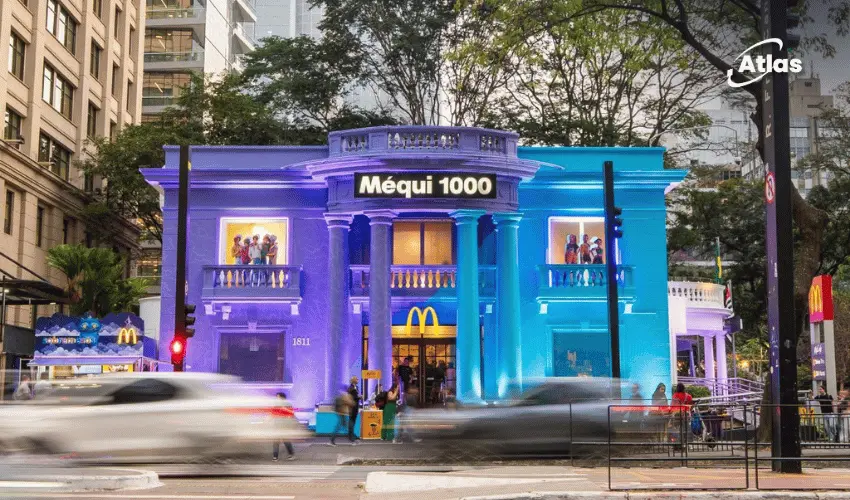
That is what McDonald’s is doing at Méqui 1.000, its landmark restaurant on Avenida Paulista in São Paulo.
The flagship has received a new visual identity inspired by KPop Demon Hunters, bringing the rivalry between Huntr/X and Saja Boys into the restaurant environment.
A store becomes media
The activation goes far beyond applying a few themed graphics to the windows.
The entire restaurant becomes part of the communication system.
- The facade creates the first impact.
- The dining room continues the story.
- Ordering and service points extend the visual world.
- The drive-thru carries the campaign into another customer journey.
This turns the store itself into a piece of media architecture.
A layered journey from sidewalk to order
The strongest part of the concept is its use of progression.
The customer does not receive the entire experience at once.
Instead, each environment reveals another piece of the rivalry between the two KPop Demon Hunters universes.
The journey begins outside.
Then it continues inside the restaurant.
By the time the customer receives the order, they have moved through several layers of the same story.

The facade does the OOH work
From the street, the restaurant functions like a large-format outdoor placement.
The building interrupts McDonald’s familiar visual system with a temporary entertainment identity designed to attract attention from pedestrians and passing traffic.
That disruption is especially valuable because the audience already knows what a McDonald’s normally looks like.
Changing the expected appearance creates immediate visual tension.
The building becomes recognizable because it is suddenly behaving differently.
Why breaking brand consistency can create attention
Brand consistency is normally treated as a fundamental rule.
But flagship activations sometimes gain impact by deliberately breaking that rule for a short period.
The familiar McDonald’s architecture provides the baseline.
The KPop Demon Hunters transformation creates the surprise.
Because the original brand is already deeply recognizable, the temporary visual shift does not necessarily weaken attribution.
It can actually make the location more noticeable.
Avenida Paulista is part of the strategy
The location makes the activation significantly more valuable.
Avenida Paulista is one of São Paulo’s most important cultural, commercial and pedestrian corridors.
On Sundays, the avenue closes to vehicle traffic and becomes an even more active public space.
For a flagship experience, that creates a large audience that can encounter the campaign without ever planning to visit McDonald’s.
The store therefore serves both customers and passersby.

The address already behaves like a media platform
Méqui 1.000 has become more than a restaurant.
It has repeatedly served as a branded stage for entertainment and cultural campaigns.
TV1 has previously transformed the same location around properties including Minecraft, Formula 1 and Brincando de Méqui.
This repetition gives the address its own media value.
Audiences can begin to expect that something different may be happening there.
The physical site becomes a recurring campaign platform.
Why recurring flagship takeovers work
Repeated use of the same high-profile store creates several advantages:
- Operational familiarity: Teams already understand how the space can be transformed.
- Audience expectation: People learn that the flagship regularly hosts unusual experiences.
- Media recognition: The location itself becomes newsworthy.
- Creative flexibility: Different entertainment properties can use the same architecture in new ways.
Instead of starting from zero for every activation, McDonald’s is effectively building a permanent experiential platform inside its retail network.
Pop culture creates reasons to visit
The restaurant no longer competes only on food and convenience.
A major entertainment collaboration gives people another reason to visit:
To experience the campaign itself.
That changes the role of the physical store.
The location becomes a destination for fans, content creators and people curious about the transformation.
Food remains part of the visit, but culture becomes the traffic driver.
The Huntr/X and Saja Boys rivalry creates structure
The campaign also benefits from having two recognizable opposing worlds.
Instead of one undifferentiated visual theme, the rivalry between Huntr/X and Saja Boys gives designers a natural framework for dividing and connecting spaces.
Different areas can represent different sides of the story while still belonging to the same property.
This creates contrast, visual variety and a reason for customers to keep exploring.
The journey extends beyond the dining room
Including the drive-thru is strategically important.
Many immersive retail activations focus only on people who enter the store.
That leaves out a significant part of restaurant traffic.
By bringing the campaign into the drive-thru, McDonald’s extends the experience to customers who may never step inside.
The activation therefore adapts to several modes of interaction with the same location.
- Pedestrians encounter the facade.
- Visitors experience the interior.
- Customers interact with branded service points.
- Drivers experience the theme through the drive-thru.
Designed for real life and social media
A highly transformed flagship naturally creates content.
Fans can photograph the facade, record the interior and compare the different themed areas.
The campaign therefore operates simultaneously as physical experience and social media source material.
This is especially relevant for a pop culture property with audiences accustomed to sharing fandom publicly.
The store becomes a backdrop for fan participation.
OOH without buying a conventional billboard
One of the most interesting aspects of the activation is that McDonald’s already owns the physical canvas.
The facade performs many of the same functions as premium OOH:
- Large-scale visibility.
- High pedestrian exposure.
- Urban disruption.
- Strong photography potential.
- Repeated impressions from local traffic.
The difference is that the media surface is also a functioning place of business.
That creates a direct connection between awareness and transaction.
From exposure to participation
A traditional billboard usually ends with awareness.
This activation can continue the relationship.
Someone sees the transformation from Avenida Paulista, enters the restaurant, explores the themed spaces, orders food and potentially shares the experience online.
The customer journey therefore moves through several marketing objectives in one location:
Attention → curiosity → visitation → participation → purchase → sharing.
Plan your OOH campaign
Get recommendations for markets, formats and availability based on your campaign goals.
Request a media plan
Comments
Share your take. Keep it constructive and specific.