
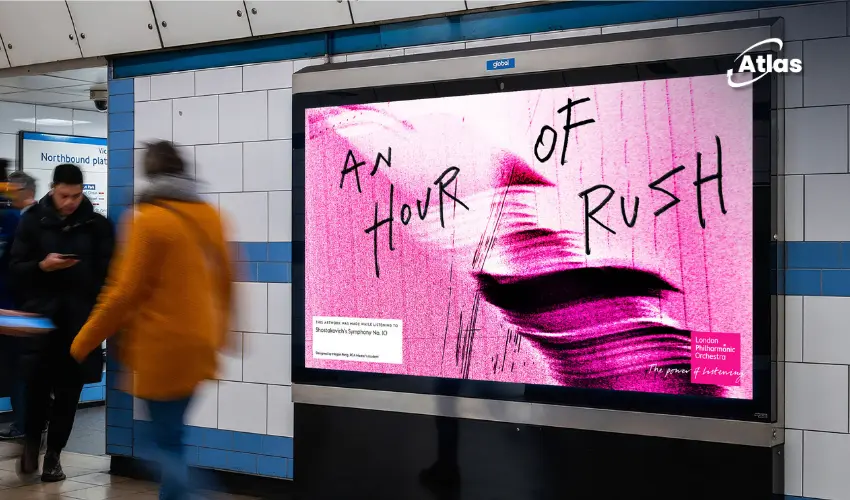
London Philharmonic Orchestra Turns the Feeling of Music Into Public-Space Visuals
Want to Turn an Idea Into an OOH Experience People Can Feel?
The London Philharmonic Orchestra campaign shows how public media can communicate something as intangible as emotion. If your brand, cultural organisation or entertainment property wants to use DOOH, experiential media, transit or high-impact urban placements to create a stronger human response, Atlas OOH can help bring that idea into physical space.
Listening is usually invisible.
You can see the orchestra.
You can see the audience.
But you cannot directly see what the music makes someone imagine or feel.
“The Power of Listening” tries to make that invisible response visible.
The new brand platform gives the London Philharmonic Orchestra a long-term idea built around the exchange between musicians, audiences and communities.
A brand platform designed to go beyond advertising
The campaign is not positioned as a short-term seasonal line.
According to the supplied campaign information, “The Power of Listening” is intended to influence artistic programming, future collaborations, education and community work, as well as the Orchestra’s public communications.
That gives the idea more weight than a conventional advertising platform.
It becomes a way of describing what the organisation believes orchestral music can do.
Royal College of Art artists turned listening into visual language
The first campaign expression was developed in collaboration with the Royal College of Art.
Eight postgraduate artists were each asked to listen deeply to a piece of orchestral music and then create something from the feelings it produced.
The works came from music released through the Orchestra's own record label, spanning decades of its history under different Principal Conductors.
The result is deliberately varied.
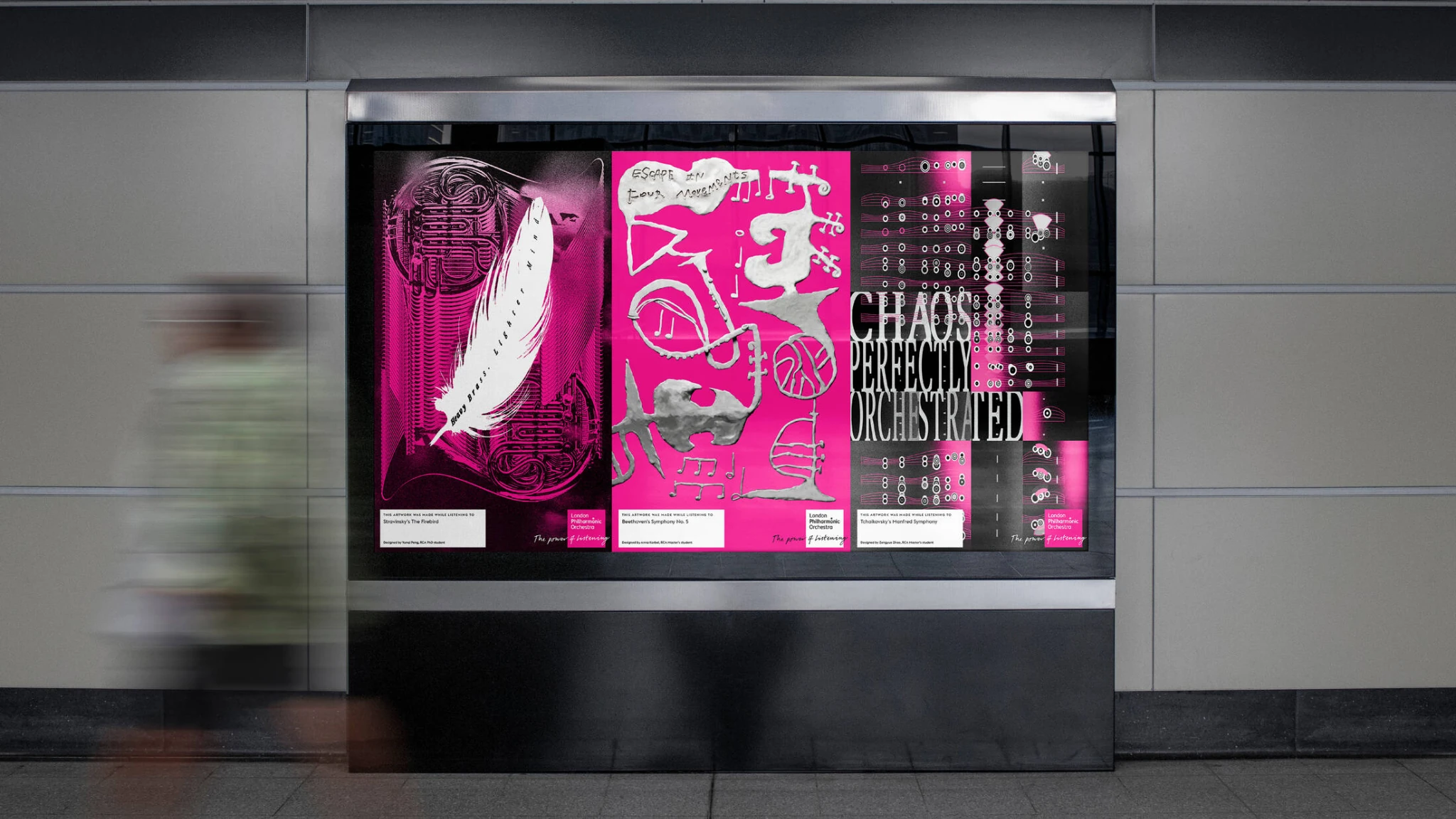
Each artwork shows a different interpretation of what listening can create in the mind.
The creative gives classical music a less expected visual identity
One of the most effective aspects of the work is that it does not rely on familiar visual codes for orchestral music.
There are no conventional portraits of conductors or formal concert-hall imagery dominating the campaign.
Instead, the work is expressive, graphic, energetic and sometimes chaotic.
That choice helps the Orchestra communicate with people who may not immediately see classical music as something designed for them.
The campaign treats the listener’s emotional response as the hero rather than the institution itself.
The Listening Wall turns OOH into an active experience
A specially built Listening Wall at Vinegar Yard in London gives the visual work another dimension.
All eight artworks are paired with headphones.
Passers-by can listen to the same orchestral pieces that inspired the artists while looking at the resulting artwork.
That creates a simple but powerful loop:
- A musician performs the work.
- An artist listens and interprets it visually.
- The artwork enters public space.
- A passer-by listens to the same music.
- The audience forms its own emotional response.
The campaign therefore asks people to participate instead of only observe.
Experiential media helps remove the barrier of the concert hall
The location is strategically important.
The Listening Wall is designed to reach people who may never have considered an orchestral experience as something “for them.”
By moving the first encounter into a public environment, the Orchestra reduces the cultural and physical barrier of entering a concert hall.
People can experience the music on their own terms, in everyday city life.
DOOH extends the idea across London
The campaign does not stop at the Listening Wall.
Its visual system extends across paid and organic social media and digital out-of-home placements across London.
That allows the artworks to appear in the same urban environment the campaign wants to interrupt.
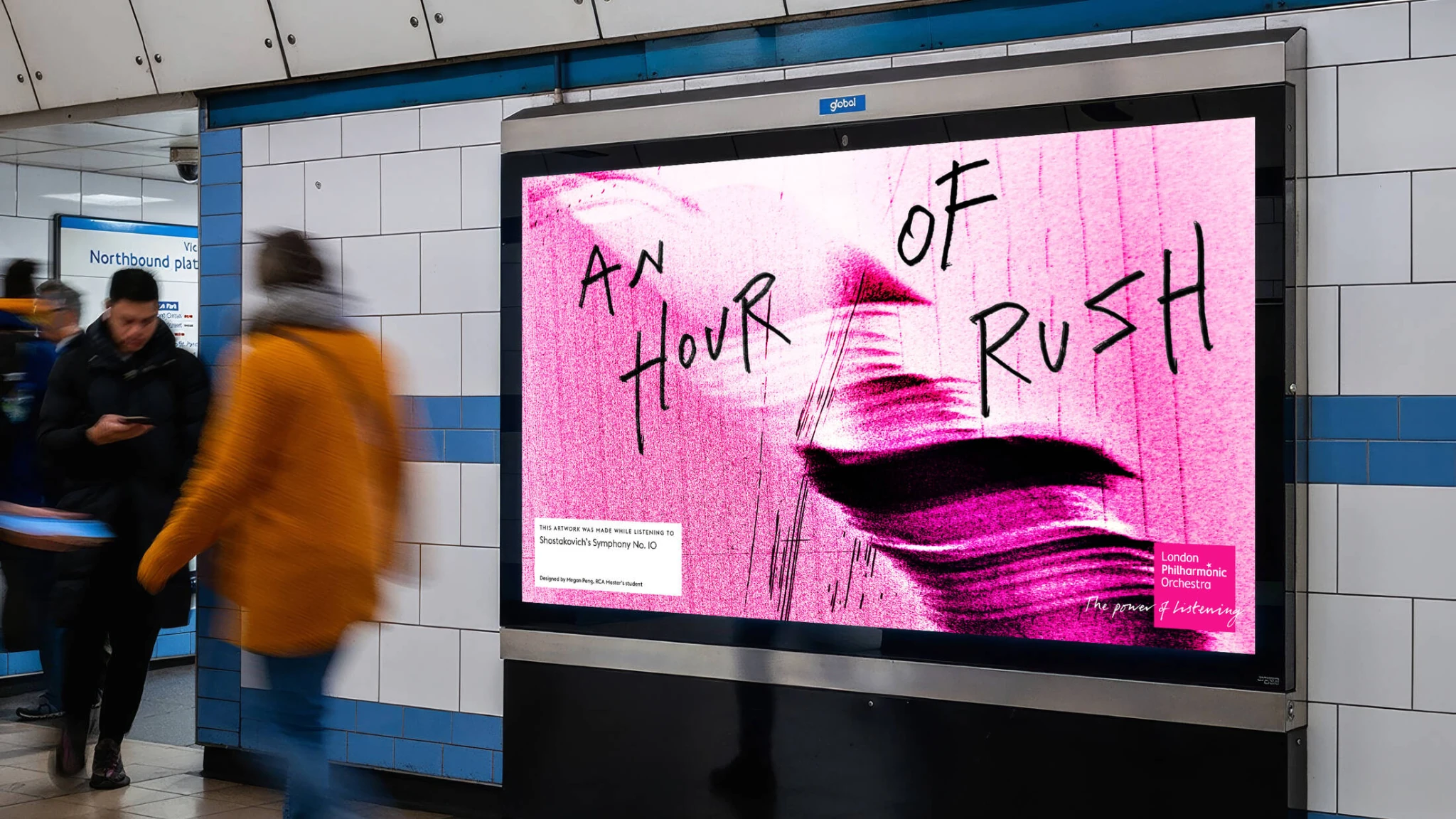
Commuters may encounter a vivid visual interpretation of orchestral music during an ordinary journey through the city.
The contrast between everyday movement and expressive artwork is part of the campaign's power.
The medium reinforces the message
The campaign asks people to stop and listen.
Outdoor media gives that idea a useful tension because it appears in places where people are usually moving quickly.
A train platform, street environment or commuter route is normally designed around speed.
The campaign introduces a moment of reflection into that movement.
That makes the media environment part of the concept rather than simply a place to display the artwork.
Why the collaboration with RCA matters
The partnership with the Royal College of Art gives the campaign a second creative voice.
The Orchestra supplies the music.
The artists supply their individual visual responses.
Neither interpretation is presented as definitive.
Instead, the campaign suggests that listening can create completely different internal experiences for different people.
That openness supports the broader ambition of making orchestral music feel less exclusive and more personally relevant.
From outdoor advertising to cultural invitation
The strongest aspect of “The Power of Listening” is that it does not behave only like an ad campaign.
It works as an invitation.
The OOH catches attention.
The visual art creates curiosity.
The headphones allow participation.
The Orchestra becomes the next destination.
This creates a more complete journey from public-space discovery to live cultural experience.
Atlas OOH can help cultural brands make ideas physical
The London Philharmonic Orchestra shows how outdoor media can carry more than information.
It can create a pause, provoke an emotional response and invite participation.
Atlas OOH can help cultural organisations, entertainment brands and creative platforms combine DOOH, experiential activations, transit media and urban placements to transform abstract ideas into public experiences.
Whether the goal is awareness, audience development or deeper participation, the right physical media strategy can help people experience a brand before they ever reach the final destination.
Bottom line
“The Power of Listening” turns the London Philharmonic Orchestra’s core belief into something people can encounter in the city.
Music becomes visual art.
Visual art becomes OOH.
OOH becomes an invitation to listen.
And listening becomes the bridge between the Orchestra and audiences who may never have considered classical music part of their world.
The campaign does not simply promote the sound of the Orchestra. It visualises what listening can make people feel.
If your brand wants to translate emotion, culture or creativity into a physical media experience, Atlas OOH can help build an OOH strategy designed around attention, participation and meaningful public-space encounters.
Frequently asked questions
What is The Power of Listening?
The Power of Listening is the London Philharmonic Orchestra's new long-term brand platform, built around the connection created between musicians, audiences and communities through active listening.
Who created the campaign?
The brand platform was created by Ace of Hearts, with the first campaign expression developed in collaboration with postgraduate artists from the Royal College of Art.
What is the Listening Wall?
The Listening Wall is a specially built installation at Vinegar Yard in London that pairs eight original artworks with headphones, allowing visitors to hear the orchestral pieces that inspired each visual response.
How does the campaign use OOH and DOOH?
The campaign extends the visual artworks into public media across London, including digital outdoor placements, while the Listening Wall adds an experiential layer that lets people hear the music behind the creative.
Plan your OOH campaign
Get recommendations for markets, formats and availability based on your campaign goals.
Request a media plan
Comments
Share your take. Keep it constructive and specific.