
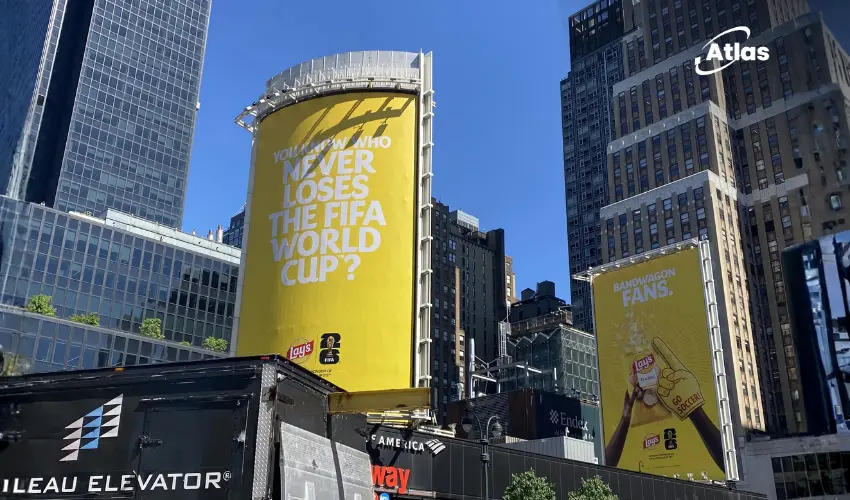
Lay’s Turns Two NYC Billboards Into a FIFA World Cup Conversation
As the road to the FIFA World Cup gains momentum, brands around the world are looking for ways to capture attention and become part of the conversation. Lay’s chose to do it with one of advertising’s oldest and most effective tools: curiosity.
Instead of filling a billboard with product shots and messaging, the brand launched a bold execution that begins with a simple question displayed across a bright yellow canvas. The oversized creative immediately grabs attention, encouraging passersby to stop, think, and look for more information.
The twist is that the answer doesn’t appear on the same billboard.
It appears on a neighboring placement, turning two separate media units into a connected storytelling experience that unfolds across the city skyline.

Turning Billboards Into a Conversation
Most outdoor campaigns deliver a complete message in a single glance. Lay’s takes a different approach by creating a moment of discovery.
The first billboard introduces intrigue. The second provides the payoff.
This sequencing transforms the audience from passive viewers into active participants. Rather than simply seeing an advertisement, people become involved in solving it.
Why Curiosity Works
Human beings naturally seek closure.
When presented with an incomplete story or unanswered question, people instinctively want to know more. This psychological principle has long been used in entertainment, journalism, and advertising.
Lay’s applies it perfectly to outdoor media.
By withholding part of the message, the campaign creates a small but powerful engagement moment that traditional billboard advertising often struggles to achieve.
Leveraging World Cup Excitement
The FIFA World Cup is one of the few global events capable of capturing attention across countries, cultures, and generations.
As anticipation builds, audiences become more receptive to football-related messaging and more likely to engage with campaigns connected to the tournament.
Lay’s benefits from this environment by positioning itself within the broader cultural conversation surrounding the event.
The campaign doesn't need to explain why football matters. The audience already understands.
Instead, it uses that existing excitement as a platform for creativity.
The Power of Simplicity
Outdoor advertising is often most effective when it communicates one clear idea.
Lay’s avoids clutter, lengthy copy, and visual complexity. The campaign relies on three elements:
- A bold question.
- A highly visible color palette.
- A reveal placed nearby.
This restraint allows the concept itself to become the hero.
In a medium where viewers may have only a few seconds to engage, simplicity becomes a competitive advantage.
Creating a City-Scale Experience
One of the most interesting aspects of the campaign is how it uses the urban environment as part of the storytelling.
The distance between the billboards creates anticipation. The city itself becomes the connective tissue between the question and the answer.
This approach transforms outdoor media from a static display into something that feels interactive without requiring technology or digital interfaces.
It's a reminder that great OOH ideas often come from rethinking how people move through space.

What Brands Can Learn
- Curiosity is a powerful attention driver.
- Multiple placements can work together as one story.
- Simplicity often increases effectiveness.
- Major cultural events amplify creative ideas.
Most importantly, the campaign demonstrates that outdoor advertising doesn't need complicated technology to feel engaging.
Bottom Line
Lay’s FIFA World Cup billboard campaign proves that sometimes the best way to get attention is not to give audiences all the answers immediately.
By turning two billboards into a single narrative, the brand creates an experience that rewards curiosity while tapping into the excitement surrounding the world’s biggest sporting event.
It's a simple idea, executed with confidence, and a strong example of how outdoor advertising can transform a city into part of the story.
Plan your OOH campaign
Get recommendations for markets, formats and availability based on your campaign goals.
Request a media plan
Comments
Share your take. Keep it constructive and specific.