
Kwit for Good: IMA Uses Stark OOH to Reframe Smoking Through Children’s Eyes
Anti-smoking campaigns have long relied on shock, warnings, and graphic health consequences. IMA’s new campaign for Kwit takes a different route: it asks smokers to see the habit through the eyes of their children.
Created to mark the UK launch of Kwit, a global quit-smoking app, the pro-bono campaign is titled “Kwit for Good.” Timed around World No Tobacco Day, the work is designed to drive behaviour change by reframing cigarettes as an immediate emotional threat inside everyday family life.
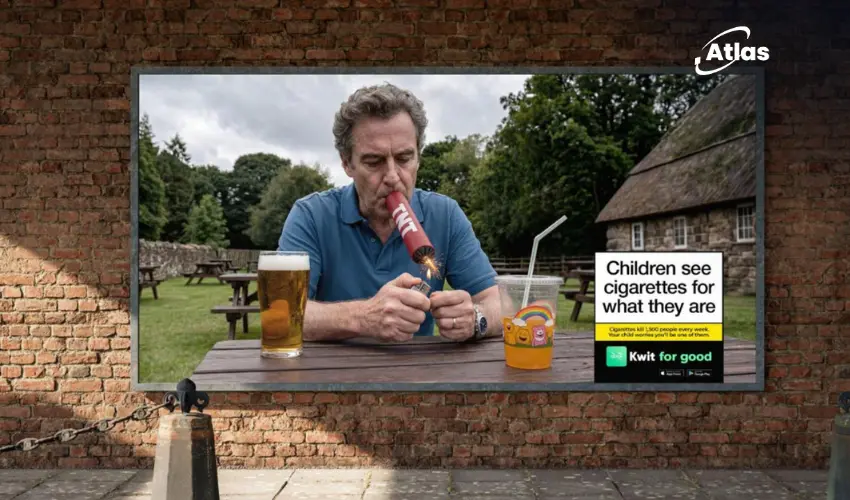
The creative features parents in familiar daily situations, watched by their children, with sticks of dynamite in their mouths. The image is deliberately stark. It turns smoking into something children can understand literally: dangerous, unstable, and frightening.
The Public Health Problem Behind the Campaign
The campaign responds to a severe public health reality: cigarettes continue to kill large numbers of people in the UK every week. Many of those affected are parents, which gives the campaign its emotional focus.
Rather than focusing only on the smoker’s personal health, IMA shifts attention to the family members who witness the habit and live with its consequences.
Why the Dynamite Metaphor Works
The dynamite visual is intentionally uncomfortable. It replaces the familiar image of a cigarette with an object that instantly signals danger.
This works because the campaign does not need a complicated explanation. The metaphor is immediate: smoking is not harmless, passive, or private. It is a risk that sits visibly in the middle of family life.
By presenting the scene from a child’s perspective, the campaign avoids becoming another medical warning. Instead, it becomes an emotional mirror. The smoker is invited to see not only the physical danger of cigarettes, but also the confusion, concern, and pain their habit can create for those around them.
OOH as a Behaviour Change Channel
The campaign will run in press on World No Tobacco Day, followed by out of home placements and a supporting campaign film.
OOH is a particularly strong fit for this kind of public health message because it forces the creative into shared space. A poster on the street can interrupt routine behaviour, spark conversation, and make a private habit feel socially visible.
For quit-smoking campaigns, that visibility matters. Behaviour change often begins with a moment of recognition, and OOH can create that moment at scale.
Positioning Kwit as the Next Step
The campaign does more than shock. It offers a practical next step through the Kwit app, which is designed to help smokers break addiction and sustain progress over time.
This is where the work becomes more than awareness advertising. The emotional impact creates the reason to act, while the app provides the tool to begin.
For public health campaigns, that combination is critical. A strong message can create urgency, but behaviour change needs an accessible path forward.
What Brands Can Learn From Kwit for Good
“Kwit for Good” demonstrates how provocative advertising can be effective when the shock serves a clear purpose.
- The idea is rooted in a human truth: Smoking affects families, not only individuals.
- The visual metaphor is instantly understood: Dynamite makes the danger impossible to ignore.
- The media plan supports urgency: World No Tobacco Day gives the campaign cultural relevance.
- The call to action is useful: Kwit gives smokers a direct way to start quitting.
The strongest public health advertising does not simply warn people. It helps them see their behaviour differently and then gives them a way to change it.
Bottom Line
IMA’s “Kwit for Good” campaign uses OOH, press, and film to turn smoking from a familiar habit into a visible family danger. By framing cigarettes through the eyes of children, the campaign creates a memorable emotional argument for quitting.
It is a sharp example of how outdoor advertising can support public health when strong creative insight, media timing, and a clear action path work together.
Comments
Share your take. Keep it constructive and specific.