
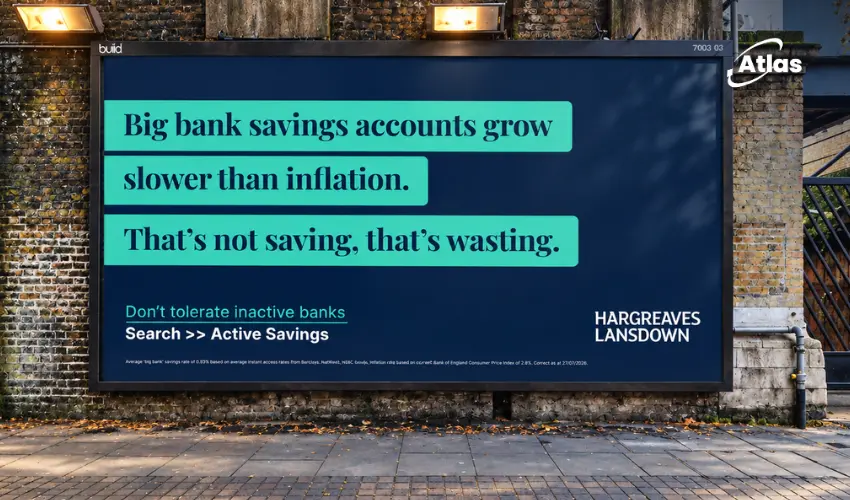
Hargreaves Lansdown Challenges Inactive Banks With OOH
Hargreaves Lansdown is taking aim at one of the quietest habits in personal finance: leaving cash with the same familiar bank simply because it feels easier not to move it.
The UK investment and savings platform has launched a new TV spot for Active Savings as part of its biggest savings campaign to date. Created by Stitchy, the work is the latest phase of the integrated Don’t Tolerate Inactive Banks campaign, already active across OOH, print, social and creator channels, with VOD launching alongside TV.
The campaign is built around a sharp creative reversal. If Hargreaves Lansdown offers Active Savings, then the established banks that benefit from customers doing nothing become inactive banks.
That naming decision gives the campaign its power. It turns a passive behavior into a visible enemy.
A Campaign Built Around Saver Inertia
The insight behind the campaign is simple but commercially important.
Many people with meaningful cash savings, often in the range of £10,000 to £20,000 or more, keep their money with a familiar bank because of habit, trust or long-term loyalty. The problem is that familiarity does not always mean the money is working as hard as it could.
By calling those institutions inactive banks, Stitchy gives the audience a new way to think about a very common behavior. The campaign does not frame savers as careless or foolish. Instead, it places the pressure on banks that quietly benefit when customers leave their savings unquestioned.
This matters because financial advertising often struggles to make abstract money behaviors feel immediate. Interest rates, account switching and savings platforms can be difficult to dramatize. Don’t Tolerate Inactive Banks solves that by creating a simple world where inactivity becomes visible, comic and slightly ridiculous.
The Inactive Bank as a Comic World
The 30-second film, directed by Ben Green at Bullion, takes viewers inside an imaginary inactive bank.
The setting is full of lethargy: yawning staff, unanswered phones and employees finding increasingly creative ways to pass the time. Instead of presenting banking inertia through charts or warnings, the ad builds a world where the behavior is exaggerated enough to become funny.
Creator Rob Madin, known for his comedy alter-ego Brett Domino, plays a banker who presents a poor savings rate as though it were a generous reward for years of customer loyalty.
That performance exposes the gap between the reassuring language of traditional banking and what customers may actually receive in return. The comedy works because the banker's confidence is misplaced. The more casually he presents the offer, the more viewers are invited to question whether loyalty is being rewarded or taken for granted.
Humor That Blames the Banks, Not the Customer
One of the smartest choices in the campaign is where the joke is aimed.
The humor comes at the expense of the banks, not the savers. That distinction is important because financial services campaigns can easily make people feel judged, confused or defensive.
Here, the customer is not the punchline. The inactive bank is.
That makes the campaign more inviting. It gives people permission to laugh at the absurdity of banking complacency while also encouraging them to rethink their own savings behavior.
Stitchy also brought in David Schneider, the BAFTA-nominated writer, director, actor and comedian, as comedy craft consultant. That extra layer of comedy expertise helps sharpen the film's timing, characterization and physical humor.
For a financial product, this is a valuable creative route. Humor makes the subject more approachable, but the argument still remains clear: your savings deserve more attention.
How OOH Distils the Idea
While the film creates the full comic world of the inactive bank, OOH and print have a different job.
Outdoor media needs to reduce the campaign to its most memorable challenge. In this case, the line Don’t Tolerate Inactive Banks does the heavy lifting.
It is direct, easy to read and strategically pointed. It suggests that accepting a poor savings outcome is not simply a neutral choice. It is something people should question.
For passers-by, the message can land quickly. They do not need to understand every detail of Active Savings in the moment. They only need to recognize the tension: maybe the bank they trust is not rewarding that trust as well as they assume.
That makes OOH a strong channel for this campaign. It creates mental availability around the problem before people move into more detailed digital or product channels.
For financial services, fintech and investment brands looking to create campaigns with this kind of clarity, Atlas OOH can help turn complex money behaviors into outdoor messages that are simple, visible and easy to remember. The goal is not to copy this campaign, but to apply the same strategic thinking: find the human behavior, simplify the message and place it where the right audience can see it.
From Active Savings to Inactive Banks
The creative strategy is also effective because it uses the product name itself.
Active Savings is not only a product descriptor. In this campaign, it becomes the starting point for the opposite idea: inactive banks.
That gives the brand a clean and ownable contrast. Hargreaves Lansdown becomes active, while the banks relying on customer inaction become inactive. The comparison is easy to understand and flexible enough to work across TV, OOH, print, social and creator-led content.
It also makes the campaign feel more distinctive in a category where many savings messages rely on percentages, rates and generic promises to “earn more.”
Rates still matter, but the campaign adds a behavioral frame. It asks people not only what rate they are getting, but why they might be tolerating less.
A Post-Social Approach to Financial Advertising
The campaign reflects Stitchy’s post-social approach to creativity.
That means taking what social has taught brands about earning attention, such as recognizable behavior, distinctive characters, creator sensibility and moments people actually want to watch, and applying that thinking beyond the feed.
In this case, Rob Madin’s creator background helps the TV performance feel more character-led and watchable. Shorter social films can then extend the bankers’ time-wasting behavior into individual comic scenarios, while OOH and print provide the sharper public-facing challenge.
This is an important lesson for integrated campaigns. TV, social and OOH do not need to feel like separate creative worlds. They can each express the same idea in the way that best fits the channel.
The film builds the world. Social extends the behavior. OOH lands the argument.
Why the Campaign Works for Financial Services
Financial services brands often need to make people care about decisions they may prefer to avoid.
Savings can feel important but not urgent. Many people know they should review their accounts, but the task is easy to postpone. That is why the campaign's language is useful. Don’t Tolerate Inactive Banks gives people a reason to move the issue up their mental priority list.
It also makes Hargreaves Lansdown feel more active and challenger-like, even though the brand is already a major player in UK investing and savings.
The campaign positions Active Savings as a credible alternative to the default bank relationship. It does not simply ask people to chase a rate. It asks them to challenge inertia.
Why the Campaign Works
- It gives the problem a name: “Inactive banks” turns savings complacency into a memorable enemy.
- It uses humor strategically: The comedy makes personal finance easier to engage with without trivializing the issue.
- It protects the customer: The joke is aimed at banks, not at people who have stayed loyal out of habit.
- It connects directly to the product: Active Savings naturally creates the contrast with inactive banks.
- It works across channels: TV builds the comic world, social extends the characters, and OOH distils the idea into a direct challenge.
- It makes an invisible habit visible: Leaving savings untouched becomes something people can recognize and reconsider.
- It creates a clear behavioral prompt: The campaign encourages people to question what their bank loyalty is actually earning them.
What Marketers Can Learn
The strongest lesson from this campaign is that financial services marketing becomes more effective when it focuses on behavior, not just product features.
Hargreaves Lansdown could have led with product mechanics: multiple banking partners, rates, account management and switching. Those details matter, but they are not always enough to create attention in the wider market.
Instead, the campaign starts with a human truth: people often stay where they are because moving money feels like effort.
By dramatizing that behavior through the idea of inactive banks, the campaign becomes more memorable than a standard savings-rate message. It creates a story, a tone and a simple enemy.
For marketers, this is a useful reminder. When a category is full of similar functional claims, the opportunity may be to name the behavior holding customers back.
The OOH Lesson
OOH is especially useful when a campaign has a line that can carry the entire strategic idea.
Don’t Tolerate Inactive Banks works outdoors because it is short, pointed and emotionally clear. It challenges passivity in a way that can be understood at speed.
In financial services, that clarity matters. People may not stop on the street to compare detailed savings products, but they can absorb a simple idea that later influences consideration.
That is the role OOH plays here. It does not need to explain every feature of Active Savings. It needs to make the problem of inactive banks feel visible enough that people remember it when they are ready to review their money.
Why It Matters for Savings Brands
Savings brands compete not only with each other, but with inertia.
The hardest competitor may be the familiar bank already holding the customer’s money. Even when people suspect they could do better elsewhere, the effort of comparing options can be enough to keep them still.
That is why this campaign is strategically strong. It recognizes that the customer barrier is not only awareness. It is complacency, habit and trust in the default.
By framing those defaults as inactive, Hargreaves Lansdown creates a more active role for itself in the customer's financial life.
The campaign is not personal financial advice. It is a brand challenge: question whether your savings are doing enough.
Bring Your Financial Services OOH Campaign to Life With Atlas OOH
Campaigns like this show how powerful OOH can be when a brand has a clear insight, a strong creative idea and a simple message that people can understand quickly. Atlas OOH helps brands bring that kind of thinking into the real world through outdoor campaigns designed to build visibility, trust and action.
Whether the goal is to launch a financial product, challenge customer inertia, explain a complex service or make a brand feel more present in the market, Atlas OOH can help plan and activate media that turns strategy into public attention. We help brands make their campaigns real, visible and memorable across the places where audiences move, work, commute and make decisions.
Bottom Line
Hargreaves Lansdown’s Don’t Tolerate Inactive Banks campaign shows how financial services advertising can make a low-engagement savings issue feel entertaining, visible and urgent.
Created by Stitchy, the campaign uses comedy, character and an easy-to-understand contrast between Active Savings and inactive banks to challenge the hold established banks have over people’s money.
Across TV, VOD, OOH, print, social and creator channels, the work turns saver inertia into something people can see, laugh at and question.
For Hargreaves Lansdown, the message is simple: your savings should not sit quietly while your bank benefits from your inaction.
In a category often driven by rates and rational comparisons, this campaign proves that a strong behavioral idea can make money feel much more memorable.
Plan your OOH campaign
Get recommendations for markets, formats and availability based on your campaign goals.
Request a media plan


Comments
Share your take. Keep it constructive and specific.