
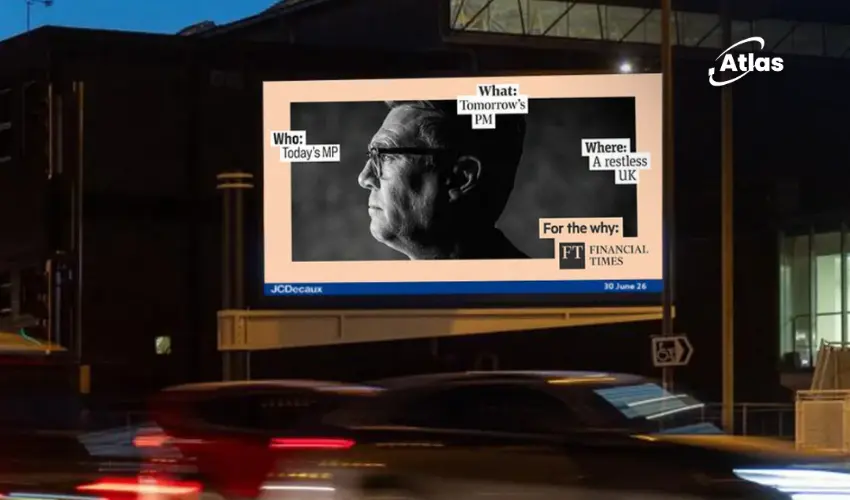
Financial Times Turns Political Speculation Into Tactical OOH
The Financial Times has unveiled a new tactical outdoor campaign that responds directly to a pivotal moment in British politics.
Created by New Commercial Arts, the execution features a black-and-white profile of Andy Burnham alongside the headline:
The copy does not present the political outcome as certain. Instead, it uses the speculation surrounding Burnham's future to create an immediate question that invites audiences to look beyond the headline.
Bringing “For The Why” Into the News Cycle
The campaign extends the Financial Times' For The Why platform, which positions the publication as a destination for readers seeking deeper explanations of business, economic and political developments.
Its creative structure uses the familiar questions of who, what and where before leaving the most important question—the why—for the Financial Times to answer.
In this execution, the format allows the brand to respond quickly to a developing political story while keeping its broader positioning consistent.
Strategic Placement in London
The campaign is running across high-impact digital screens in:
- Canary Wharf.
- Battersea Power Station.
- The City of London.
These locations place the message in front of business leaders, financial professionals, commuters and politically engaged audiences who are likely to follow the economic consequences of changes in government.
Why the Campaign Works
- It is timely: The creative responds to a political conversation already attracting public attention.
- It is easy to understand: The who, what and where structure communicates the idea in seconds.
- It creates curiosity: The headline raises a question rather than attempting to explain the entire story.
- It supports the brand promise: The Financial Times positions itself as the source that explains why political events matter.
- It uses relevant locations: The screens reach audiences with a direct interest in politics, business and the economy.
The OOH Lesson
Tactical outdoor advertising is most effective when a brand can react to a current conversation without abandoning its long-term identity.
The Financial Times does not simply borrow attention from a political story. It connects that story with the central value of its journalism: providing context, interpretation and deeper analysis.
Bottom Line
The Financial Times' Andy Burnham campaign demonstrates how DOOH can respond to the news cycle with speed and clarity.
Through a striking portrait, a concise headline and carefully selected London locations, the campaign turns political uncertainty into a clear invitation to understand the forces behind the headlines.
Comments
Share your take. Keep it constructive and specific.