
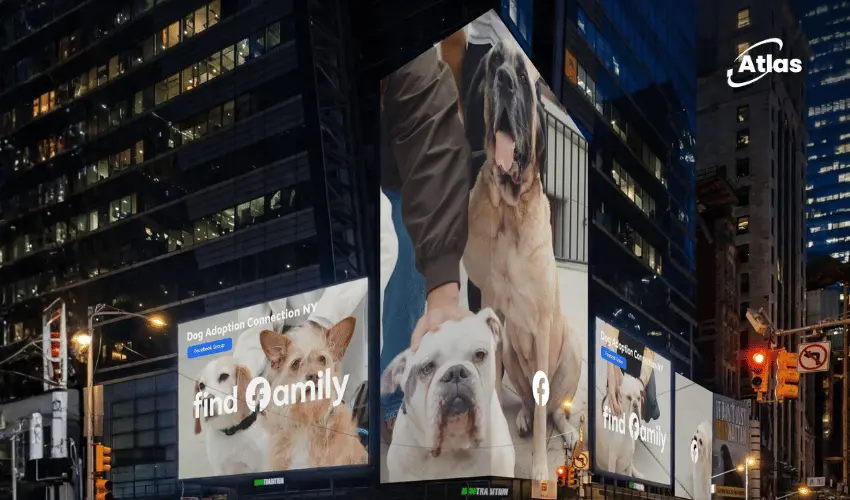
Facebook Turns Everyday Searches Into Human Stories With New OOH
People rarely use social platforms for purely functional reasons.
They may begin with a task.
Find a group.
Look for a recommendation.
Search for a person.
Discover a product.
But the most memorable outcome is often something they did not originally intend to find.
That is the tension behind Facebook's “Find More Than What You're Looking For.”
Looking beyond the search
The campaign shifts Facebook away from being presented only as a utility.
Instead of focusing on features, search tools or platform scale, the work asks a more human question:
What can happen after you find the thing you came for?

A simple behavioral truth drives the campaign
The idea begins with a familiar pattern.
Someone joins a Facebook community because they need something specific.
That functional motivation creates the setup.
The emotional outcome creates the payoff.
The gap between the two is where the creative lives.
Finding a dog becomes finding family
One example makes the idea especially clear.
A person joins a dog adoption Facebook Group.
The surface objective is straightforward:
Find a dog.
But the deeper outcome is much more meaningful:
Find a new member of the family.
That shift from transaction to emotion gives the campaign its strongest storytelling device.
Why the structure is so efficient
The campaign can be understood as a simple three-part system:
- Functional need: Someone is looking for something.
- Unexpected discovery: The interaction leads somewhere else.
- Emotional payoff: What they find matters more than the original search.
This gives Facebook a repeatable creative framework that can support many different human stories without losing consistency.
OOH is the right medium for this kind of tension
The outdoor work does not need to tell the full story.
It only needs enough contrast between the search and the outcome for audiences to complete the meaning themselves.
That makes the idea especially suitable for OOH.
The copy can remain short.
The photography can remain simple.
The emotional implication does the rest.
Headlines carry the strategic weight
Each execution pairs a concise line with the Facebook logo and photography by Jason Nocito.
That visual restraint is important.
The campaign does not need complicated UI screenshots or interface demonstrations.
The headline carries the idea.
The image gives it human texture.

Photography keeps the platform human
The choice to foreground people rather than interfaces helps reposition Facebook around lived experience.
The platform remains present, but it is not the visual hero.
The human outcome is.
That matters for a category where technology brands can easily become too abstract or product-led.
New York and Los Angeles give the message the right context
The campaign launched across New York City and Los Angeles.
Both cities are built around movement, discovery and overlapping communities.
People are constantly searching for places, work, friends, recommendations and experiences.
That makes the urban environment itself relevant to the campaign idea.
The city reinforces the meaning of discovery
Someone seeing the campaign may already be on the way to find something.
A restaurant.
A meeting.
A neighborhood.
A community.
The message suggests that the most valuable part of that journey may not be the thing they originally set out to find.

From utility to emotional connection
Many technology campaigns default to functionality.
Speed.
Scale.
Features.
Efficiency.
Facebook takes a different route here.
The platform is positioned around what human interaction can lead to.
That moves the brand story from utility toward consequence.
The platform is not the destination
This is one of the most useful strategic shifts in the campaign.
Facebook does not need to be the emotional center of every execution.
The platform facilitates the interaction.
The value exists in what comes next.
Plan your OOH campaign
Get recommendations for markets, formats and availability based on your campaign goals.
Request a media plan



Comments
Share your take. Keep it constructive and specific.