
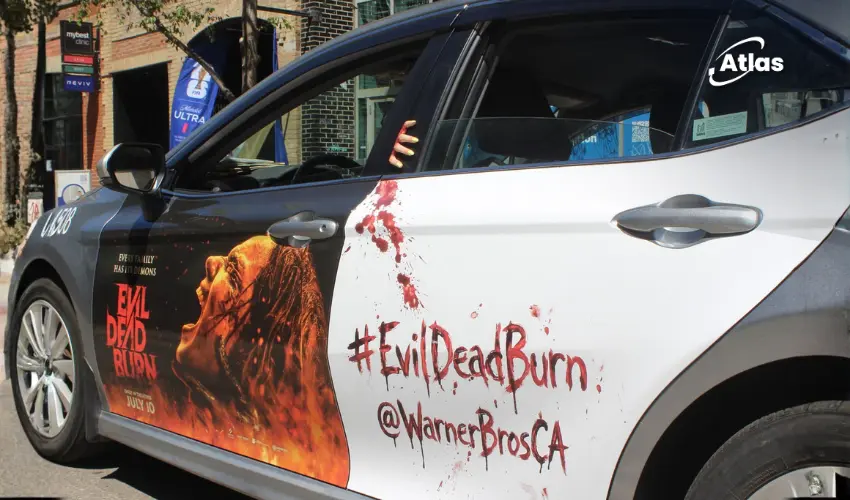
Evil Dead Burn Sends Terrifying Taxis Into Toronto
Some taxis are designed to take passengers safely home. The vehicles supporting Evil Dead Burn appear to promise a very different destination.
A horror-themed mobile out-of-home activation is hitting the streets of Toronto this summer, transforming familiar taxis into moving advertisements for the latest release connected to the Evil Dead franchise.
The campaign uses the everyday familiarity of a city taxi and turns it into something threatening, creating an activation that feels closely connected to the movie’s dark and unsettling atmosphere.
Turning an ordinary vehicle into a horror experience
Taxis are usually associated with convenience, safety and routine city travel. By placing frightening imagery and Evil Dead branding across these vehicles, the campaign disrupts that familiar expectation.
The idea works because the media format becomes part of the creative. The taxi is not simply carrying a movie poster. It becomes a character within the campaign: a vehicle that audiences may notice approaching, passing through traffic or waiting on the side of the street.
Why taxis are effective for a horror release
Entertainment campaigns need to generate more than awareness. They also need to create curiosity and give audiences something worth discussing, photographing or sharing.
A fleet of unusual taxis can achieve this across multiple parts of the city. Each vehicle moves through different neighborhoods, entertainment districts, busy roads and pedestrian areas, allowing the campaign to reach audiences without being limited to one fixed location.
The activation also benefits from surprise. People may encounter one of the taxis unexpectedly during their normal routine, creating a brief real-world horror moment that reflects the tone of the movie.
Mobile OOH expands the campaign’s reach
Unlike a traditional billboard, a branded taxi does not remain in one place. It travels through the city and can generate repeated exposure across different environments throughout the day.
- Street visibility: The vehicles can attract attention from pedestrians, drivers and public transit passengers.
- Geographic flexibility: The campaign can appear across multiple Toronto neighborhoods and entertainment areas.
- Social potential: A visually unusual taxi gives fans a reason to take photos and share the activation online.
- Contextual impact: Seeing a disturbing vehicle in an ordinary city setting makes the campaign feel more unexpected.
This combination allows the activation to function as both an outdoor media placement and a piece of experiential marketing.
Bringing the movie into the real world
Horror marketing is often most effective when it breaks the boundary between the screen and the audience’s surroundings.
Instead of only showing scenes from the movie, the Evil Dead Burn campaign brings part of its visual world into Toronto. The vehicles suggest that something sinister is already moving through the city before the film even reaches theatres.
This approach can make the release feel more immediate. The audience is not simply being told that a new horror movie is coming. They are encouraged to keep watching the streets for signs that the campaign may appear near them.
Clear release messaging
Although the execution is theatrical, the campaign still communicates the essential information directly: Evil Dead Burn is coming to theatres July 10, and tickets are on sale now.
This balance is important. The creative attracts attention through surprise and visual impact, while the release date and ticket message give audiences a clear next step.
For entertainment brands, spectacle can generate conversation, but the campaign must still make it easy for interested viewers to understand when and where they can experience the product.
Bottom line
The Evil Dead Burn taxi activation turns a familiar part of Toronto’s streets into a moving horror advertisement.
By combining mobile reach, unexpected encounters and a format that supports the movie’s sinister tone, the campaign creates a stronger connection between the film and the real world.
It is a simple but effective example of how entertainment brands can use transit and mobile OOH to make a launch feel less like an advertisement and more like an event already unfolding around the audience.
Comments
Share your take. Keep it constructive and specific.