
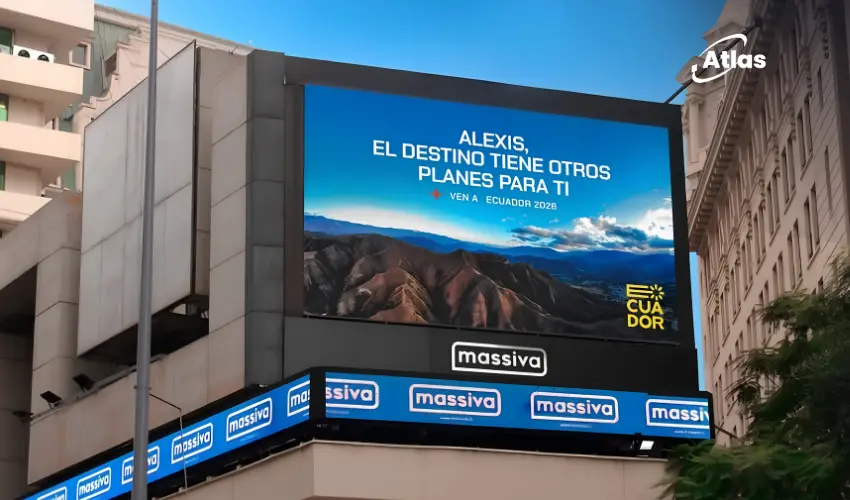
Ecuador Turns World Cup Absences Into a Tourism OOH Campaign
Most tourism campaigns attached to major sporting events focus on the fans, the host cities or the tournament itself.
Ecuador has taken a different approach. During the FIFA World Cup 2026, the country launched an international outdoor campaign that targets a much smaller audience: elite football players who are not participating in the tournament.
Rather than competing within the crowded ecosystem of World Cup sponsorships and football advertising, Ecuador positions itself in a parallel space — one built around leisure, travel and unexpected free time.
Using Absence as the Creative Idea
The campaign is based on a simple observation: players whose national teams failed to qualify for the World Cup suddenly have something rare during the summer.
Time.
Instead of treating their absence from the tournament as a disappointment, Ecuador reframes it as an opportunity.
The campaign turns the concept of missing the World Cup into a reason to travel, creating a playful invitation rather than a traditional tourism message.
Personalized Billboards Across Europe and South America
The outdoor campaign appears in cities including Madrid, Paris, Milan and Santiago.
Each billboard speaks directly to a specific football player whose national team will not be participating in the tournament.
Among the athletes featured are Gianluigi Donnarumma, Jan Oblak, Alexis Sánchez and Khvicha Kvaratskhelia.
The personalized approach makes the campaign feel more like a direct invitation than a traditional tourism advertisement.
Conversational Advertising Instead of Destination Selling
The billboards use a light, conversational tone.
One execution aimed at Donnarumma reads: "We know you're free this summer."
Another asks Kvaratskhelia: "When will you ever have such a long vacation again?"
The messaging feels playful and personal, almost as if Ecuador were speaking directly to the players rather than broadcasting to a mass audience.
This creates a sense of authenticity and generates curiosity among football fans who encounter the campaign.
Leveraging the World Cup Without Mentioning It
One of the campaign’s most interesting strategic choices is that it avoids direct references to FIFA or the World Cup itself.
Instead, it relies on the cultural context surrounding the tournament.
Everyone already understands why these players are unexpectedly available during the summer. The campaign trusts the audience to connect the dots.
That subtlety allows Ecuador to benefit from global football attention without becoming another football sponsor message.
Tourism Marketing Through Cultural Relevance
The campaign forms part of a broader international tourism push taking place during the World Cup period.
In recent weeks, Ecuador has also launched activations in several cities across the United States, one of the tournament’s host markets.
Together, these efforts position Ecuador as a destination that understands how to insert itself into global cultural conversations without relying on conventional tourism advertising tactics.
What Makes the Campaign Effective
- It uses an unexpected audience: The campaign targets players rather than fans.
- It transforms a negative into a positive: Missing the World Cup becomes a travel opportunity.
- It personalizes the message: Individual athletes receive tailored billboard copy.
- It leverages cultural context: The campaign benefits from World Cup attention without explicitly referencing it.
- It stands out from tourism conventions: The work focuses on conversation rather than destination imagery.
The Bigger OOH Lesson
Many destination campaigns compete for attention by showing beautiful landscapes, attractions or experiences.
Ecuador demonstrates that sometimes the strongest tourism idea begins with a cultural insight rather than a destination photograph.
By identifying an overlooked audience and creating a playful narrative around their circumstances, the campaign earns attention precisely because it feels unexpected.
Bottom Line
Ecuador’s World Cup tourism campaign shows how brands and destinations can participate in major global events without becoming official sponsors or competing directly for attention.
By speaking to football stars who will not be on the pitch this summer, the country transforms absence into opportunity and creates a tourism message people are likely to remember.
The result is a clever example of how outdoor advertising can use context, timing and personalization to make a destination stand out during one of the world's busiest media moments.
Plan your OOH campaign
Get recommendations for markets, formats and availability based on your campaign goals.
Request a media plan
Comments
Share your take. Keep it constructive and specific.