
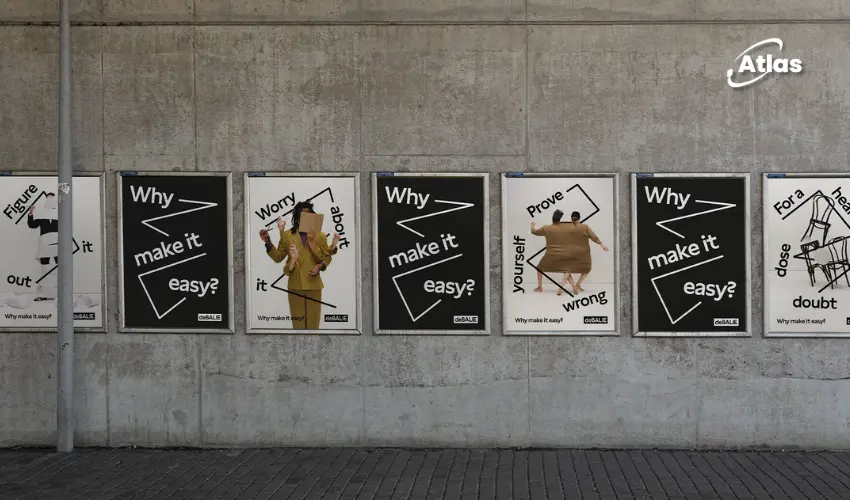
De Balie Turns Discomfort Into a City-Wide OOH Advertising Campaign
Want to Use OOH Advertising and Outdoor Media to Make People Think?
De Balie’s campaign is a strong example of how OOH Advertising and Out-of-Home Advertising can do more than promote an event or institution. Outdoor Media can provoke, challenge and invite reflection. If your brand or organisation wants to translate a cultural, political or intellectual idea into public-space media, Atlas OOH can help build an OOH Marketing strategy around attention, disruption, Location-Based Advertising and deeper engagement.
Most campaigns try to make things easier.
De Balie deliberately goes in the opposite direction.
Under the line “Why make it easy?”, the Amsterdam cultural institution positions discomfort, doubt and friction as valuable parts of public life.
That idea fits De Balie’s long-standing identity as a place for art, film, politics and debate.
An OOH Campaign Built Around the Value of Discomfort
For 45 years, De Balie has been known in Amsterdam as a space for difficult conversations, new ideas and public exchange.
The OOH Campaign makes that role explicit, using Street Advertising and public-space communication to turn De Balie’s institutional identity into a visible city-wide statement.
Instead of trying to reassure audiences with polished certainty, it argues that uncertainty can be productive.
The more you learn, the more you realise how much remains unresolved.
That is not treated as a problem here. It is treated as a reason to keep engaging.
Creative OOH Copy Does the Heavy Lifting
The campaign’s copy is intentionally direct, showing how Creative OOH can use minimal language to create maximum tension in Outdoor Advertising environments.
Lines such as “Prove yourself wrong”, “Figure it out” and “For a healthy dose of Doubt” are not designed to comfort the audience.
They are designed to unsettle passive thinking.
That makes the campaign feel less like a standard awareness push and more like an invitation to participate in De Balie’s worldview.
The writing does not explain everything for the viewer.
It creates tension and asks people to do some interpretive work.
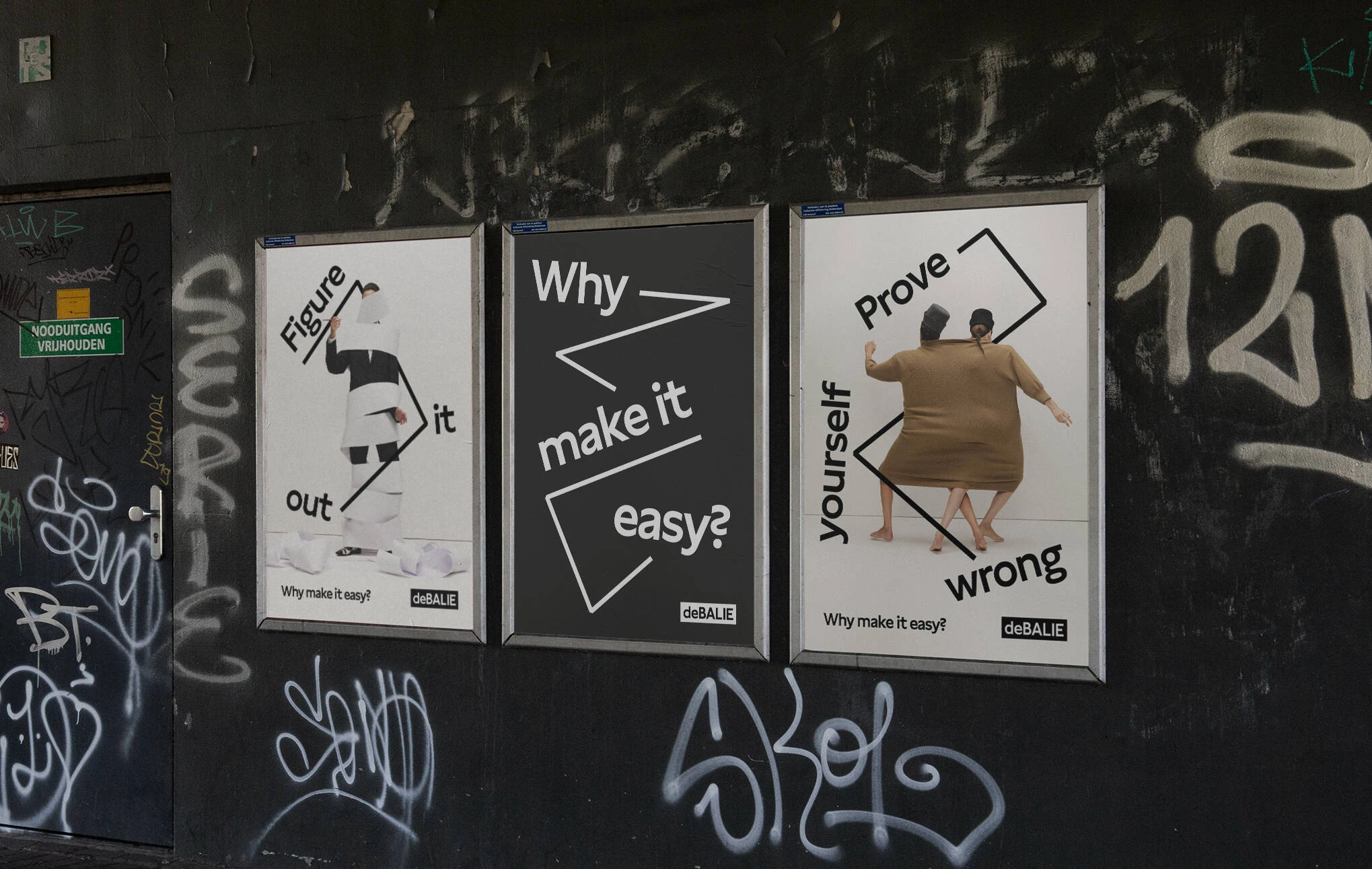
Bold Graphic Design Strengthens the Outdoor Advertising Message
The visual system supports the campaign’s intellectual edge and gives the Outdoor Advertising executions a distinctive identity across OOH Media placements.
Large type, angular graphic forms and minimal colour palettes make the work feel sharp, modern and uncompromising.
The surreal photography by Woody Bos and Anna Claassen adds another layer of tension by presenting people in visually awkward or unexpected compositions.
That discomfort is not accidental.
It mirrors the campaign’s argument that growth often begins when certainty breaks down.
City-Wide OOH Advertising Brings the Idea Into Public Space
The campaign is rolling out across Amsterdam, using city-wide OOH Media, Street Advertising and Location-Based Advertising to bring De Balie’s philosophy into the rhythm of daily life.
That matters because the campaign is not only speaking to existing visitors.
It is also trying to reach newcomers and people who may not already see themselves as part of a cultural-debate audience.
Out-of-Home Advertising gives the institution a chance to place its values directly in the city rather than only inside its venue, turning everyday routes into contextual Outdoor Media touchpoints.
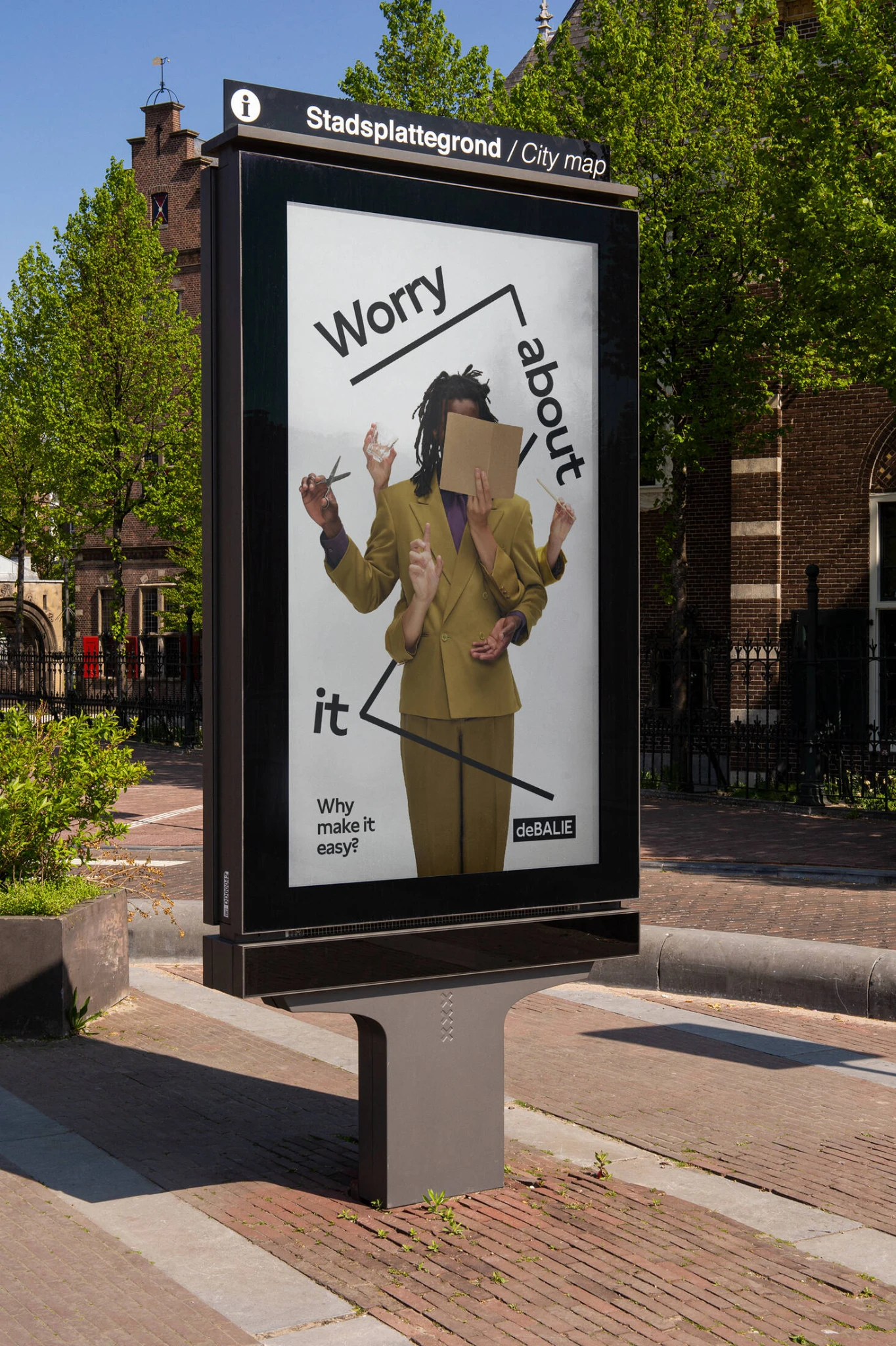
Street Advertising and Outdoor Media Become Part of the Argument
Outdoor Media is especially suitable for this idea because OOH Advertising appears in environments where people move quickly and often process messages automatically.
De Balie’s campaign resists that passivity.
It asks the viewer to pause, decode and reflect.
That makes the placement itself part of the concept.
The posters do not merely occupy city space; they turn Street Advertising into a form of contextual OOH that challenges how people use their attention within it.
Why This OOH Marketing Strategy Works for a Cultural Institution
Many cultural campaigns focus on programming details first.
This OOH Marketing campaign starts one level higher.
It communicates what De Balie stands for.
That gives the institution a stronger long-term brand position because it is not simply advertising individual events, but reinforcing a public identity built around difficult but rewarding exchange.
The campaign tells audiences what kind of experience they can expect before they ever walk through the doors.
Atlas OOH Can Turn Cultural Ideas Into Outdoor Advertising Campaigns
De Balie shows how OOH Advertising, Outdoor Marketing and city-scale media can turn a philosophical stance into a public invitation.
Atlas OOH can help cultural institutions, festivals, entertainment brands and public-interest organisations build OOH Advertising, Transit Advertising, Billboard Advertising, Street Advertising and Creative OOH campaigns that transform challenging ideas into visible, city-scale communication.
When the concept is strong, the street can become an extension of the institution itself.
OOH Case Study Takeaway: Why “Why Make It Easy?” Works
“Why make it easy?” is a strong OOH Case Study and example of cultural Out-of-Home Advertising that refuses to flatten complexity.
It uses provocative copy.
It pairs that copy with surreal imagery.
It brings De Balie’s values into the city.
And it reminds audiences that the most rewarding conversations are often the ones that challenge them most.
The result is a campaign that turns discomfort into an asset and makes public debate feel visually urgent, contemporary and alive.
If your organisation wants to create an OOH Campaign that does more than inform—one that uses Billboard Advertising, Outdoor Media or Street Advertising to provoke, question and invite participation—Atlas OOH can help build a strategy designed for real public engagement.
Frequently asked questions
What is De Balie’s “Why make it easy?” campaign about?
The campaign argues for the value of discomfort, friction and deeper thinking, encouraging audiences to embrace uncertainty and challenge their own assumptions.
Who created the campaign?
According to the supplied campaign information, the campaign was developed by creative strategy agency Dawn for De Balie.
What makes the campaign visually distinctive?
The campaign combines provocative copy such as “Prove yourself wrong” with bold graphic layouts and surreal photography by Woody Bos and Anna Claassen.
Where is the campaign running?
The campaign is rolling out city-wide across Amsterdam, inviting both regular visitors and newcomers to engage with De Balie’s message.
Plan your OOH campaign
Get recommendations for markets, formats and availability based on your campaign goals.
Request a media plan
Comments
Share your take. Keep it constructive and specific.