
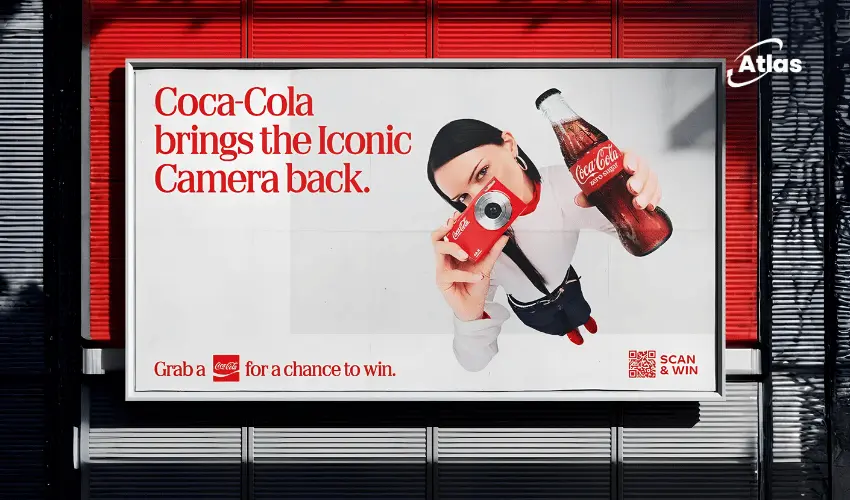
Coca-Cola Brings Back Its Most Iconic Promotions for a New Generation
Transactional campaigns often begin with the incentive.
Coca-Cola started with the idea.
The brief was to create a campaign capable of driving real consumer action without allowing the promotional mechanic to overpower the creative.
The answer was to look backward.
What if Coca-Cola brought back some of the most recognizable promotional objects it has used throughout its history?

Turning brand history into the prize
Coca-Cola has spent decades producing branded objects that became much more than promotional giveaways.
Yo-yos, mini coolers, jackets and other merchandise entered popular culture and, in some cases, became collectibles.
The new campaign uses that history as the reward system itself.
Nostalgia becomes a transaction driver
The idea connects directly with the current appetite for nostalgia, particularly among younger audiences.
Gen Z regularly engages with design, fashion, technology and culture from periods they may not even have personally experienced.
That makes Coca-Cola's promotional archive unusually valuable.
A vintage-style yo-yo or mini cooler can feel nostalgic to one generation and newly desirable to another.
Cross-generational appeal
This is one of the campaign's strongest advantages.
Older audiences may remember the original promotions.
Younger audiences may discover the same objects through the lens of retro culture.
The same creative idea therefore works across different age groups for different reasons.
- Older consumers recognize the memory.
- Younger consumers recognize the aesthetic.
- Collectors recognize the scarcity.
- Everyone recognizes Coca-Cola.
The product is the entry point
Despite the cultural framing, the campaign has a clear commercial objective.
Consumers scan their Coke for the chance to win the promotional items.
That creates a direct path between creativity and transaction.
- See the campaign.
- Want the collectible.
- Buy Coca-Cola.
- Scan to participate.
The creative therefore supports measurable behavior without feeling like a generic sales promotion.

The creative core remains the real currency
That distinction matters.
Many promotional campaigns become little more than instructions:
Buy. Scan. Win.
Coca-Cola's concept gives audiences a stronger reason to care about what they might win.
The objects themselves carry decades of brand memory.
That makes the prize inseparable from Coca-Cola.
Why branded merchandise matters
The strongest promotional merchandise does not behave like advertising.
People actually want to own it.
A Coca-Cola mini cooler, jacket or digital camera can continue creating impressions long after the promotional period ends.
The merchandise becomes another media channel.
The digital camera is especially well timed
The inclusion of a digital camera is particularly relevant to current nostalgia culture.
Compact digital cameras have returned as aesthetic objects among younger consumers looking for a visual style different from smartphone photography.
That makes the prize feel connected to contemporary behavior while still carrying a retro sensibility.
It is exactly the kind of object that can generate organic social content after it is won.
OOH can make the archive feel monumental
The concept also has strong potential in outdoor media.
Instead of treating the prizes as small promotional objects, OOH can enlarge them dramatically.
A giant yo-yo, mini cooler or retro camera can become the hero visual of an entire placement.
This turns familiar memorabilia into public spectacle.
- Large format amplifies nostalgia.
- One hero object keeps the message simple.
- Different collectibles can rotate across DOOH.
- QR or scan messaging can provide the transactional bridge.

Every object tells a different chapter
A campaign built around multiple historic promotions gives Coca-Cola a flexible creative system.
Each item can become its own execution.
The yo-yo may trigger one set of memories.
The jacket may connect with fashion.
The mini cooler may evoke summer and collecting.
The digital camera can connect directly with today's retro-tech culture.
Together, they create a visual archive of Coca-Cola's place in popular culture.
Why Europe is a natural setting
The campaign is designed to speak across generations and markets throughout Europe.
That creates an interesting challenge because individual promotional memories may vary from country to country.
But Coca-Cola's visual identity and long history give the campaign enough consistency to connect those different experiences.
The central message remains simple:
Something iconic is coming back.
OOH can connect memory and immediate action
Outdoor is particularly useful for a scan-to-win campaign because it can perform both brand and response roles.
The large creative earns attention first.
The mechanic gives audiences something to do next.
In high-dwell environments, a QR or participation prompt can convert the nostalgia into immediate action.
In faster roadside formats, the visual can build recognition that supports participation later at retail.
A promotion that strengthens brand equity
There is another strategic advantage.
The campaign can drive transactions without sacrificing long-term brand building.
Every prize reminds audiences that Coca-Cola has been creating culturally memorable objects for decades.
The promotion therefore reinforces the brand's iconic status while generating short-term commercial behavior.
Those objectives are often treated separately.
Here, they support one another.
From archive to modern content
The historic items also provide strong material for social storytelling.
Coca-Cola can show original versions, old advertisements, collector stories and new interpretations of the same objects.
Winners can then create another layer of content once the merchandise reaches them.
The campaign effectively turns the brand archive into a modern content engine.

Plan your OOH campaign
Get recommendations for markets, formats and availability based on your campaign goals.
Request a media plan
Comments
Share your take. Keep it constructive and specific.