
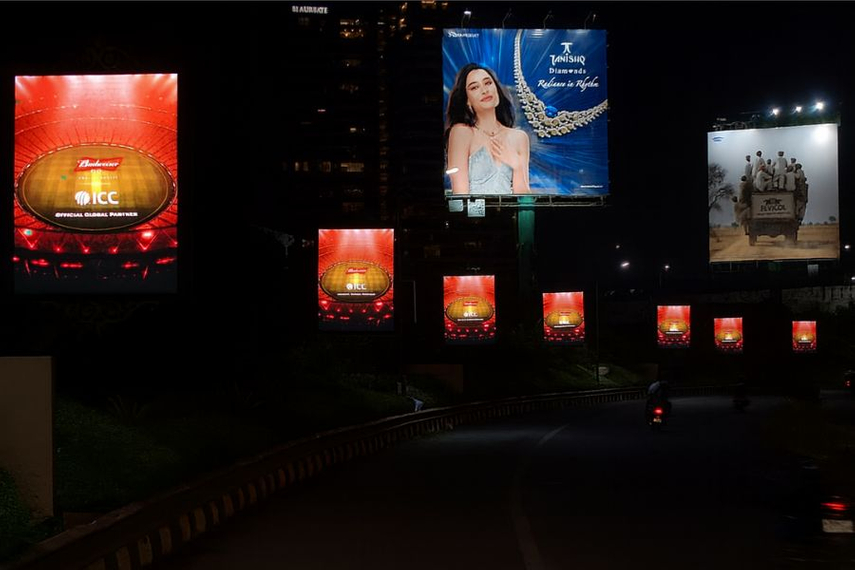
Quick take: Budweiser 0.0 ran a massive “digital roadblock” across 50+ premium screens along a 16 km stretch of Mumbai’s Western Express Highway—turning a commute corridor into one continuous brand moment. (Sources: Campaign India, Adgully, exchange4media)
What happened
Instead of treating each screen as a separate placement, the execution stitched together dozens of units along a single corridor to create the feeling of a continuous takeover—more like dominance than typical multi-site buying.
Why this format is powerful
A roadblock isn’t just reach. It’s perception engineering:
- Repeated exposure in minutes (frequency compresses fast on a commute)
- A visible sense the brand is everywhere on that route
- Higher memorability because the pattern is unmistakable
The result is a psychological shift: the audience doesn’t experience a “campaign across screens.” They experience a corridor that feels branded end-to-end.
The planning lesson
When a brand wants share of attention (not just impressions), roadblocks can outperform scattered placements—especially on routes with heavy daily repetition. The strongest use case is simple: pick a corridor where your audience repeats behavior, then make your presence impossible to miss.
A practical roadblock checklist
- Choose one corridor with high repeat travel (commute routes win)
- Own continuity (cluster screens so the takeover feels “unbroken”)
- Standardize creative cues (same palette / icon / headline structure)
- Measure beyond delivery (brand lift, recall, search lift by corridor markets when possible)
Plan your OOH campaign
Get recommendations for markets, formats and availability based on your campaign goals.
Request a media planSources
- Campaign India — Connect OOH executes large-scale DOOH roadblock for Budweiser 0.0
- Adgully — Budweiser 0.0 executes largest-ever DOOH roadblock with Connect OOH
- exchange4media — Connect OOH delivers major DOOH activation for Budweiser 0.0
- Media4Growth — Budweiser 0.0 launches a massive 50-screen DOOH takeover

Comments
Share your take. Keep it constructive and specific.