
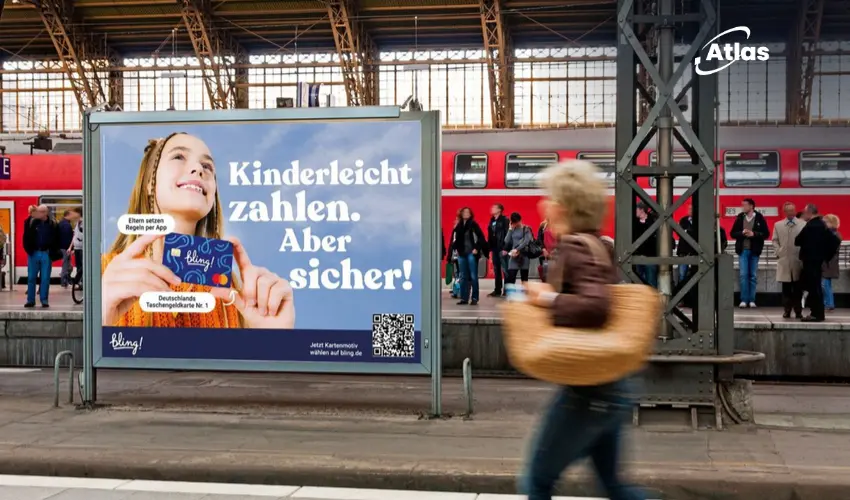
How Bling Used Smart OOH Targeting to Reach Families in Germany
One of the biggest misconceptions in outdoor advertising is that success comes from being everywhere. In reality, some of the most effective campaigns succeed by being exactly where they need to be.
That's the approach taken by Bling, the financial literacy platform designed for families and children. Instead of maximizing reach across entire cities, the company focused on strategic placements in Bremen, Hannover, and Frankfurt am Main where its audience is most likely to be found.
The result is an OOH campaign built around a simple principle: right place, right time.

Finding Families Where They Already Are
For brands targeting parents and children, location matters as much as creative.
Rather than dispersing posters across random high-traffic areas, Bling concentrated its campaign around schools, placing messages directly within environments that families interact with every day.
This approach increases relevance because the campaign appears in the context of daily routines rather than interrupting unrelated activities.
When outdoor media aligns naturally with audience behavior, the message often feels more useful and less intrusive.

Adding Time-Based Relevance Through DOOH
Location was only part of the strategy.
Bling also incorporated digital public video screens that allowed campaign delivery to be optimized according to the time of day.
This enabled the brand to align communications with daily family routines, increasing the likelihood that messages would reach audiences during moments of higher attention and relevance.
As digital out-of-home continues to grow, time-based targeting is becoming one of the medium's most valuable capabilities.
Why Financial Literacy Benefits From Contextual Media
The campaign promotes the Bling Card and App, tools designed to help families manage allowances, teach money habits, and introduce children to financial literacy.
Because the product sits at the intersection of parenting and education, school environments provide a natural contextual fit.
The placement itself reinforces the message, creating a stronger connection between the brand's purpose and the audience's daily lives.
This alignment between location and proposition is often what separates effective OOH campaigns from forgettable ones.
Moving Beyond Mass Reach
For years, many outdoor campaigns were evaluated primarily by how many people they could reach.
Today's advertisers increasingly recognize that relevance can be more valuable than raw scale.
Data, digital screens, and audience insights now allow brands to build campaigns that focus on precision rather than volume.
Bling's strategy reflects this shift by prioritizing audience quality over audience quantity.
- Targeted locations.
- Audience-aligned environments.
- Time-sensitive delivery.
- Clear contextual relevance.
Together, these elements create a campaign designed to drive consideration among exactly the people most likely to benefit from the product.
What Marketers Can Learn
The campaign offers a valuable lesson for brands across categories.
Many advertisers still approach outdoor media as a coverage exercise. However, the most successful campaigns increasingly behave more like audience strategies than media plans.
By combining thoughtful location selection with digital flexibility, brands can create communications that feel timely, useful, and highly relevant.
In many cases, that approach delivers stronger results than simply increasing the number of impressions.
Bottom Line
Bling's campaign across Bremen, Hannover, and Frankfurt demonstrates how modern OOH can combine precision targeting with broad public visibility. By focusing on schools, families, and time-based messaging, the brand shows that effective outdoor advertising isn't about being everywhere—it's about being exactly where your audience needs you to be.
As DOOH capabilities continue to evolve, campaigns like this provide a blueprint for smarter, more audience-focused media planning.

Plan your OOH campaign
Get recommendations for markets, formats and availability based on your campaign goals.
Request a media plan
Comments
Share your take. Keep it constructive and specific.