
Audible Turns a Twin Identity Swap Into a Multi-Format OOH Story
“Und was macht das mit Ihnen?”
Audible’s campaign for a new audiobook narrated by Karoline Herfurth demonstrates how an audio story can be translated into a highly visible public experience.
The campaign appeared across connected DOOH, multi-panel large-format sites, giant posters and media walls.
Its impact, however, did not come only from the number or scale of the placements.
Each format acted as a different point of contact within the same narrative idea.

Making an audio story visible
Audiobooks are experienced privately, usually through headphones, mobile devices or speakers.
That creates a particular advertising challenge.
The campaign needs to communicate enough of the story to generate interest without giving away the complete experience or relying on sound alone.
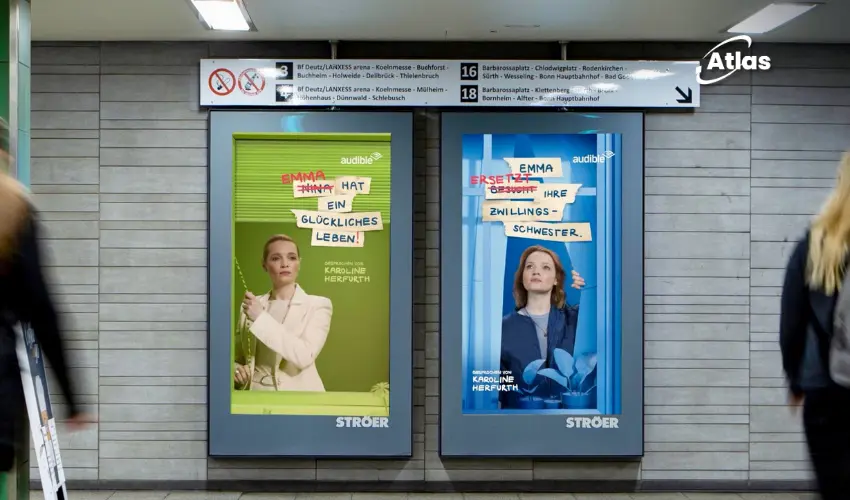
Audible’s solution was to focus on the relationship between the central characters, Emma and Nina.
The outdoor creative makes their shared identity and emotional connection visible before audiences hear a single chapter.
Emma and Nina only reveal the idea together
The most distinctive part of the campaign is the way the two central images interact.
Viewed separately, each portrait introduces one character.
Placed beside one another, Emma and Nina begin to communicate a shared story.
Their relationship becomes clearer, and the identity switch between the twin sisters starts to feel visible within the physical media environment.
This creates a campaign in which proximity matters.
The audience needs to see more than one execution to understand the complete creative idea.
From multiple placements to one narrative system
Large campaigns often use several OOH formats primarily to increase reach.
Audible’s work goes further by giving those formats a narrative function.
- Connected DOOH links separate screens: Characters and messages can appear in sequence or respond to one another across adjacent displays.
- Multi-panel sites create relationships: Emma and Nina can be presented side by side as parts of one composition.
- Giant posters create emotional scale: Portraits become dominant enough to communicate tension and character.
- Media walls extend the story: Large connected surfaces provide enough space for multiple elements to interact.
Each format delivers visibility, but it also contributes to the audience’s understanding of the story.
Using public movement as part of the experience
Audiences may not encounter every campaign element at the same moment.
They might first see Emma on one site, later encounter Nina on another and gradually recognize that the two images belong to the same narrative.
This makes movement through the city part of the storytelling process.
The campaign does not need to explain the identity switch through a long headline. Recognition develops as audiences collect different pieces of the idea across their journey.
The importance of visual consistency
A multi-format campaign can quickly feel fragmented when every placement uses a different composition or creative language.
Audible avoids that problem by maintaining a consistent relationship between character photography, typography and campaign messaging.
This allows the audience to connect executions even when they appear in different sizes or environments.
The repeated visual cues act as signals that Emma and Nina belong to the same story.
Why portraiture works for audiobook promotion
The campaign places people, rather than devices or listening technology, at the center of the creative.
This keeps attention on the emotional story instead of the platform used to access it.
Portraits are especially useful for this type of campaign because subtle changes in expression, posture and styling can suggest relationships and psychological tension without requiring extensive copy.
At large scale, the characters begin to feel physically present in the city.
Karoline Herfurth adds recognition
The audiobook is narrated by Karoline Herfurth, giving the campaign an additional point of interest for audiences familiar with her work.
A recognizable narrator can strengthen an audiobook launch because voice performance is central to the product experience.
However, the outdoor creative still prioritizes the story itself.
The narrator’s involvement supports the release, while Emma and Nina provide the main visual and narrative hook.
Asking the audience a personal question
The campaign line “Und was macht das mit Ihnen?” can be understood as asking what the story does to the listener or how it affects them.
This turns the campaign away from a simple content announcement and toward an emotional invitation.
Rather than only asking audiences to listen, Audible encourages them to consider their own reaction to the story.
The line also reflects the intimacy of audiobook listening, where the narrator’s voice and the audience’s imagination create a highly personal experience.
Why scale alone was not the idea
The campaign was difficult to miss because it occupied many prominent outdoor formats.
But visibility alone does not explain why the execution worked.
The real strength came from coordinating those placements so they felt like different chapters of one communication system.
Emma and Nina did not simply appear across many surfaces. Their relationship became clearer through the way those surfaces were arranged and experienced.
From reach to cumulative understanding
Traditional reach planning asks how many people encounter the campaign.
This execution also considers what audiences understand after several encounters.
The first placement may create recognition. The second may reveal the twin relationship. A later media wall may clarify the identity-switching tension.
This cumulative structure rewards repeated exposure and gives frequency a storytelling role.
- The first encounter introduces a character.
- The second reveals a visual connection.
- Adjacent placements suggest the shared identity.
- The campaign question encourages further discovery.

Plan your OOH campaign
Get recommendations for markets, formats and availability based on your campaign goals.
Request a media plan
Comments
Share your take. Keep it constructive and specific.