
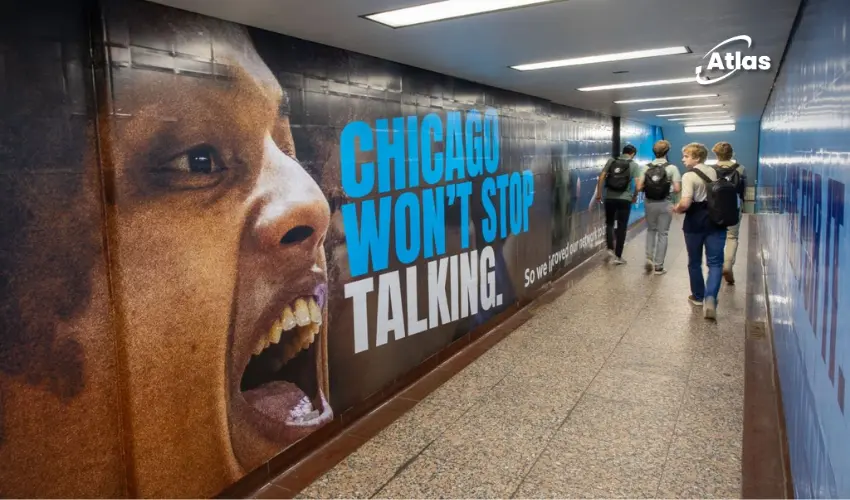
AT&T Takes Over Chicago’s Transit Journey From the Red Line to the Loop
In a busy transit system, delivering a message clearly is only part of the challenge.
The other part is maintaining visibility while passengers move between tunnels, platforms, stations and city streets.
AT&T addressed both through an out-of-home campaign extending from the Lake Red Line tunnel into Chicago’s central Loop.
Delivered through the Chicago Transit Authority environment with Intersection, the campaign used the commuter journey as a connected sequence of media opportunities rather than depending on one isolated placement.

Following audiences through the city
Transit campaigns are strongest when they reflect how people actually move.
A passenger may first encounter the brand inside a tunnel, see it again while changing levels or leaving the station, and then receive another impression while continuing through the surrounding business district.
This creates a sequence of repeated exposures within one journey.
Why the Lake Red Line location matters
The Lake station sits within one of Chicago’s most active downtown environments.
Its connection with the Red Line places the campaign in front of commuters, residents and visitors moving through the central city.
Tunnel advertising also provides a more contained media environment than an individual street billboard.
Passengers move past a sequence of branded surfaces, creating visual continuity and giving the campaign more time to establish recognition.
From the tunnel to the Loop
Extending the campaign into the Loop helps AT&T remain visible after passengers leave the immediate station environment.
This approach connects underground transit media with the commercial, cultural and pedestrian activity above it.
- Tunnel placements create repetition: Passengers encounter the message across a continuous travel space.
- Station media creates dwell time: Waiting and transferring provide longer opportunities to notice the creative.
- Loop visibility adds urban scale: The campaign remains present within Chicago’s central business district.
- Connected placements improve recall: Multiple impressions reinforce one consistent message.
A relevant setting for a connectivity brand
Telecommunications services are closely connected with the way people navigate cities.
Commuters use their phones to check routes, communicate changes in arrival times, access entertainment and remain productive while travelling.
This makes public transportation a contextually relevant environment for AT&T.
The brand appears while audiences are actively depending on connectivity, allowing the media location to reinforce the category itself.
Communicating clearly in a complex environment
Chicago transit passengers are often moving quickly and processing several forms of information at once.
Campaign creative therefore needs a simple hierarchy, recognizable branding and concise copy.
Long explanations or complicated visual systems can lose impact when viewed from a moving train or during a short station transfer.
AT&T’s established brand recognition allows the campaign to communicate with fewer elements and prioritize immediate visibility.

Why repeated exposure matters
A single outdoor placement may introduce a message, but coordinated transit media can reinforce it several times within the same day.
Regular commuters may also repeat the journey throughout the campaign period, allowing recognition to build gradually.
This frequency is particularly valuable for telecommunications brands, where awareness and familiarity can influence future decisions even when consumers are not immediately considering a new service.
Transit infrastructure as a connected media network
The campaign demonstrates that tunnels, stations and surrounding downtown placements should not be viewed as separate environments.
Together, they form a connected urban media network.
Each format performs a different role:
- The tunnel introduces and repeats the message.
- The station captures passengers during moments of waiting.
- The Loop extends visibility into the wider city.
- The complete journey builds familiarity through frequency.
Plan your OOH campaign
Get recommendations for markets, formats and availability based on your campaign goals.
Request a media plan
Comments
Share your take. Keep it constructive and specific.