
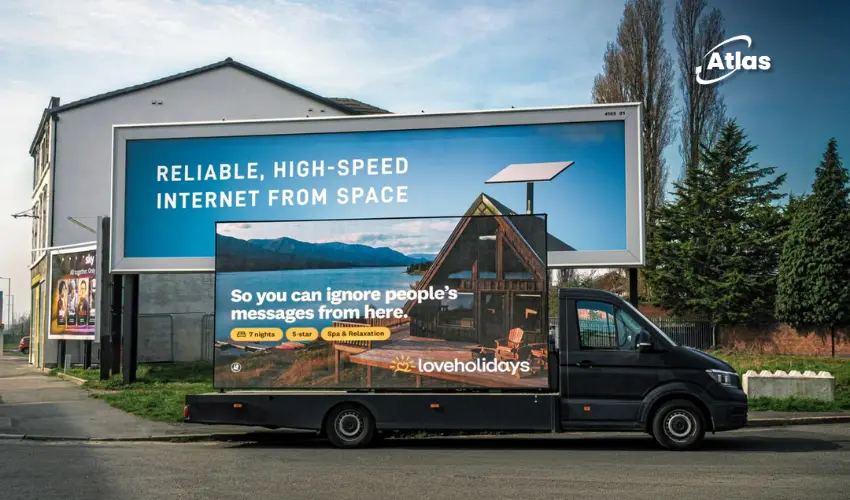
Quick answer: Mobile billboard advertising works best when a campaign needs movement, event proximity, route control, or local street-level visibility. It is not a replacement for every fixed billboard buy. It is strongest when the route, schedule, creative, and measurement plan are defined before media is purchased.
Search demand around mobile billboards often comes from buyers who already know the format but are not sure how to evaluate it. The key question is not whether a truck can carry an ad. The better question is whether movement creates an advantage for the campaign.
When Mobile Billboards Make Sense
Mobile billboards are useful when geography and timing matter. A brand may want to show up around a trade show, a retail opening, a concert, a sports event, a campus, a competitor corridor, or several neighborhoods in one market.
They can also help when fixed OOH inventory is limited or when the campaign needs flexibility before committing to a broader market plan. For broader cost logic, compare mobile options against billboard costs in 2026.
Planning Table
| Use case | Route strategy | Creative approach | Primary proof |
|---|---|---|---|
| Store opening | Circle retail zones, parking areas, and nearby commuter roads | Short offer, location cue, simple direction | Photos, GPS route, operating hours |
| Event marketing | Run near venue entry, hotels, transit stops, and nightlife corridors | Event message, date, booth or ticket cue | Time-stamped route proof |
| Market launch | Cover priority neighborhoods before scaling fixed media | Brand recognition and search prompt | Route logs, web/search lift |
| Advocacy or public issue | Prioritize civic areas, campuses, and community gathering points | Clear issue, memorable phrase, action | Photos, route recap, response activity |
| Competitive conquesting | Use routes near competitor stores or category corridors where allowed | Comparison-safe benefit or offer | Route compliance and outcome signal |
Mobile Billboard vs Digital Billboard
A mobile billboard creates movement and proximity. A digital billboard creates visibility on a fixed screen with flexible creative rotation. The right choice depends on whether the campaign benefits more from moving through the market or owning selected high-visibility locations.
If the plan needs fast creative changes, dayparting, and screen flexibility, read the Atlas digital billboard advertising guide. If the plan needs route-level control, mobile may be the better test.
How to Evaluate a Billboard Truck Proposal
- Route logic: The proposal should explain why each route reaches the intended audience.
- Operating schedule: Ask for dates, hours, dayparts, dwell areas, and any event-specific timing.
- Vehicle type: A wrapped truck, static billboard truck, and digital LED truck are different buys.
- Creative specs: The message must be readable from distance and while moving.
- Compliance: Routes, parking, sound, lighting, and event proximity can have local restrictions.
- Proof: Require route logs, photos, and a recap that matches the purchased schedule.
Pricing Factors
Mobile billboard pricing varies by market, vehicle type, production, route complexity, operating hours, campaign length, labor, fuel, permits, storage, and whether the vehicle is static, wrapped, or digital. A low quote is not automatically better if route quality, proof, or availability is weak.
Buyers should compare the mobile plan against fixed inventory in the same market. Atlas can help compare mobile options with fixed Houston billboards, Miami billboards, Los Angeles billboards, and other market plans.
Measurement Checklist
Start with delivery proof: route map, GPS logs, operating hours, photos, and any permitted stopping points. Then measure outcomes that match the campaign job: branded search, direct traffic, landing page sessions, store visits, promo use, lead volume, QR scans, or calls.
For more on the sequence of proof before outcomes, use the Atlas guide to comparing outdoor advertising companies. A good partner should explain how mobile media fits the broader OOH plan, not just sell truck hours.
Plan your OOH campaign
Get recommendations for markets, formats and availability based on your campaign goals.
Request a media plan


Comments
Share your take. Keep it constructive and specific.